August 10, 2026 • 5 min read

Bitcoin Crash: What Happens When BTC Dumps
Quick Answer
When bitcoin dumps, leveraged positions get force-liquidated, amplifying the sell pressure and turning a decline into a fast crash. Every bitcoin crash over 50 percent so far has eventually been followed by a recovery to a new high, though timing has varied widely.
You must be 18+ to access this content. Please gamble responsibly.
Key Facts
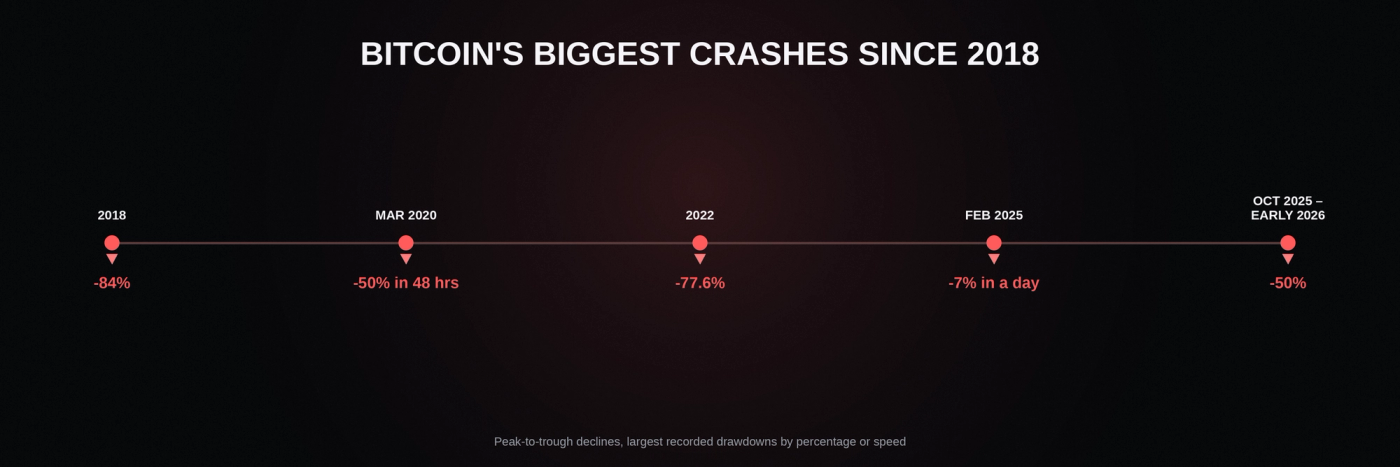
| 2018 crash | Roughly -84%, from about $19,800 (Dec 2017) to about $3,200 (Dec 2018) |
| March 2020 "Black Thursday" | Roughly -50% within about 48 hours |
| 2022 crash | Roughly -77.6%, from about $69,000 (Nov 2021) to about $15,476 (Nov 2022) |
| February 2025 flash drop | Roughly -7% in a single day, down to about $87,630 |
| Oct 2025 to early 2026 correction | Roughly -50%, from ATH near $126,000 to about $63,000 to $65,000 |
| Crashes over 50% historically | At least 6, each eventually followed by a recovery to a new high |
| Common amplifier | Leveraged futures positions getting force-liquidated, adding cascading sell pressure |
| Sentiment during crashes | The Fear and Greed Index typically falls to "Extreme Fear" |
When bitcoin dumps, it's rarely one clean cause. A crash usually starts with a trigger, bad macro news, a major exchange collapsing, a big holder selling, and then gets amplified by leveraged traders getting force-liquidated, which dumps even more sell pressure into a market that's already falling. Bitcoin has crashed more than 50 percent from a cycle peak at least six separate times in its history, and every single time so far, it has eventually recovered and gone on to set a new high. That track record is not a promise about the next one, but it's the actual pattern behind the panic.
It helps to separate two different questions people usually mean when they ask what happens when BTC dumps: the mechanical question of what actually drives the price down so fast, and the practical question of what it means for anyone holding bitcoin or playing with it. This guide covers both, starting with the mechanics.
What Actually Happens Mechanically When Bitcoin Dumps
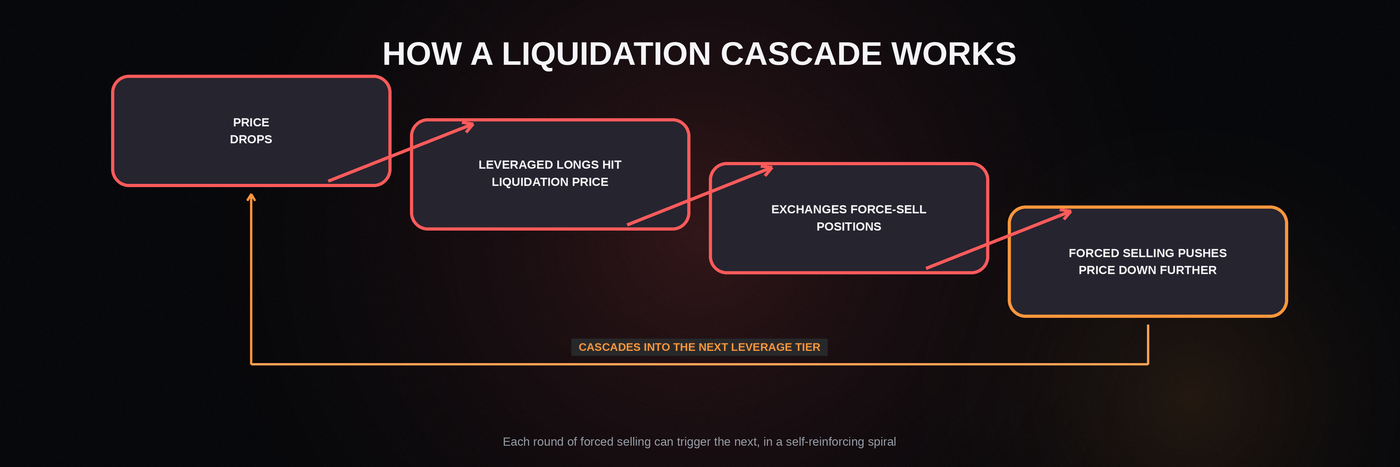
A meaningful share of daily bitcoin trading volume happens through leveraged futures contracts, where traders borrow money to bet on price direction with more size than their actual capital would allow. When price starts falling, traders holding leveraged long positions start hitting their liquidation price, the point at which an exchange automatically closes their position to prevent their losses from exceeding their collateral. That forced closing is itself a sell order, dumped into the market regardless of what price it fills at, which pushes the price down further and triggers the next tier of liquidations below it. This cascade can compress what might otherwise have been a gradual multi day decline into a matter of hours. Spot selling by long term holders and panic selling by retail traders adds to the pressure, but the leverage unwind is usually what turns an ordinary down day into a full blown crash headline.
Bitcoin's Biggest Crashes, Ranked
Bitcoin's crash history follows a recognizable rhythm across market cycles. In 2018, bitcoin fell more than 80 percent over roughly a year, from near $19,800 in December 2017 to around $3,200 by December 2018, as the first major retail speculation bubble unwound. In March 2020, bitcoin lost close to half its value in about 48 hours, a crash now known as Black Thursday, as COVID-driven panic hit every market simultaneously, before stimulus spending and institutional interest drove a recovery within months. The 2022 crash was the deepest of the recent cycles, a 77.6 percent decline from roughly $69,000 in November 2021 to about $15,476 in November 2022, driven by Federal Reserve rate hikes, the Terra/Luna stablecoin collapse in May, and the FTX exchange collapse that November. More recently, a sharp single day drop of around 7 percent hit in late February 2025 amid new tariff announcements and ETF outflows, and after bitcoin's October 2025 all time high near $126,000, it corrected roughly 50 percent, stabilizing near $63,000 to $65,000 by early 2026.
Why Crashes Feel Worse Than the Chart Alone Shows
During a sharp drop, sentiment indicators like the Crypto Fear and Greed Index typically fall into what's labeled Extreme Fear, and social media fills with liquidation screenshots and worst case predictions, which tends to make a crash feel more catastrophic in the moment than the underlying percentage move might justify on its own. Funding rates on futures exchanges, the periodic payments traders make to each other based on which side is more crowded, often flip negative during a crash as short sellers pile in expecting further downside, which can itself set up a sharp reversal once those short positions eventually get squeezed. None of this means a crash isn't real or that losses aren't real, they absolutely are for anyone holding through one, but the psychological intensity of a crash and its actual severity relative to bitcoin's broader multi-year trend are two different things worth separating in your head while it's happening.
What Recovery Has Looked Like Historically
Recovery timing has varied a lot from crash to crash. The 2020 Black Thursday drop recovered within months, helped by unusually aggressive global stimulus spending. The 2018 to 2019 recovery took closer to three years before bitcoin reclaimed its prior high. The 2022 bear market bottom in November gave way to a recovery that eventually pushed bitcoin past $100,000 for the first time in December 2024, more than two years later. There's no fixed timeline, and nothing guarantees the current post-October-2025 correction resolves the same way earlier ones did, past performance in any market is not a promise about the next cycle. What has held true across every major bitcoin crash so far, though, is that none of them turned out to be the permanent end some headlines predicted at the time, a pattern we cover in more detail in our is crypto dead breakdown.
Crash, Correction, or Bear Market: What's the Difference
These terms get used loosely, but they describe different things. A correction usually refers to a decline of roughly 10 to 20 percent from a recent high, a normal and fairly frequent occurrence in any volatile asset. A crash describes a much sharper, faster drop, often 30 percent or more within days or weeks, typically driven by a specific trigger event and amplified by leverage liquidations. A bear market describes a sustained period, often lasting many months, where price stays well below its prior high with limited sustained recovery attempts. Bitcoin has experienced all three repeatedly, and a single event can technically be all three depending on the time window you're measuring, a crash over a few days can mark the start of a bear market that lasts over a year, inside what was already a correction from an even higher earlier peak.

What To Actually Do When BTC Dumps
This is not financial advice, and nobody can tell you with certainty what bitcoin does next. What history does suggest is that the investors who fare worst through a crash tend to be the ones using leverage they can't actually afford to lose, and the ones who sell at the exact bottom out of panic rather than according to any plan they set in advance. Setting a plan before volatility hits, how much you're actually willing to lose, whether you're holding for years or trading short term, and sticking to it during the scary part, tends to produce better outcomes than reacting in real time to a falling chart and a timeline full of doom. If you're funding a crypto deposit of any kind during volatile periods, only ever commit money you were already prepared to lose entirely, crashes are exactly when that discipline matters most.
How a Crash Affects Crypto Casino Play
A bitcoin crash doesn't change how deposits, withdrawals, or game outcomes work at a crypto casino, the platform's infrastructure runs the same regardless of what BTC is worth that day. What does change is the dollar value of your balance if you're holding it in BTC rather than a stablecoin, which is exactly the kind of volatility some players specifically seek out through gameplay rather than a portfolio screen. We go deeper on exactly how a price drop shows up across the crypto casino industry in our bitcoin price drop analysis. If you'd rather sidestep that swing entirely while you play, depositing in a dollar pegged stablecoin keeps your balance steady no matter what the charts are doing outside the game window.
One more practical note worth flagging: exchanges themselves can behave erratically during the most violent minutes of a crash, order books thin out, prices can briefly diverge between platforms, and withdrawal queues can back up during peak panic. None of that reflects bitcoin's underlying value changing that fast, it reflects infrastructure straining under an unusual volume spike. It is one more reason rash, split-second decisions during the worst of a crash tend to work out worse than decisions made from a plan set when markets were calm.
Responsible Gambling
If watching bitcoin crash makes you want to chase losses, either in the market or at the tables, treat that instinct as a signal to step back rather than press harder. Flush's responsible gambling tools include deposit limits, session timers, and self-exclusion, all adjustable directly from your account. Free, confidential support is available around the clock from GamCare (0808 8020 133) and BeGambleAware in the UK, and the National Council on Problem Gambling (1-800-GAMBLER) in the US, or via Gambling Therapy globally.
Every crash in bitcoin's history has eventually given way to a recovery, though nobody can promise the next one plays out the same way. If you want to experience that volatility through gameplay rather than a brokerage app, deposit and play at Flush's casino, where withdrawals settle in minutes whether the market is up, down, or somewhere in between.
How We Researched This
Methodology
This guide was researched via live web search on August 10, 2026, covering bitcoin's major historical crashes (2018, March 2020, 2022, February 2025, and the October 2025 to early 2026 correction), the mechanics of leveraged liquidation cascades, and recovery timelines for each cycle. Percentage declines and dates reflect widely corroborated figures across multiple market data sources and were cross-referenced against Flush's own published bitcoin price history article for internal consistency. This is not financial advice.
FAQ
Frequently Asked Questions
What causes a bitcoin crash?
How much has bitcoin crashed in its biggest drops?
Does bitcoin always recover after a crash?
What's the difference between a crash and a correction?
Should I sell during a bitcoin crash?

Share This Post
Share this post for your chance to win!
Related Posts
Level up your knowledge
Bitcoin Price Drop 2026: What It Means for Crypto Casinos
Bitcoin fell to a 21-month low in July 2026 after record ETF outflows. Here's what the drop means for crypto casino deposits, bankrolls, and withdrawal timing.
5 min read

What Is the Highest Bitcoin Has Ever Been? ATH History
Bitcoin's all time high sits around $126,000, set in early October 2025. Here's the full timeline of its major peaks, and where the price stands now.
5 min read