August 8, 2026 • 5 min read

No-Vig Calculator + Fair Odds Guide
Quick Answer
A no-vig calculator strips a sportsbook's built-in margin from odds to reveal true implied probability. Convert each side to implied probability, add both together, then divide each by that total so they sum to exactly 100%, removing the vig.
You must be 18+ to access this content. Please gamble responsibly.
Key Facts
| What vig means | The bookmaker's built-in commission on both sides of a bet |
| Vig-free market total | Implied probabilities sum to exactly 100% |
| Typical real market overround | Roughly 102% to 108% |
| No-vig calculation steps | Convert, sum, normalize, convert back |
| Coin-flip fair price | Plus 100 on both sides (American odds) |
| Typical juiced coin-flip price | Around minus 110 on both sides |
| Use case | Finding break-even win rate and spotting betting value |
A no-vig calculator strips the bookmaker's built-in margin out of a set of betting odds so you can see the true, fair implied probability behind them. Every sportsbook price you see already has that margin baked in, which means the odds on their own never quite add up to 100 percent. This guide explains what the vig actually is, walks through the math to remove it by hand, and shows how a no-vig calculator applies that same process automatically.
What Is the Vig (or Juice)?
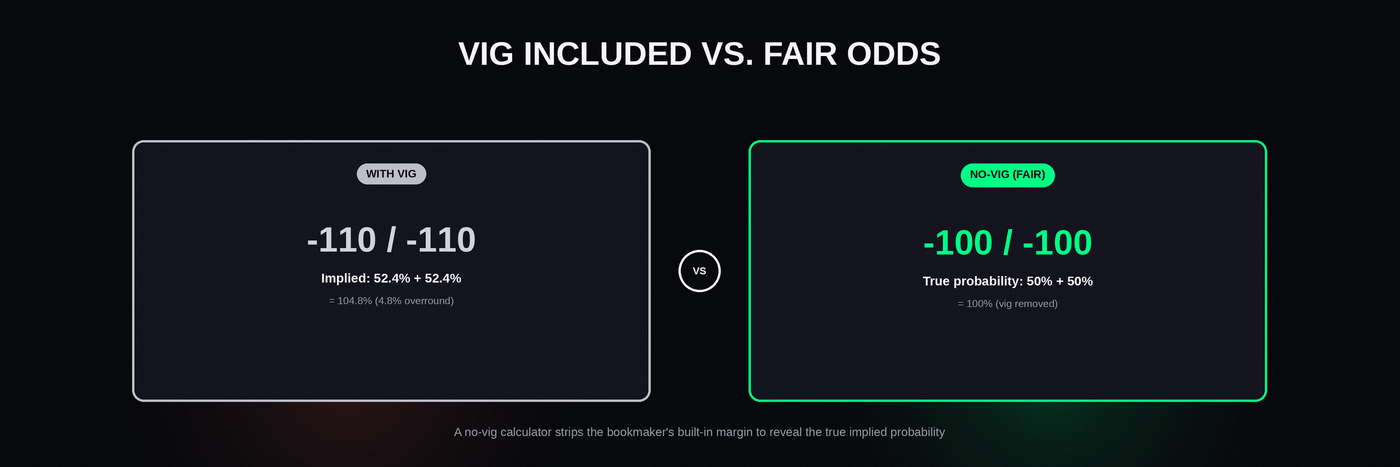
Vig, short for vigorish and also called juice, is the commission a sportsbook builds into its odds on both sides of a bet. It is how the book makes money regardless of which side wins, separate from any skill in setting the line correctly. A perfectly fair coin flip market, with true 50 percent odds on each side, would price at plus 100 on both sides in American odds. A real sportsbook instead prices that same coin flip closer to minus 110 on each side, and that gap between plus 100 and minus 110 on both outcomes is the vig.
Why Odds Never Reflect True Probability
If you convert both sides of a two-way market into implied probability and add them together, a vig-free market sums to exactly 100 percent. A real sportsbook market almost always sums to something above 100 percent, commonly between 102 and 108 percent depending on the sport, the book, and how competitive that particular market is. That extra percentage above 100 is the book's overround, and it is spread across both sides of the bet rather than sitting as a separate visible fee, which is exactly why it is easy to miss unless you calculate it directly.
The No-Vig Calculator: How It Works Step by Step
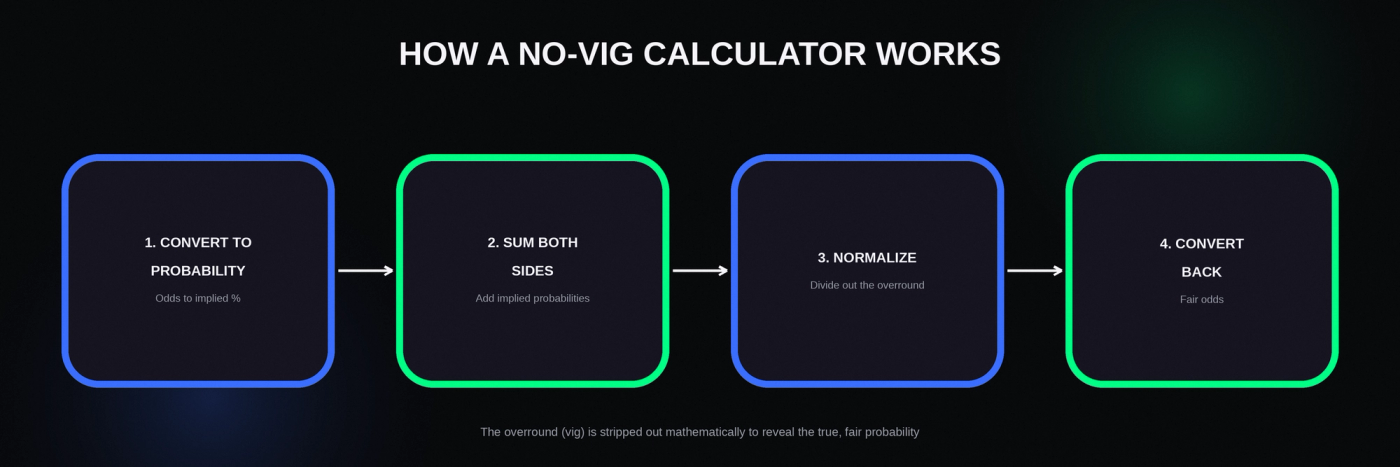
A no-vig calculator takes the odds on both sides of a market and works through four steps to isolate the true probability. First, convert each side's odds into implied probability. For American odds, a negative number converts using the negative odds divided by the negative odds plus 100, and a positive number converts using 100 divided by the positive odds plus 100. Second, add both implied probabilities together to get the total, which will be some number above 100 percent for any real market. Third, divide each individual side's implied probability by that total to normalize both sides back down so they sum to exactly 100 percent. Fourth, convert those normalized, vig-free probabilities back into odds format if you want a fair price rather than just a probability.
Worked Example: Stripping the Vig from a Moneyline
Take a moneyline priced at minus 150 on the favorite and plus 130 on the underdog. Converting minus 150 to implied probability: 150 divided by (150 plus 100), which equals 150 divided by 250, or 60 percent. Converting plus 130: 100 divided by (130 plus 100), which equals 100 divided by 230, or about 43.5 percent. Adding both sides together gives 60 plus 43.5, which equals 103.5 percent, so this book is running roughly a 3.5 percent overround on this specific market.
To strip that vig out, divide each side by the 103.5 percent total. The favorite's fair probability becomes 60 divided by 103.5, which equals about 57.97 percent, and the underdog's fair probability becomes 43.5 divided by 103.5, which equals about 42.03 percent. Notice those two numbers now sum to exactly 100 percent, which is the entire point of the exercise. Converting 57.97 percent back into American odds gives a fair line of roughly minus 138 on the favorite, compared to the book's actual minus 150, meaning the book is charging you about 12 cents of vig on that side alone.
Why This Matters for Bettors
Knowing the fair, no-vig probability behind a line matters for two practical reasons. First, it tells you the actual break-even win rate you need to hit for a given bet to be profitable long term, which is different from the number the raw odds suggest once vig is stripped out. Second, comparing the no-vig probability across multiple sportsbooks on the same market is one of the more reliable ways to spot which book is offering the least favorable price on a given side, since books do not all carry identical margins on every market.
This matters just as much on esports and crypto-native markets as it does on traditional sports. Whether you are checking a moneyline on a major league game or a match odds market for a Valorant or CS2 tournament through Flush's esports sportsbook, the same no-vig math applies, since every book, regardless of what it covers, builds a margin into its lines the same way.
Using Fair Odds to Spot Value
Once you can calculate a fair, no-vig probability, the next step is comparing it against your own independent estimate of how likely an outcome actually is. If your estimate is meaningfully higher than the book's fair probability, that is what bettors call value, a price that pays out more than the outcome's true likelihood would suggest. This is a different exercise from simply picking winners, since a bet can lose and still have been a good value bet if the underlying probability genuinely favored it, and a bet can win while still having been a poor value bet that got lucky. Tracking your own no-vig calculations over time, rather than relying on gut feeling about which side looks better, is the more disciplined way to build toward long-term profitability. Regulatory context matters too. If you are checking whether a specific market is even legal to bet on where you live, our guide on whether sports betting is legal in Oklahoma walks through how state-level legality gets decided, which is a useful companion read to the math covered here.
This same normalization process works on any two-way or three-way market, including draw markets in soccer, so it is worth practicing on a few real lines before relying on it. For more betting math and strategy breakdowns, browse the rest of the Flush blog.
Responsible Gambling
Understanding vig and fair odds is a math exercise, not a guarantee of winning bets. Set a budget before you start and treat betting as entertainment spending, not a way to recover losses. Flush's responsible gambling tools include deposit limits, session timers, and self-exclusion, all adjustable directly from your account. Free, confidential support is available around the clock from GamCare (0808 8020 133) and BeGambleAware in the UK, and the National Council on Problem Gambling (1-800-GAMBLER) in the US, or via Gambling Therapy globally.
Stripping the vig out of a line takes four steps and a calculator, and once it becomes second nature, comparing odds across books gets a lot faster. Check current lines and bet across sports and esports markets at Flush's esports sportsbook.
How We Researched This
Methodology
The formulas and worked example in this guide were built from standard American-odds-to-probability conversion math used across the sports betting industry, verified against multiple published sportsbook education resources and odds-conversion references. The 3.5 percent overround figure and all downstream calculations in the worked example were computed directly rather than sourced from a third party, so readers can check the arithmetic themselves using the four steps outlined.
FAQ
Frequently Asked Questions
What does a no-vig calculator actually do?
What is vig in sports betting?
How do you calculate implied probability from American odds?
Why do sportsbook odds add up to more than 100 percent?
How is a no-vig calculation useful for finding betting value?

Share This Post
Share this post for your chance to win!