May 12, 2026 • 5 min read
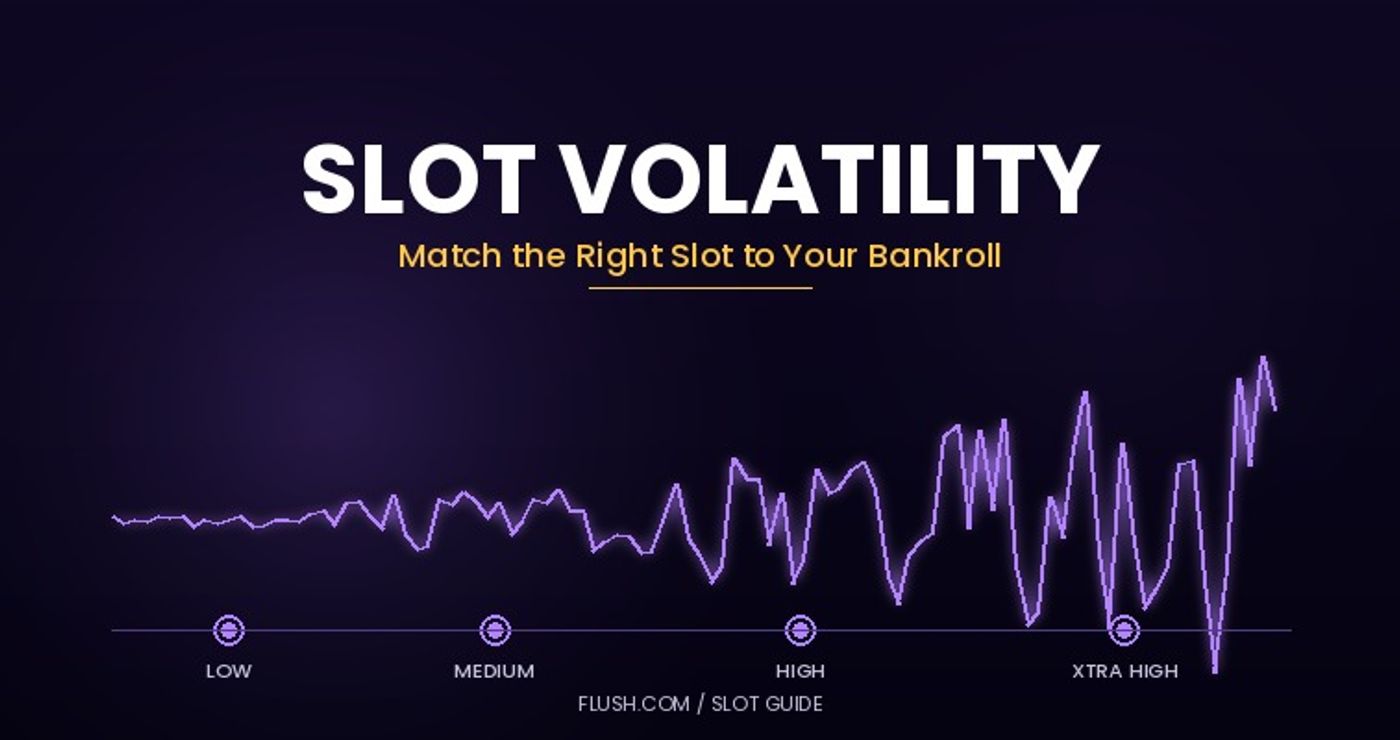
Slot Volatility Explained
Quick Answer
Quick answer: slot volatility tells you how a game distributes its wins. Low volatility pays often but small. Xtra High pays rarely but huge.
Key Facts
| Volatility tiers | Low, Medium, High, Xtra High |
| Low volatility bankroll | Minimum 50x base bet |
| Medium volatility bankroll | Minimum 100x base bet |
| High volatility bankroll | Minimum 150x base bet |
| Xtra High volatility bankroll | Minimum 200x base bet |
| Low volatility win frequency | Every 3 to 8 spins |
| Xtra High win frequency | Every 100 to 300 spins |
| Suggested demo test | 30 to 50 spins |
| Highest max win listed | Tombstone No Mercy, 500,000x |
| Supported cryptocurrencies | 9 (BTC, ETH, BNB, LTC, USDT, USDC, TRX, POL, DOGE) |
Match volatility to your bankroll before you spin, or you will burn through your budget on a game that was never built for the money you brought.
Slot volatility, also called variance, is the single most practical concept in slot strategy. This guide explains the four volatility tiers (low, medium, high, Xtra High), the bankroll requirements each one demands, and how to test a game's rhythm before you commit real crypto at Flush. Published May 2026.
I've spent four years analysing RTP variance and feature trigger frequency across the major slot studios at this crypto casino. The single most common reason players blow their bankroll is mismatched volatility, picking a game built for 0.4 ETH sessions when they brought 0.1 ETH. This guide is built to fix that before it happens to you.
Table of Contents
- What Is Slot Volatility?
- The Four Volatility Levels Explained
- Slots by Volatility: Quick Reference
- Volatility vs RTP: Why They Are Not the Same
- How to Find a Slot's Volatility Rating
- How Volatility Changes Your Bankroll Requirements
- Which Volatility Level Is Right for You?
- In Practice: Three Games at Flush
- Volatility and Crypto: The Extra Layer
- Common Volatility Mistakes
- How to Apply This at Flush
What Is Slot Volatility?
Slot volatility is the risk profile of a slot game. It is baked into the game's code by the developer and determines two things: how often you win, and how large those wins tend to be.
Think of it as a dial. Turn it toward low, and wins come frequently but stay small. Turn it toward high, and wins become rare but can be enormous when they land. Neither setting is better. They serve different players with different bankrolls and different goals. Volatility is sometimes called variance. The terms mean the same thing.
Here is why it matters in practice. Imagine two players, each with 0.2 ETH, each playing a slot with 96% RTP:
- Player A chooses a low volatility game. After 100 spins: 40 winning spins, bankroll barely moved, free spins feature triggered twice.
- Player B chooses an Xtra High volatility game. After 100 spins: 9 winning spins, bankroll down 60%, bonus feature never triggered.
Same RTP. Completely different experience. Three things volatility controls directly:
- Win frequency: how many spins pass between wins. Low volatility: every 3 to 8 spins. Xtra High volatility: 100 to 300 spins between meaningful wins.
- Win size: low volatility returns 2x to 50x on most hits. High volatility concentrates payouts into rare hits reaching 500x, 5,000x, or higher.
- Bonus feature frequency: high volatility slots often require deep runway just to trigger the feature that holds most of the game's payout potential.
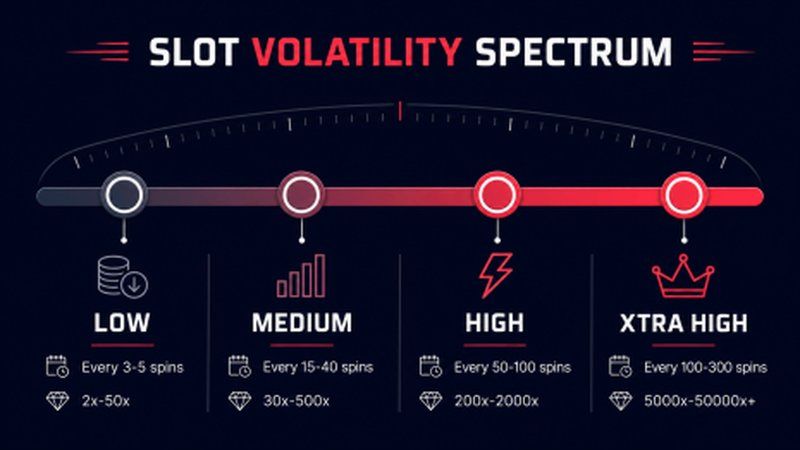
Volatility is a dial, not a judgement. Low means frequent small wins. Xtra High means rare but potentially massive payouts.
The Four Volatility Levels Explained
Low Volatility
Games like Starburst (NetEnt) and similar slots sit here. Wins land frequently, often every 3 to 8 spins. The wins themselves are small, typically 2x to 50x your bet. Your bankroll moves like a slow heartbeat: small gains, small losses, generally flat or gently declining over time.
Who it suits: players with smaller bankrolls who want long sessions. Clearing a bonus. Learning a new game. Bankroll requirement: minimum 50x your base bet. At 0.002 ETH per spin, that is 0.1 ETH.
Medium Volatility
Games like Book of Dead (Play'n GO) and Sweet Bonanza (Pragmatic Play) sit here. Wins arrive less often, perhaps every 15 to 40 spins, but they are chunkier when they land. A strong base game hit might return 30x to 200x. The free spins feature can deliver 500x or more in a good run.
Who it suits: the majority of players. Enough win frequency to stay engaged, enough upside to make sessions worthwhile. Bankroll requirement: minimum 100x your base bet. At 0.002 ETH per spin, that is 0.2 ETH.
High Volatility
Games like Gates of Olympus (Pragmatic Play) and Tombstone (Nolimit City) live here. Wins are infrequent. Dry spells of 50 to 100 spins between meaningful hits are normal. When wins land they can be substantial, 200x to 2,000x from a single feature.
Who it suits: players with larger bankrolls who understand long dry spells are part of the design, not a malfunction. Bankroll requirement: minimum 150x your base bet. At 0.002 ETH per spin, that is 0.3 ETH.
Xtra High Volatility
Games like Tombstone No Mercy (Nolimit City) and San Quentin (Nolimit City) sit here. Meaningful wins drop to once every 100 to 300 spins. Dry spells of 200 spins are not rare. When the game pays, it can pay extraordinary amounts, 10,000x to 50,000x or more on the right feature run.
Who it suits: players with large bankrolls and high risk tolerance. Not recommended for players new to high variance play. Bankroll requirement: minimum 200x your base bet. At 0.002 ETH per spin, that is 0.4 ETH.
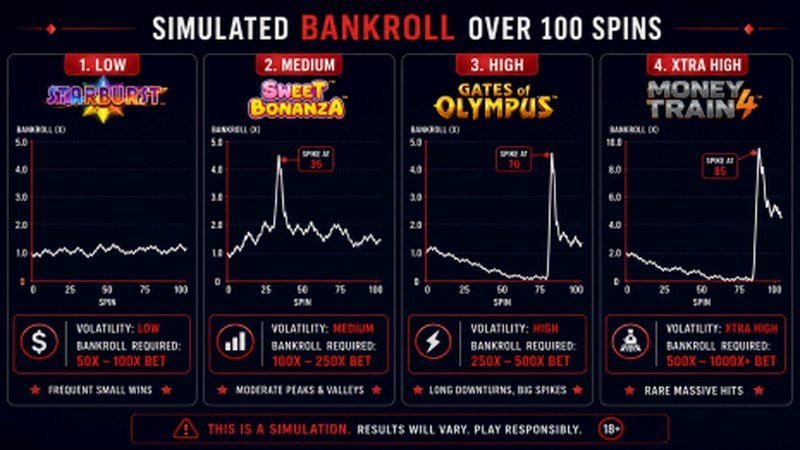
Each volatility tier produces a different bankroll pattern over 100 spins. Higher volatility needs longer survival before big wins arrive.
Slots by Volatility: Quick Reference
Before you load a game, check where it sits. This list covers commonly played slots across all four volatility tiers at Flush.
Low Volatility
- Starburst (NetEnt), RTP 96.09%, Max Win 500x. Long sessions, small bankrolls.
- Pyramid King (Pragmatic Play), RTP 96.48%, Max Win 1,000x. Bonus clearance, steady play.
- Blood Suckers (NetEnt), RTP 98.00%, Max Win 1,000x. Highest RTP in the low-vol catalogue.
Medium Volatility
- Book of Dead (Play'n GO), RTP 96.21%, Max Win 5,000x. Balanced sessions, free spins upside.
- Sweet Bonanza (Pragmatic Play), RTP 96.48%, Max Win 21,175x. Cluster pays, multiplier bombs.
- Reactoonz (Play'n GO), RTP 96.51%, Max Win 4,570x. Cascading wins, fun mechanics.
- Big Bass Bonanza (Pragmatic Play), RTP 96.71%, Max Win 2,100x. Regular bonus triggers.
High Volatility
- Gates of Olympus (Pragmatic Play), RTP 96.50%, Max Win 15,000x. Multiplier stacking.
- Tombstone (Nolimit City), RTP 96.01%, Max Win 10,000x. Western theme, high feature upside.
- Wanted Dead or a Wild (Hacksaw Gaming), RTP 96.38%, Max Win 12,500x. Multiple bonus modes.
- Dead or Alive 2 (NetEnt), RTP 96.82%, Max Win 100,000x. Extreme potential inside bonus.
Xtra High Volatility
- Tombstone No Mercy (Nolimit City), RTP 96.06%, Max Win 500,000x. One of the highest ceilings in any slot at Flush.
- San Quentin (Nolimit City), RTP 96.03%, Max Win 150,000x. Prison break mechanic, extreme variance.
TIP: Every game in this list has a free demo at Flush. Test the rhythm for 30 to 50 spins before you commit real crypto. No account or sign-up required.
Volatility vs RTP: Why They Are Not the Same
RTP (Return to Player) is the long-term percentage a game returns to all players across millions of spins. A 96% RTP slot returns 96 units for every 100 wagered, over time, across all players combined.
Volatility is how that 96% is distributed across individual spins and sessions.
Two slots can share an identical 96% RTP and feel completely different because of their volatility settings:
Slot A (Low Volatility): RTP 96%, win every 4 spins, typical win 3x to 20x, steady predictable, bankroll 50x base bet
Slot B (High Volatility): RTP 96%, win every 80 spins, typical win 200x to 2,000x, long dry spells with rare huge hits, bankroll 150x or more
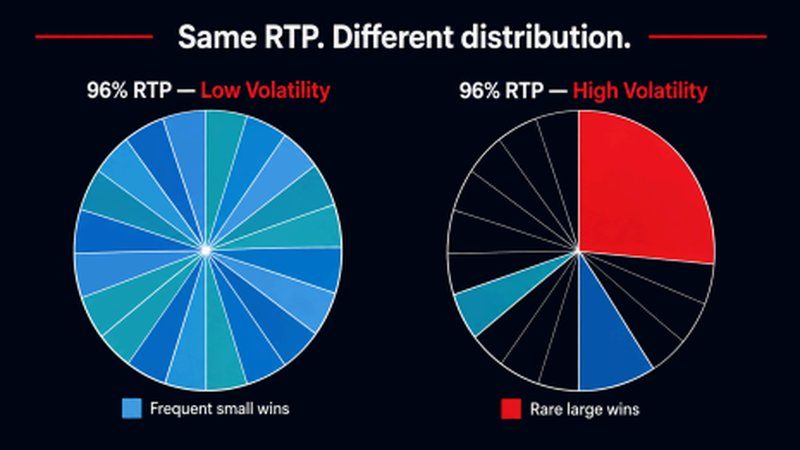
Same RTP, different distribution. RTP tells you how much comes back. Volatility tells you how and when.
RTP becomes meaningful only over millions of spins. In your 50-spin session tonight, RTP is almost irrelevant. What matters is whether your bankroll can survive long enough to reach the features that hold the game's payout potential. That survival question is answered by volatility, not RTP.
Key insight: a 94% RTP low volatility slot can keep you playing comfortably for 3 hours on the same budget as a 96% RTP Xtra High slot that drains in 80 spins. Lower RTP, better session, because the volatility matched the bankroll.
How to Find a Slot's Volatility Rating
Method 1: Check the game card at Flush (fastest). Every game at Flush displays its volatility rating on the game card before you click play. Low, Medium, High, or Xtra High, alongside the RTP and max win.
Method 2: Open the game info panel. Inside any slot, tap the "i" or "?" button. Most major providers (Pragmatic Play, Play'n GO, Nolimit City) list RTP, hit frequency, and volatility here.
Method 3: Read the paytable. A wide gap between lowest and highest paying symbols signals high volatility. Modest top prizes with many mid-range wins signal low volatility.
Method 4: Play demo mode for 50 spins. Load the free demo and observe the rhythm. Frequent small wins equals low volatility. Long stretches with nothing followed by big hits equals high volatility.
TIP: Win every 3 to 8 spins is Low. Every 15 to 40 spins is Medium. Every 50 to 100 spins is High. Every 100 to 300 spins is Xtra High. When in doubt, assume High and plan your bankroll accordingly.
How Volatility Changes Your Bankroll Requirements
The rule is simple: the higher the volatility, the larger the bankroll you need relative to your bet size. The reason is runway. High volatility games concentrate their payout potential into rare features. Run out of bankroll before the bonus triggers, and you leave with nothing.
- Low: minimum 50x base bet, 2 to 3% of bankroll per spin, 0.1 ETH at 0.002 ETH per spin, 50+ spin runway
- Medium: minimum 100x base bet, 1.5 to 2.5% per spin, 0.2 ETH at 0.002 ETH per spin, 100+ spin runway
- High: minimum 150x base bet, 1 to 2% per spin, 0.3 ETH at 0.002 ETH per spin, 150+ spin runway
- Xtra High: minimum 200x base bet, 1 to 1.5% per spin, 0.4 ETH at 0.002 ETH per spin, 200+ spin runway
If you have 0.2 ETH and want to play a high volatility game at 0.002 ETH per spin, you are underbankrolled. You have 100 spins, but high volatility needs 150 minimum. Either drop your bet to 0.0013 ETH or choose a medium volatility game instead.
Never increase your bet to win faster on a high volatility game. That shortens your runway and almost guarantees you hit your stop-loss before the features arrive.
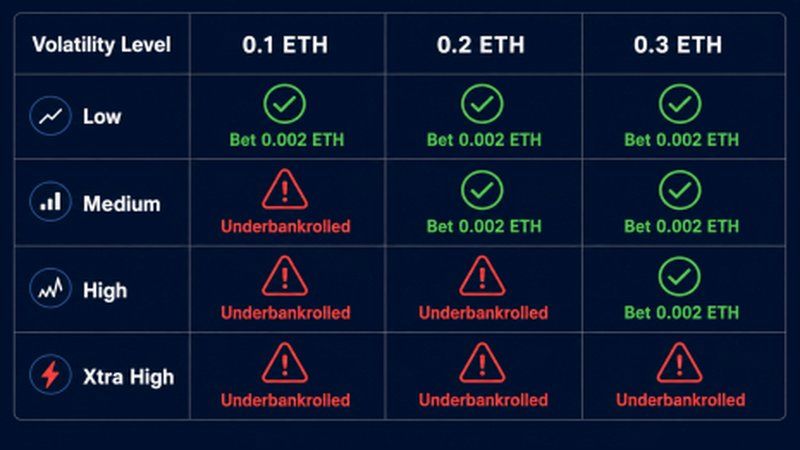
Match your bankroll to the game's volatility before you spin. Underbankrolled sessions almost never reach the bonus.
Which Volatility Level Is Right for You?
Choose Low Volatility if:
- Your session bankroll is under 100x your intended bet size
- You want to play for 2 or more hours without dramatic swings
- You are testing a game for the first time
- You are clearing a bonus with wagering requirements
- Long losing streaks make you want to re-deposit immediately
Choose Medium Volatility if:
- Your session bankroll is 100x to 150x your bet
- You want a balance of regular activity and meaningful upside
- You can handle 20 to 40 losing spins before a significant hit
- You enjoy games like Book of Dead, Sweet Bonanza, or Reactoonz
Choose High Volatility if:
- Your session bankroll is 150x to 200x your bet
- You understand 60 to 100 spin dry spells are expected, not unusual
- You are chasing a specific bonus feature with known upside
- You are comfortable stopping at your stop-loss even if the bonus never triggers
Choose Xtra High Volatility if:
- Your session bankroll is 200x or more your bet
- You have played high volatility games before and understand the pattern
- You accept that many sessions will return nothing significant
Psychology warning: many players overestimate their tolerance for dry spells. Before risking real money, play any high volatility game for 100+ spins in demo mode without changing your bet or quitting early. The demo is free at Flush. Use it to find out what volatility level you can actually handle, not what you think you can handle.
In Practice: Three Games at Flush
Starburst (NetEnt), Low Volatility, RTP 96.09%
Starburst pays both ways with expanding wilds that trigger re-spins. Hit frequency sits around 22%, meaning roughly 1 in 4 to 5 spins returns something. Wins are small, 3x to 20x on most hits, with occasional 50x or more on full-reel wild combinations.
Bankroll at Flush: 0.1 ETH session, bet 0.002 to 0.003 ETH per spin.
Sweet Bonanza (Pragmatic Play), Medium Volatility, RTP 96.48%
Sweet Bonanza uses a cluster pays mechanic with tumbling reels and multiplier bombs. Hit frequency in the base game sits around 30%, keeping things moving. The real upside lives in the free spins feature, where multiplier bombs can stack to deliver 500x to 2,000x or more in a strong run.
Triggering the free spins typically takes 30 to 80 base game spins. The Bonus Buy option (100x your bet) skips the wait, but among bonus buy slots this should only be used if your bankroll is 300x or more your bet size.
Bankroll at Flush: 0.2 ETH session, bet 0.002 ETH per spin.
Tombstone No Mercy (Nolimit City), Xtra High Volatility, RTP 96.06%
Tombstone No Mercy is built around extreme variance. Hit frequency in the base game is around 15 to 20%, meaning many spins return nothing. When the bonus triggers and runs well, wins of 5,000x to 50,000x or more are achievable. The published ceiling is 500,000x, one of the highest in any slot at Flush.
Bankroll at Flush: 0.3 to 0.4 ETH minimum session, bet 0.001 to 0.0015 ETH per spin.
Volatility and Crypto: The Extra Layer
When you play at a crypto casino like Flush, volatility operates alongside a second layer of variance: the price of the cryptocurrency you deposited. This creates a situation traditional casino players never face.
You deposit 0.3 ethereum (ETH) to play an Xtra High slot. Your session bankroll is worth $750 USD. You play 120 spins. Meanwhile, ETH drops 8%. Your 0.3 ETH is now worth $690 USD even if you have not lost a single spin. Two forms of variance running simultaneously: game variance and price variance.
Three ways to handle this:
- Option 1: Denominate in crypto units. Set your stop-loss in ETH, not dollars. "I stop at 0.15 ETH" means 0.15 ETH regardless of price. The cleanest approach.
- Option 2: Use stablecoins. Flush supports USDT or USDC. A USDT session bankroll keeps its USD value regardless of what bitcoin or ethereum does. Removes price variance entirely.
- Option 3: Only deposit what you play. Deposit the session bankroll, play, withdraw the result. Limits exposure to price movement during play.
Instant deposit warning: Flush deposits process in under 60 seconds and withdrawals process in under 2 minutes. You hit your stop-loss on an Xtra High slot after 80 spins with no bonus. The deposit screen takes 45 seconds. That is 45 seconds between an emotional loss and a second deposit. Set a re-deposit rule before your first session: "I only re-deposit once per 24 hours."
Common Volatility Mistakes
- Mistake 1: Choosing by max-win number, not by bankroll compatibility. A 50,000x max win is irrelevant if your bankroll cannot survive long enough to trigger the feature that could produce it.
- Mistake 2: Playing high volatility with low-volatility expectations. A 60-spin dry spell on a high vol game is expected. The game is not broken. The player's expectations were wrong.
- Mistake 3: Increasing bet size to get to the bonus faster. Higher bets do not trigger bonuses more frequently. They only shorten your runway.
- Mistake 4: Switching volatility tiers mid-session without adjusting bet. Your 0.1 ETH was right for medium vol. It is underbankrolled for high vol at the same bet size.
- Mistake 5: Skipping demo mode. Volatility is something you feel, not just something you read in a table. If 20 demo spins in a row with nothing makes you anxious, that game is telling you something useful.
How to Apply This at Flush
Every game at Flush shows its volatility rating on the game card before you click play. You do not need to dig through paytables or search elsewhere.
- Step 1: decide your session bankroll before you browse games. Write it down.
- Step 2: filter games by volatility to match your bankroll. Low = 50x, Medium = 100x, High = 150x, Xtra High = 200x.
- Step 3: test your shortlisted game in free demo for 30 to 50 spins. If it frustrates you, choose a different game.
- Step 4: set your stop-loss in crypto units before your first real spin. On a 0.2 ETH session, stop at 0.1 ETH. No exceptions.
Flush supports nine cryptocurrencies: bitcoin (BTC), ethereum (ETH), BNB, LTC, USDT, USDC, TRX, POL, and DOGE. Deposits confirm in under 60 seconds. Withdrawals process in under two minutes with no maximum limit. Crypto deposits and withdrawals settle on-chain rather than through card processors or bank wires, so confirmation times are measured in seconds rather than business days. No documents required to open an account.
⚠ The speed of crypto deposits means you can fund your account and lose it faster than with traditional payment methods. Set a deposit limit before each session and check our responsible gambling tools if play stops feeling fun.
How We Researched This
Methodology
This guide groups slots into four volatility tiers (low, medium, high, Xtra High) using the RTP and max-win figures published by providers such as NetEnt, Play'n GO, Pragmatic Play, Hacksaw Gaming and Nolimit City, plus the volatility ratings shown on Flush game cards. Bankroll multiples and hit-frequency ranges are the author's rules of thumb, and the ETH bankroll examples are illustrative scenarios rather than recorded sessions. RTP and volatility settings can vary by operator, and crypto prices move, so check the game info panel before playing.
FAQ
Frequently Asked Questions
What is slot volatility and why does it matter?
What is the difference between high volatility and low volatility slots?
How much bankroll do I need for a high volatility slot?
How do I find a slot's volatility rating?
Is volatility the same as RTP?
Do I need to provide ID documents to play at Flush?
How fast are withdrawals at Flush?
Should I use stablecoins or ETH for high volatility slots?

Share This Post
Share this post for your chance to win!
Related Posts
Level up your knowledge
USDT Gambling: Which Network to Use and Why It Matters
USDT keeps your casino balance's dollar value flat, but which network you send it over changes your speed and fee dramatically. Here is what actually matters.
5 min read
TRON Gambling: How to Gamble With TRX
TRX settles in seconds for a fraction of a cent, the same network many USDT deposits already use. Here is what actually matters when gambling with TRX directly.
5 min read

Best Crypto Sports Betting: A Complete 2026 Guide
Crypto sports betting means funding a sportsbook with BTC, ETH, or a stablecoin instead of a card. Here is how it actually works, and how Flush's own sportsbook applies it.
5 min read