August 10, 2026 • 5 min read

What Is Bitcoin Mining? Guide
Quick Answer
Bitcoin mining is the process of using specialized computers to solve a cryptographic puzzle roughly every ten minutes, securing the network and creating new bitcoin as a reward. It now runs almost entirely on industrial-scale ASIC hardware, not home computers.
You must be 18+ to access this content. Please gamble responsibly.
Key Facts
| Consensus mechanism | Proof of Work using the SHA-256 hashing algorithm |
| Global network hash rate | Roughly 1 zettahash per second (1,000+ EH/s) as of mid-2026 |
| Difficulty adjustment | Every 2,016 blocks, roughly every two weeks |
| Current block reward | 3.125 BTC per block, set at the April 2024 halving |
| Next halving | Expected around 2028, reward drops to 1.5625 BTC |
| Total supply cap | 21 million BTC, last coin expected around the year 2140 |
| Dominant hardware | ASICs, e.g. Bitmain Antminer S21 XP at roughly 270 TH/s |
| Rough profitability threshold | Electricity around $0.06 to $0.08 per kWh or lower with current hardware |
Bitcoin mining is the process that creates new bitcoin and keeps the network secure, and it works by having computers compete to solve a cryptographic puzzle roughly every ten minutes. The computer that solves it first gets to add the next block of pending transactions to the blockchain and collects a reward paid in freshly issued bitcoin plus the transaction fees attached to that block. Nobody mines bitcoin with a laptop anymore, not profitably. It is an industrial process today, run by purpose built hardware and large scale operations chasing thin margins on the cheapest electricity they can find.
What Bitcoin Mining Actually Does
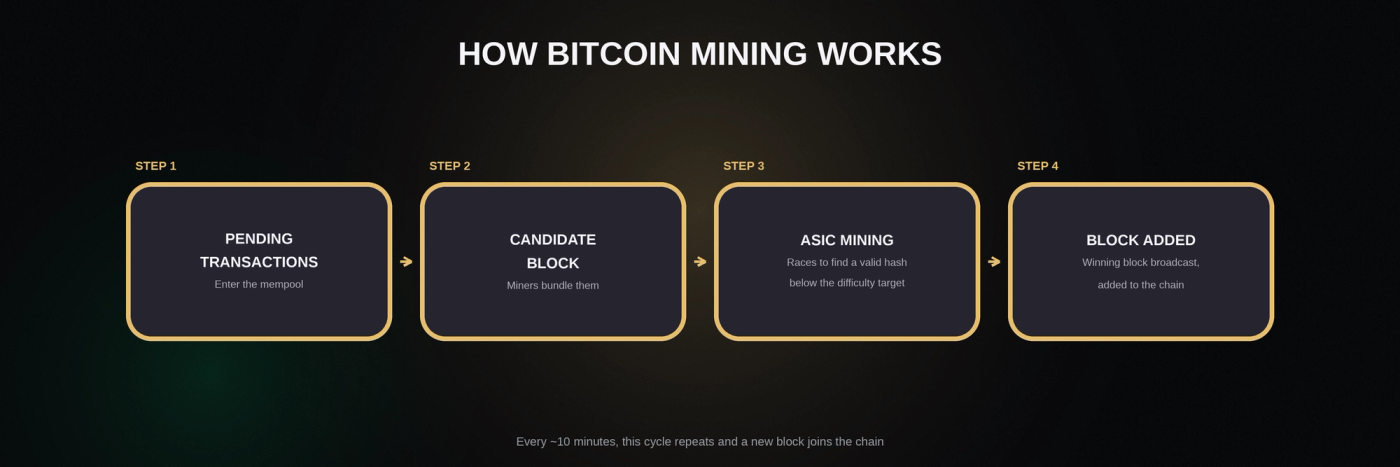
Bitcoin has no central bank or clearinghouse deciding which transactions are valid. Instead, it relies on a system called proof of work, where miners spend real computing power to earn the right to update the ledger. Every ten minutes or so, miners bundle up the transactions waiting in the network's queue, known as the mempool, into a candidate block. They then run that block's data through the SHA-256 hashing algorithm over and over, changing a small value called a nonce each time, until someone produces a hash that falls below a target set by the network's current difficulty. Finding that hash is almost pure trial and error, there is no shortcut or clever math that gets you there faster than raw computing speed. Once a miner finds a valid hash, every other node on the network can check it almost instantly, which is what makes the system trustworthy without needing a central authority.
The Hardware Miners Use Today
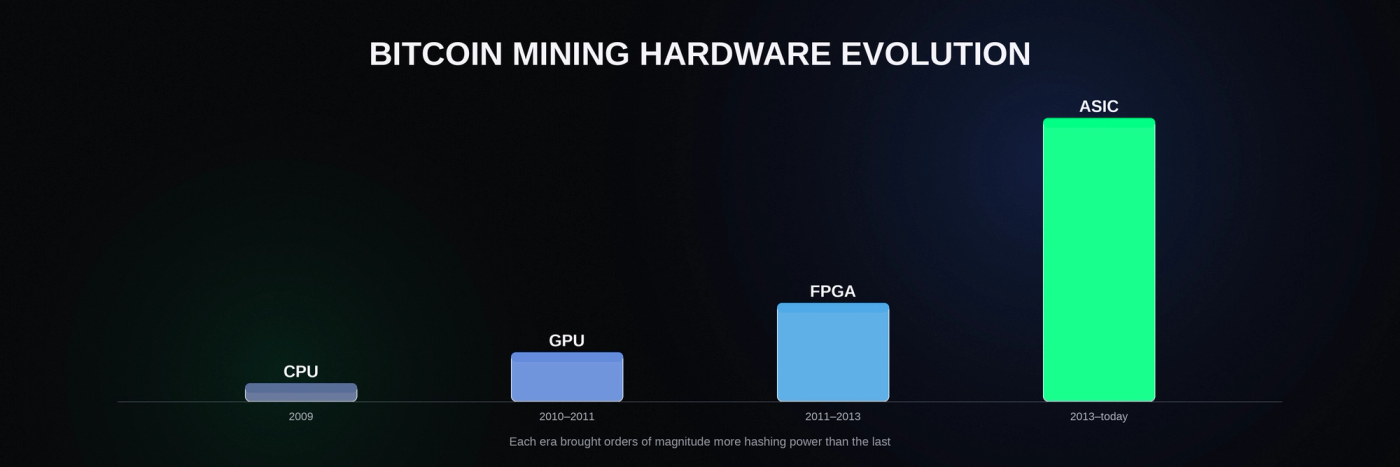
Bitcoin mining hardware has gone through several generations. Early adopters mined with ordinary CPUs, then graphics cards (GPUs) took over for a few years, followed by short lived FPGA chips. Since around 2013, the field has belonged entirely to ASICs, Application Specific Integrated Circuits built to do exactly one job: compute SHA-256 hashes as fast and as efficiently as physically possible. A current generation machine like Bitmain's Antminer S21 XP can push out roughly 270 terahashes per second while drawing power in the range of 13 to 14 joules per terahash, a huge efficiency jump over hardware from even three or four years earlier. That efficiency number matters more than raw speed, because electricity is the single biggest ongoing cost of mining. A miner running older, less efficient machines on the same power bill as a competitor running current generation ASICs is simply going to lose that race over time. None of this hardware race changes what happens on the other side of a bitcoin transaction, once your coins are confirmed on chain you can move them anywhere, including into a crypto deposit at a platform like Flush in about the same time it takes for a handful of network confirmations.
How Difficulty and Hash Rate Work Together
Hash rate is the total computing power pointed at the bitcoin network at any given moment, measured these days in exahashes per second, and by mid-2026 the global figure has pushed past the zettahash mark, roughly 1,000 exahashes per second combined across every miner on earth. That number only goes up over time as more efficient hardware comes online, which creates a problem: if hash rate keeps climbing, blocks would start getting found faster than every ten minutes. Bitcoin corrects for this automatically. Every 2,016 blocks, which works out to roughly two weeks, the network looks at how long that batch of blocks actually took and adjusts the difficulty target up or down to bring the average back toward ten minutes per block. When hash rate is climbing, as it has been through most of 2026, difficulty keeps rising too, which means each individual miner needs proportionally more computing power just to keep earning the same share of rewards.
This feedback loop is also why bitcoin's block time has stayed remarkably close to ten minutes on average across more than fifteen years, despite total network hash rate growing by many orders of magnitude over that span. A sudden crash in hash rate, say if a major mining region lost power unexpectedly, would temporarily slow block production until the next difficulty adjustment caught up and lowered the target again. The system is self correcting by design, with no human operator needed to intervene.
Mining Pools and How Rewards Get Split
At today's difficulty level, a single miner running one or two machines has essentially no realistic chance of finding a block on their own, the odds are closer to a lottery than a job. That is why almost all miners join pools, groups of participants who combine their hash rate and split whatever rewards the pool collectively earns, in proportion to how much computing power each member contributed. Pools smooth out the payouts, instead of waiting months for a lucky solo block and getting nothing in between, a pool member gets a small, steady, predictable trickle of bitcoin roughly matching their share of the pool's total hash rate. The tradeoff is a small fee taken by the pool operator and, at a broader level, a legitimate concern that hash rate concentrated in a handful of large pools reduces the network's decentralization, something the bitcoin community has debated for years without a clean fix.
Block Rewards and the Halving Schedule
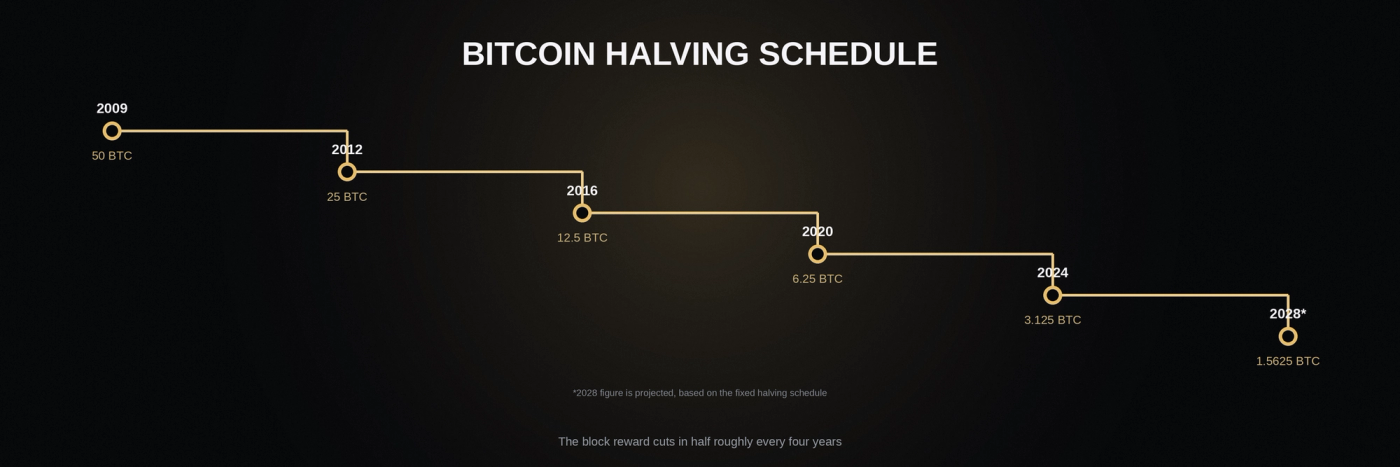
Every bitcoin in existence was created as a mining reward, and that reward is designed to shrink over time. It started at 50 BTC per block in 2009, then cut in half at three roughly four year intervals, November 2012, July 2016, and May 2020, before the most recent halving in April 2024 brought the reward down to its current level, 3.125 BTC per block. The next halving is expected around 2028, when it will drop again to 1.5625 BTC. This built in scarcity mechanism is what caps bitcoin's total supply at 21 million coins, a limit the network is expected to reach gradually over more than a century, with the final fraction of a coin not mined until roughly the year 2140. For a closer look at exactly when that next cut lands and what it tends to do to price and mining economics, see our bitcoin halving countdown guide.
Why Transaction Fees Matter More as Block Rewards Shrink
Every halving cuts the newly issued bitcoin miners collect, which means transaction fees have to gradually pick up more of the slack if mining is going to stay profitable enough to keep the network secure over the long run. Right now block rewards still make up the bulk of miner income, and fees fluctuate a lot depending on how congested the mempool is at any given moment, spiking during periods of high demand and dropping close to negligible during quiet stretches. This is one of the more debated long-term questions in bitcoin economics: whether fee revenue alone will eventually be enough to fund the same level of mining security once block subsidies shrink toward zero over the coming decades. Nobody has a definitive answer yet, since it depends heavily on how much real-world transaction demand bitcoin ends up carrying by then, and reasonable analysts disagree on how that plays out.
Energy Use and the Debate Around It
Bitcoin mining consumes a genuinely large amount of electricity, since it is, by design, a competition to burn computing power faster than everyone else. That has made it a regular target of criticism, and the concern is legitimate on its face. The counterargument miners and researchers point to is that the industry has steadily shifted toward cheaper power sources, which in many regions also means cleaner or otherwise wasted power: hydroelectric surplus during rainy seasons, flared natural gas that would otherwise be burned off at oil sites, and curtailed wind or solar output that grid operators cannot use in the moment. Because a mining rig can be switched on or off almost instantly and does not care where it is physically located, large operations have increasingly set up next to exactly these kinds of stranded or intermittent energy sources rather than competing for standard grid power. The debate over the net environmental impact is ongoing and genuinely contested, and this guide will not pretend there is a settled consensus either way.
Can You Still Mine Bitcoin Profitably at Home in 2026
For the overwhelming majority of people, no. Profitability at current difficulty levels generally requires electricity priced somewhere around six to eight cents per kilowatt hour or lower, running current generation ASIC hardware, which itself costs thousands of dollars per unit. Most home electricity rates sit well above that threshold, which means a single machine plugged in at a typical household rate will usually cost more in power than it earns in bitcoin. Be especially cautious of cloud mining contracts and any offer promising a fixed daily bitcoin payout in exchange for an upfront deposit, this space has a long history of scams that simply take the deposit and pay early users with money from new signups until the scheme collapses. If your actual goal is exposure to bitcoin rather than the mining process itself, buying it directly and holding or spending it, including funding a crypto casino account, is a far more predictable path than trying to compete with industrial mining farms on their own turf.
What Mining Has to Do With Provably Fair Gaming
Bitcoin mining and provably fair casino games are unrelated products, but they lean on the same underlying idea: a hash function that is trivial to check and effectively impossible to reverse engineer. Mining uses that property to make the blockchain tamper resistant, nobody can quietly rewrite history because doing so would mean out computing the entire rest of the network. Provably fair games use the exact same category of hashing to let a player verify, after the fact, that a casino did not alter a game outcome once it saw where the money was placed. It is the same cryptographic building block put to a completely different job. If you want to see that concept applied to actual gameplay rather than block validation, Flush's Originals catalogue runs on a commit reveal system you can check round by round, and the mechanics of how that works are laid out in full on Flush's fairness overview page.
Responsible Gambling
Set a budget before you start and treat it as entertainment spending, not a way to recover losses. Flush's responsible gambling tools include deposit limits, session timers, and self-exclusion, all adjustable directly from your account. Free, confidential support is available around the clock from GamCare (0808 8020 133) and BeGambleAware in the UK, and the National Council on Problem Gambling (1-800-GAMBLER) in the US, or via Gambling Therapy globally.
Mining is how bitcoin gets made and how the network stays honest, but you do not need a warehouse of ASICs to hold or spend bitcoin yourself. Deposit BTC and play at Flush's casino, where every deposit clears in minutes and every Originals round can be checked against the same kind of hashing that secures the blockchain itself.
How We Researched This
Methodology
This guide was researched via live web search on August 10, 2026, covering current bitcoin network hash rate, ASIC hardware specifications, mining difficulty adjustment mechanics, and the confirmed block reward and halving schedule through the April 2024 halving. Figures on hash rate and hardware efficiency reflect publicly reported mid-2026 estimates and should be treated as approximate snapshots, since both change continuously. The bridge to provably fair gaming was cross-referenced against Flush's own published fairness documentation for its Originals titles.
FAQ
Frequently Asked Questions
What is bitcoin mining?
How does bitcoin mining secure the network?
Can I still mine bitcoin at home in 2026?
What happens when all 21 million bitcoin are mined?
What is a bitcoin mining pool?

Share This Post
Share this post for your chance to win!
Related Posts
Level up your knowledge
How Bitcoin Gambling Works 2026: Complete Guide
Bitcoin gambling means depositing, wagering, and withdrawing with BTC instead of fiat. Here is how deposits, withdrawals, wallets, and provably fair systems actually work.
5 min read
When Is the Next Bitcoin Halving? 2028 Countdown
The next Bitcoin halving is projected for April 2028 at block 1,050,000, cutting the mining reward from 3.125 to 1.5625 BTC. Here's how the schedule works and what past halvings actually did to price.
5 min read
Proof of Work vs Proof of Stake: The Full Breakdown 2026
What proof of work and proof of stake actually do, why Ethereum switched and Bitcoin did not, the real tradeoffs between them, and why neither one is simply the better system.
5 min read