July 22, 2026 • 5 min read

Alberta Opens Regulated iGaming 2026: What It Signals
Quick Answer
Alberta's regulated iGaming market launched July 13, 2026 with 22 operators live day one, several running crypto and stablecoin deposit rails on layer two networks. It signals growing regulatory comfort with crypto payment rails inside licensed gambling markets.
You must be 18+ to access this content. Please gamble responsibly.
Key Facts
| Launch date | July 13, 2026 |
| Operators live day one | 22 |
| Province rank | 2nd Canadian province, after Ontario (2022) |
| Crypto/stablecoin rails | Several operators, layer-two networks |
| Prior Canadian precedent | Ontario, 2022 |
| Market type | Regulated iGaming |
Key Takeaways
- Alberta became Canada's second province to open a competitive iGaming market, four years after Ontario.
- Several newly licensed operators run Bitcoin and stablecoin deposit rails on layer two networks like Arbitrum and Base.
- Provincial licenses are geographically restricted and do not extend access to players outside Alberta.
- Offshore no-KYC crypto casinos remain a separate model from regulated provincial platforms.
Alberta's regulated online gambling market went live on July 13, 2026, with 22 operators launching on day one, making it only the second Canadian province after Ontario to open its iGaming market to private, competing operators. The launch matters well beyond Alberta's borders: it is the clearest sign yet that regulators are comfortable building crypto and stablecoin rails directly into licensed gambling markets, not just tolerating offshore crypto casinos on the margins.
What Happened
Alberta's open iGaming market launched July 13, 2026, four years after Ontario became the first Canadian province to allow multiple licensed operators to compete for players, ending the government-monopoly model most provinces still run. Twenty two operators went live on day one, a larger opening slate than Ontario's original 2022 launch. Several of the newly licensed platforms serving the Canadian market run deposit and withdrawal rails on layer two blockchain networks including Arbitrum and Base, with Bitcoin and stablecoin deposits already standard among operators active in the Canadian market, according to industry coverage of the rollout.
What This Means for Crypto Casino Players
The headline story is regulatory, but the detail worth paying attention to is technical: regulated operators are choosing to build stablecoin and Bitcoin deposit rails into markets with real oversight, not routing around it. That is a meaningfully different signal than crypto gambling's earlier reputation as something that only worked in unregulated corners of the internet. When licensed, audited platforms decide layer two settlement is worth the engineering effort, it tells you the cost and speed advantages of crypto rails, fast settlement, low fees, no chargeback risk, are now compelling enough that regulators are willing to build compliance frameworks around them rather than against them.
For players outside Alberta, the direct practical impact is limited. Provincial iGaming licenses are geographically restricted by design, so an Alberta license does not open access to players elsewhere, and it says nothing about whether any specific platform accepts players in your jurisdiction. What it does signal is a broader direction: crypto payment rails inside gambling are moving from a niche offshore feature toward mainstream regulatory acceptance. Ontario's four year head start already showed this shift was durable rather than a one-off experiment. A second province building it in from day one, with 22 operators live simultaneously, suggests other jurisdictions evaluating iGaming frameworks are watching closely.
There is a second, more subtle implication for anyone who already plays at offshore crypto casinos. Regulated markets moving toward crypto rails does not replace offshore no-KYC platforms, the two serve different players with different priorities. Regulated operators still require full identity verification and are bound by provincial responsible gambling and marketing rules. Offshore crypto casinos built around no-KYC play, instant withdrawals, and provably fair verification remain a genuinely different product, not a lesser version of the regulated one. Alberta's launch is evidence that the underlying technology both models rely on, fast blockchain settlement, is now trusted enough for regulators to build around it. It is not evidence that the two models are converging.
Worth noting too: stablecoin deposits being "standard" among Alberta's new operators lines up with a trend that has shown up repeatedly in crypto casino data through 2026, players increasingly prefer settling in a dollar pegged token over a volatile coin like Bitcoin or Ethereum, specifically to avoid the deposit-to-withdrawal price swing risk that comes with holding a floating asset through a gambling session.
Flush Specifics
Flush is not licensed under Alberta's provincial iGaming framework and does not operate as a regulated Alberta operator. Flush holds a license from the Government of the Autonomous Island of Anjouan, Union of Comoros (License No. ALSI-202509008-FI1), a different regulatory model built around instant, no-KYC crypto play rather than provincial licensing. Readers in Alberta or any other jurisdiction should confirm which platforms are actually licensed to serve them and follow local law before playing anywhere.
For players outside regulated markets who are drawn to the stablecoin trend described above, Flush's crypto casino already runs on the same principle Alberta's new operators are building toward: fast, low friction crypto settlement. Flush supports nine cryptocurrencies, BTC, ETH, BNB, LTC, USDT, USDC, TRX, POL, and DOGE, confirmed directly at flush.com in July 2026, with BTC withdrawals stated at under two minutes and no platform fees layered on top of standard network costs. Players who want the stablecoin-first approach Alberta's operators are adopting can deposit and withdraw in USDT or USDC directly, keeping their balance close to a fixed dollar value for the entire session. Flush does not require identity verification to deposit, play, or withdraw, and every Flush Originals game is provably fair and verifiable on-chain, a different route to the same trust problem regulated licensing is designed to solve.
This is a developing regulatory story and provincial iGaming frameworks continue to evolve through 2026. Check Flush's crypto casino news coverage for updates as more jurisdictions move on iGaming legislation.
Responsible Gambling
Whether you play on a regulated provincial platform or an offshore crypto casino, the underlying financial risk is the same, and a new market opening is not a reason to change how much you deposit or wager. Set a deposit limit before you play. Flush's responsible gambling tools include deposit limits, session timers, and self-exclusion, all adjustable directly from your account. Free, confidential support is available around the clock from GamCare (gamcare.org.uk) and BeGambleAware (begambleaware.org) in the UK, and the National Council on Problem Gambling (1-800-522-4700, ncpgambling.org) in the US. Never gamble more than you can afford to lose.
How We Researched This
Methodology
This article is sourced from live iGaming trade coverage published by SI.com, SBC Americas, Rotowire, and New Game Network, confirming the July 13, 2026 Alberta launch date, the 22-operator opening slate, and which operators run crypto or stablecoin deposit rails on layer-two networks. Each figure was cross-checked across at least two of these outlets before being cited here. Ontario's 2022 iGaming launch is referenced as the closest prior Canadian precedent for gauging market scale and early adoption pace, not as a guarantee of similar outcomes in Alberta. No specific operator's licensing status or product claims beyond what each cited source directly reports are made in this article.
FAQ
Frequently Asked Questions
What happened with Alberta's iGaming market?
Does Alberta's iGaming launch mean crypto casinos are now regulated in Canada?
Why are regulated operators using stablecoins for deposits?
Can players outside Alberta use Alberta-licensed operators?
What is the difference between a regulated iGaming platform and an offshore crypto casino like Flush?
Sources
- BetMGM Alberta: Legal Updates & Launch Details 2026 — accessedJuly 22, 2026
- Igaming Archives - SBC Americas — accessedJuly 22, 2026

Share This Post
Share this post for your chance to win!
Related Posts
Level up your knowledge
American Bitcoin (ABTC) Explained: What the Company Is
American Bitcoin (ABTC) is a Nasdaq listed Bitcoin mining and treasury company tied to Hut 8 and the Trump family. Here's what the company actually does, stated as fact, not opinion.
5 min read
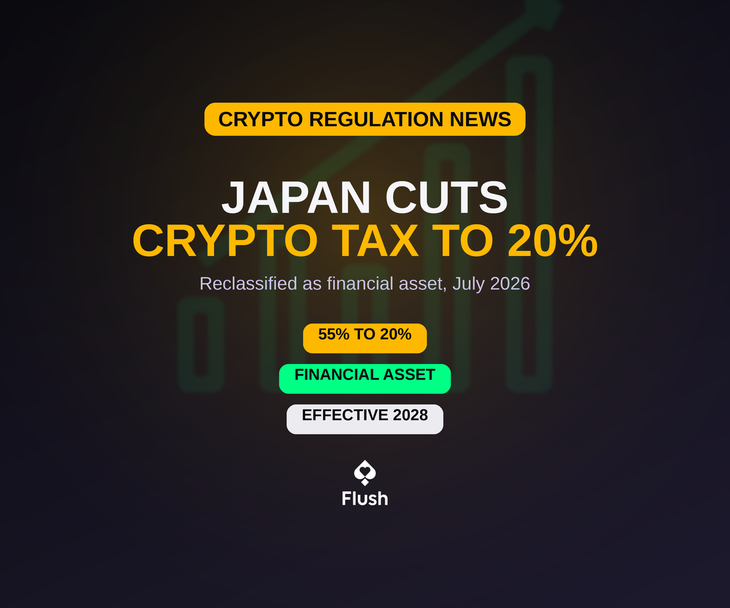
Japan Reclassifies Crypto as Financial Asset 2026
Japan's parliament reclassified crypto as a financial asset and cut its top crypto tax rate from 55% to 20%, effective 2028. Here is what it signals globally.
5 min read
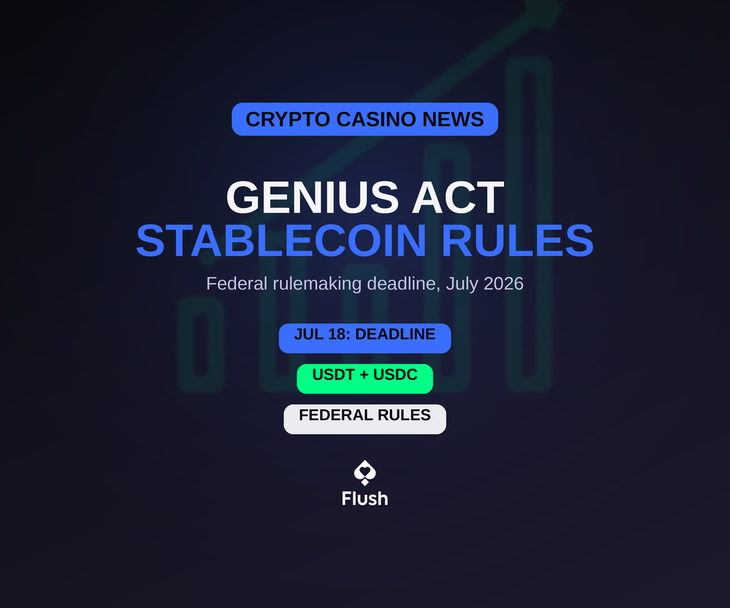
GENIUS Act Stablecoin Deadline 2026: What It Means
July 18, 2026 was the federal deadline to finalize GENIUS Act stablecoin rules. Here is what it means for USDT and USDC at crypto casinos.
5 min read