August 10, 2026 • 5 min read

Best Keno Numbers & Combinations
Quick Answer
There is no such thing as best keno numbers. Every number has equal, independent odds each draw. What actually shapes your session is spot count and bankroll management, and provably fair draws let you verify no number is favored over another.
You must be 18+ to access this content. Please gamble responsibly.
Key Facts
| Game mechanic | Pick spots from a number field, an RNG draw determines which numbers hit |
| Number independence | Every number has equal, independent odds on every single draw |
| What actually changes odds | Spot count and payout structure, not which numbers you choose |
| Fairness mechanism | Server seed (hashed, revealed after), client seed, and nonce |
| Common myth | "Hot", "cold", or "due" numbers, statistically meaningless in a fair RNG game |
| Volatility lever | More spots selected raises the top multiplier but lowers the chance of hitting enough numbers |
| House edge and RTP | Set per title, check Flush's in-game info panel for the exact current figure |
| Flush Keno location | flush.com/p/flush-originals/keno/ |
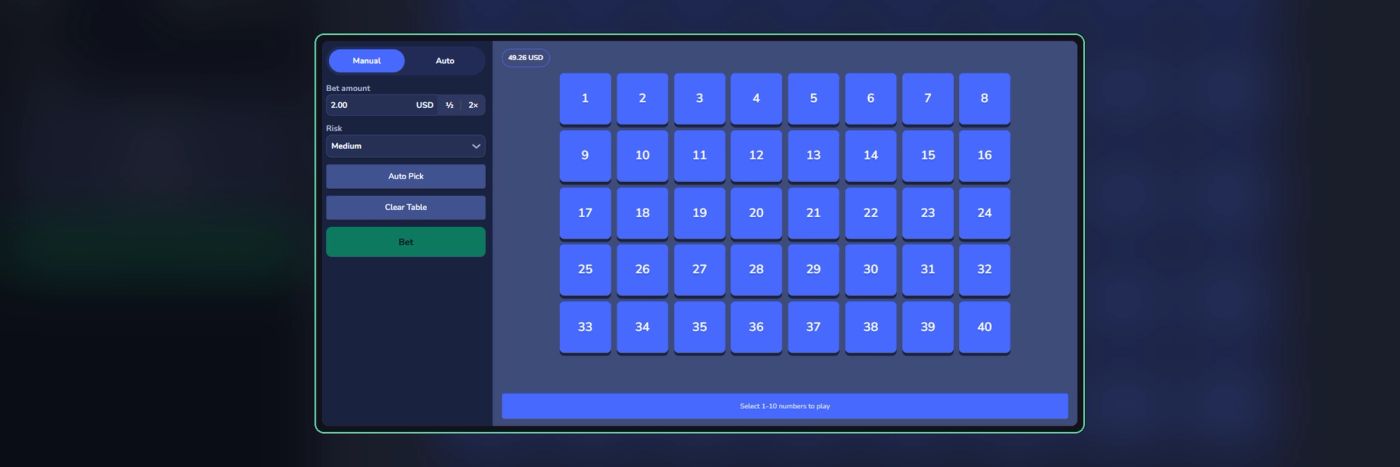
There is no such thing as best keno numbers, at least not in the sense most search results promise. Every number in a fair keno draw has exactly the same, independent probability of being drawn on any given round, and nothing about a number's history changes that going forward. What actually separates a smarter keno session from a random one isn't which numbers you tap, it's how many spots you select and how you manage your bankroll around a game that, like every casino game, is built with a house edge.
Why There's No Such Thing as Best Keno Numbers
Keno draws a set of numbers, typically 20 out of a field of 80, using a random number generator, and in a properly built game each draw is completely independent of every draw before it. That's a mathematical property called independence, and it means a number that hasn't hit in fifty rounds is exactly as likely to hit on round fifty-one as a number that just hit twice in a row. The number itself carries no memory and no momentum. Sites that rank numbers by how often they've supposedly appeared recently are describing a real pattern in a small, meaningless sample, not a signal you can bet on going forward. On a properly certified RNG or a provably fair game like Flush's Originals titles, that independence is exactly what the fairness system is designed to guarantee and let you verify.
How Keno's Randomness Actually Gets Verified
On a provably fair Originals title, the numbers drawn in your keno round come from combining a hashed server seed, a client seed you control, and a round nonce, the same commit-reveal structure used across dice, plinko, and crash-style games. Because the server seed's hash is published before you play, the operator can't quietly pick a friendlier or harsher draw once it sees your spot selection, and once the round finishes you can independently verify the draw matched what the published seed and hash actually produce. We break down exactly how that hashing mechanism works, step by step, in our provably fair algorithm guide. This is a completely different guarantee than trusting a number's recent history, it's a mathematical proof you can check yourself rather than a pattern you're hoping holds.
What Actually Changes Your Odds: Spot Count, Not Number Choice
The one keno decision that genuinely does shape your session is how many spots you select before the draw, not which specific numbers you tap. Selecting more spots widens the gap between the payout for a near miss and the payout for hitting almost everything, which raises volatility, bigger potential multipliers, but a lower chance of landing enough hits to trigger them. Selecting fewer spots does the opposite, smaller top multipliers but a higher chance of landing a partial win. This is the same volatility tradeoff you'll recognize from Plinko's risk level setting or Dice's win chance slider, a lever that changes the shape of the payout curve without changing the fundamental randomness behind each individual draw. Check the payout table inside the game itself before you commit to a spot count, since exact multipliers and the house edge are set per title and should be read directly off the game's own info panel rather than assumed from a generic keno guide.
Common Keno Myths Worth Retiring
A few myths keep circulating around keno numbers, and all of them fall apart under the same independence property covered above. Hot numbers, ones that have appeared often recently, carry no more likelihood of appearing next round than any other number, recent frequency is just noise in a small sample. Cold or due numbers, the flip side of the same myth, are just as much a misread, a number isn't owed an appearance because it's been absent, that's the gambler's fallacy in a fairly pure form. Birthday numbers, lucky numbers, and any pattern based on personal significance carry zero mathematical advantage, they're picked for sentiment, not edge, and there's nothing wrong with that as long as you know that's what it is. The only numbers-based approach worth anything here is picking a spot count and payout structure you understand and can afford, not picking specific digits you believe are due.
A Smarter Way to Approach Keno
Instead of chasing numbers, treat keno strategy as three decisions you actually control: how many spots to select based on the volatility you want, how much to bet per round relative to a budget you set in advance, and how long you play before stopping, win or lose. None of that changes the game's built in house edge, nothing legally can, but all three genuinely affect how a session feels and how long your bankroll lasts. Flush's Originals catalogue runs Keno alongside other provably fair titles like Dice and Plinko on the same verification system, so if you want to compare how spot count and risk level interact across different games, playing a few side by side is a faster education than any numbers list.
Playing Provably Fair Keno at Flush
Flush's Keno runs on the same commit-reveal fairness system as the rest of the Originals catalogue, meaning you can pull the server seed, client seed, and nonce behind any round you've played and check that the draw wasn't altered after you locked in your spots. That verification is the only genuine edge-related fact worth knowing about keno numbers, everything else, hot streaks, cold streaks, lucky picks, is entertainment, not strategy.
If you're coming to this guide hoping for a specific list of numbers to bet, it's worth sitting with why that instinct is so common. Pattern recognition is a genuinely useful survival skill in most of life, our brains are wired to find and trust patterns because in a lot of real world situations, past frequency really does predict future outcomes. A properly randomized keno draw is one of the few environments specifically engineered to defeat that instinct, each round is mathematically independent of the last on purpose. Recognizing that your pattern seeking brain is working against you here, not for you, is arguably the single most useful piece of keno strategy that has nothing to do with which numbers you tap.
Responsible Gambling
Set a budget before you start and treat it as entertainment spending, not a way to recover losses. Flush's responsible gambling tools include deposit limits, session timers, and self-exclusion, all adjustable directly from your account. Free, confidential support is available around the clock from GamCare (0808 8020 133) and BeGambleAware in the UK, and the National Council on Problem Gambling (1-800-GAMBLER) in the US, or via Gambling Therapy globally.
No number picks the winning draw for you, but a spot count you understand and a provably fair system you can actually verify come a lot closer to a real edge than any lucky numbers list. Try it yourself at Flush's casino, where every Keno round can be checked against the same hashing system covering the rest of the Originals lineup.
How We Researched This
Methodology
This guide was researched via live web search on August 10, 2026, covering keno's mathematical structure (random number generation and statistical independence between draws) and cross-referenced against Flush's own published fairness documentation for its Originals titles, which confirms Keno runs on the same server seed, client seed, and nonce structure as Dice and Plinko. This guide does not state a specific house edge or RTP percentage for Flush's Keno, since that figure is set per title and should be checked directly in the game's own info panel rather than quoted from a secondary source that may be out of date.
FAQ
Frequently Asked Questions
Are there really best numbers to pick in keno?
Does picking fewer or more numbers change my odds?
What is a hot or cold number in keno?
Is online keno provably fair?
What is keno's house edge or RTP?

Share This Post
Share this post for your chance to win!
Related Posts
Level up your knowledge
How the Provably Fair Algorithm Actually Works
Provably fair explained step by step: server seed, client seed, nonce, the hash commitment, plain hash vs HMAC, and a worked example you can recompute.
5 min read
Crypto Dice Strategy: Win Chance and Bankroll Math 2026
How crypto dice roll-under works, the tradeoff between win chance and payout, why Martingale does not beat the house edge, and how to verify a fair roll.
5 min read
Plinko Strategy: Risk Levels and Bankroll Math 2026
How the peg-grid math behind Plinko actually works, what changing risk level and row count really does to your odds, and how to verify a drop was fair.
5 min read