August 26, 2026 • 5 min read

Bitcoin Blackjack Strategy: Basic Play & Bankroll 2026
Quick Answer
Bitcoin Blackjack strategy means playing correct basic strategy against Flush's rules (dealer stands soft 17, blackjack pays 3:2) and staking flat. Flush states 98% RTP on the title and a more precise 99.43% for optimal play on the Game Info panel.
You must be 18+ to access this content. Please gamble responsibly.
Key Facts
| Game | Blackjack (single position vs. dealer) on the Flush Originals catalogue |
| Mechanic | Standard 52-card blackjack, infinite/continuously shuffled deck, dealer stands on soft 17 |
| Stated RTP | 98% shown in the page title; 99.43% shown in the in-game Game Info panel for optimal play |
| Blackjack payout | 3:2 on a two-card 21; standard wins pay 1:1 |
| Side bets | Pairs (94.23% RTP, up to 26x) and Plus Three (99.18% RTP, up to 101x) |
| Fairness model | Provably Fair: client seed plus hashed server seed plus a bet-count nonce, revealed after each round |
| Suggested stake | 1% to 2% of session bankroll per hand, flat |
| Related Originals | Video Poker, Plinko, Mines, Dice, Crash |
Bitcoin Blackjack Strategy: Basic Strategy and Bankroll Math 2026
Flush's own Blackjack table states two different numbers depending on where you look. The browser tab reads "Blackjack: 98% RTP, 5x Max Win." Open the in-game Game Info panel instead, and it lists a more precise 99.43% RTP. Neither figure is a mistake: the 98% is a rounded, marketing-facing headline, while 99.43% is the theoretical return under correct basic strategy against this exact rule set (dealer stands on soft 17, blackjack pays 3:2, split and double options as described below). Both are real, first-party numbers Flush publishes itself, and the gap between them is the entire subject of this article: getting your results close to 99.43% depends on which decisions you make at the table, not on luck alone. This is Flush's in-house Blackjack, built and priced by Flush, verifiable round by round through Provably Fair, and separate from any third-party live-dealer blackjack table you might find elsewhere on the site.
What Bitcoin Blackjack is and how the house edge works
Flush's Blackjack is a single-position game against a dealer, played with what the game itself describes as "an infinite standard 52-card deck." In practice that means a fresh, provably fair deck is drawn for every hand rather than dealt from a fixed shoe that depletes over a session, so card counting, which depends on tracking a shrinking shoe, has nothing to work with here the way it can in a physical, finite-shoe game.
Card values follow standard rules: aces count as 1 or 11, whichever benefits the hand more; face cards (jack, queen, king) are worth 10; number cards are worth their face value. Each round deals two cards to the player and two to the dealer, with the dealer showing one card face up and keeping the second, the hole card, face down until it matters.
The payout structure is what actually sets the house edge. A player blackjack, meaning an ace and a 10-value card dealt as your first two, pays 3:2. A standard win pays 1:1. If both hands total the same, or both have blackjack, it's a push and your original bet is returned. Two rules work in the player's favor specifically: the dealer must stand on soft 17 rather than hit it, and the dealer peeks at the hole card whenever showing an ace or a 10-value upcard, ending the round immediately if it's a dealer blackjack, so you're never left doubling or splitting into a hand that was already lost. These are exactly the rule combinations that produce a sub-0.6% theoretical house edge in blackjack generally, which lines up with the 99.43% figure Flush states in-game.
One number Flush does not publish is a maximum bet independent of context: the game instead caps the maximum potential payout per round at 291,705.86 USD (its stated "maximum exposure") and dynamically adjusts available bet sizes and choices so no single round can exceed that ceiling, automatically collecting your accumulated winnings if every remaining action would otherwise cross it. It's a backend safeguard, not a strategy factor, but worth knowing if you're staking large amounts.
How a Bitcoin Blackjack round is actually generated
Every round runs on the same Provably Fair mechanism used across Flush's Originals catalogue. Before you place a bet, the game has already committed to a server seed, which you only see hashed, paired with a client seed you can view and rotate yourself. A running bet counter tied to that seed pair, "total bets made with pair" in Flush's fairness panel, functions as the nonce. The deck for your round is derived from the combination of server seed, client seed, and that counter, and once you rotate to a new seed pair, Flush reveals the previous server seed in full so you can independently recompute every round played under it and confirm nothing was altered after the fact.
This matters more for Blackjack than it might for a pure luck-based game, because it rules out a specific worry players have about house-banked card games: that the deck could be shaped mid-shoe to favor the dealer. With a provably fair, single-round deck, that isn't mechanically possible without the operator's manipulation being detectable after the fact. For the full mechanism with worked examples, see what Provably Fair actually means.
Basic strategy: the decisions that actually move the house edge
Basic strategy is a fixed set of correct actions for every player-hand-versus-dealer-upcard combination, and it's the single biggest lever you control in blackjack. Deviating from it doesn't just feel riskier, it mathematically widens the gap between your results and the 99.43% Flush states for optimal play.
A few of the decisions that carry the most weight under this rule set:
Stand on hard 17 or higher, always. The temptation to hit a stiff 17 against a strong dealer upcard is common and costly; the math already accounts for the dealer's advantage in that spot.
Hit stiff hands (12 through 16) against a dealer upcard of 7 or higher. Standing here loses more often over time than hitting does, even though it feels safer in the moment.
Stand on 12 through 16 against a dealer upcard of 2 through 6. A weak dealer upcard busts often enough that you don't need to risk breaking your own hand.
Double down on a hard 10 or 11 whenever the dealer's upcard is weaker than yours (2 through 9 for an 11, 2 through 9 for a 10 excluding a matching 10). Doubling exactly one card into a strong two-card total is where the double-down option earns its keep.
Split aces and split eights, essentially always. Two hands starting from an ace, or two hands starting from an 8 instead of one hand at a poor 16, are both better positions than the single combined hand.
Note the two split-specific rules Flush enforces: splitting is allowed once per round, split hands can be doubled down, but split aces cannot be hit again after the split. Plan for that before you split a pair of aces expecting to draw further.
None of this converts negative expected value into positive expected value, and no sequence of correct decisions guarantees a winning session. What basic strategy does is keep your actual results tracking closer to the RTP Flush states for the game, rather than drifting further from it through avoidable mistakes.
Insurance and side bets: what the payout math says
When the dealer's upcard is an ace, Flush offers an insurance side bet that pays 2:1 if the dealer's hole card turns out to be a 10-value card, completing a dealer blackjack. It's a separate wager from your main hand, and it's worth treating that way: taking insurance is a bet on the dealer's hole card, priced independently of how your own hand is doing, and the underlying odds of the dealer holding a 10-value card do not favor the side bet across an infinite-deck game like this one.
Two additional side bets sit next to the main game, Pairs and Plus Three, and Flush states an RTP for each directly in the bet interface, separate from the 99.43% figure for the main hand:
Pairs pays out based on your first two cards forming a pair, at a stated 94.23% RTP: a suited pair (same rank and suit) pays 26x, a colored pair (same rank, same color, different suit) pays 11x, and a mixed pair (same rank, different color) pays 6x.
Plus Three pays out based on your first two cards plus the dealer's upcard, at a stated 99.18% RTP: a suited three of a kind pays 101x, a straight flush pays 41x, three of a kind pays 31x, a straight pays 11x, and a flush pays 6x.
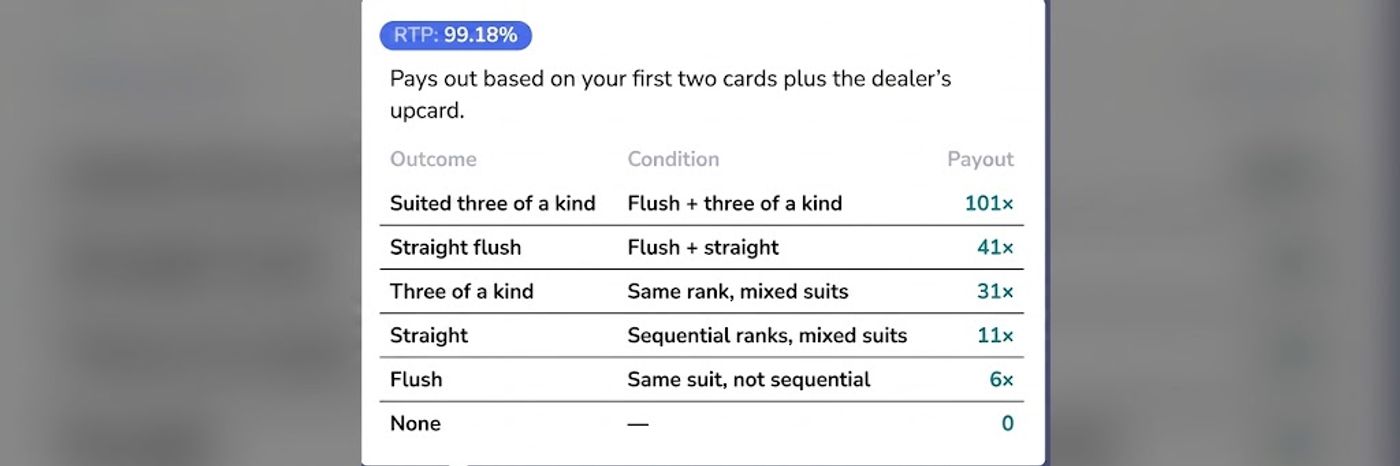
The takeaway isn't that side bets are a trap, Plus Three's stated RTP is actually close to the main game's. It's that each of these numbers is different, they're all real and Flush-published, and mixing side bets into your session changes your overall bankroll math in a way flat betting on the main hand alone does not. Know which RTP you're actually playing before you add a side wager.
Bankroll math: flat staking and unit sizing
Blackjack's relatively low house edge makes it a poor fit for aggressive betting systems, and a good fit for simple, boring bankroll management. Pick a session bankroll you're fully prepared to lose, then size each bet as a small, fixed fraction of it, commonly cited ranges are 1% to 2% per hand for a session meant to last a reasonable number of rounds. At 2% per hand, a $100 bankroll means $2 flat bets; at 1%, $1 flat bets. This isn't a formula for winning, it's a way to survive ordinary variance long enough for the stated RTP to have a chance to play out over volume, rather than being wiped out by a short losing streak on oversized bets.
Doubling systems (bet $1, then $2, then $4 after each loss to recover with one win) are worth naming specifically because they're common and they fail for a structural reason, not a bad-luck reason: any finite bankroll or table limit eventually meets a losing streak long enough to break the progression, and the underlying house edge on each individual hand never changes no matter how the bet size grows. Flat staking doesn't remove the house edge either, but it doesn't compound your losses when variance runs against you.
Common Bitcoin Blackjack mistakes
Standing on soft hands too early. A soft 17 or 18 (an ace plus 6 or 7) usually benefits from at least one more card, since a low card only improves the hand and a high card just converts the ace back to a 1.
Taking insurance as a habit rather than a deliberate side bet. It's easy to click reflexively whenever the dealer shows an ace; treat it as a separate wager with its own math, not a hedge on your main hand.
Ignoring that the dealer stands on soft 17 when deciding your own soft-hand plays. Some blackjack advice online assumes a dealer who hits soft 17, which shifts a handful of correct decisions; Flush's dealer rules are stated plainly in the in-game Game Info panel, so check them for the exact table you're playing.
Splitting pairs that basic strategy says to keep together, most commonly a pair of 10-value cards. A hard 20 is already a strong hand; splitting it into two separate hands starting from 10 each is usually a downgrade.
Chasing losses with bet increases instead of sticking to a flat unit size, for the same structural reason doubling systems fail above.
How to use this at Flush
Flush's Blackjack table sits at flush.com/p/flush-originals/blackjack, alongside the rest of the Originals catalogue at flush.com/originals. Before you play for real stakes, open the gear menu inside the game and check Game Info for the exact RTP and rule set live at the time (these can be revisited by Flush), and open the Fairness panel to see your active client seed, the hashed server seed, and the bet counter functioning as your nonce. Rotate your seed pair whenever you want a fresh, independently verifiable deck sequence, and use the Verify tab or the linked Provably Fair Document if you want to check a specific round's outcome after the fact.
Responsible Gambling
Basic strategy and disciplined bankroll sizing reduce variance and keep your results closer to Flush's stated RTP over time. Neither changes the fact that blackjack, like every casino game, carries a built-in house edge, and no combination of correct decisions guarantees a win in any individual session. Set a loss limit before you sit down, treat it as a hard stop, and step away if the game stops being fun. If gambling is causing you stress, financial strain, or is affecting your relationships or wellbeing, support is available around the clock: GamCare (0808 8020 133), BeGambleAware (0808 8020 133), the National Council on Problem Gambling (1-800-GAMBLER), and Gambling Therapy all offer free, confidential help.
How We Researched This
Methodology
This guide is built from Flush's own Blackjack game page and its Game Info panel, both read directly: the title states 98% RTP, the panel states 99.43% with the full dealer and payout rules (blackjack pays 3:2, insurance 2:1, dealer stands soft 17, continuously shuffled deck). The Pairs (94.23%) and Plus Three (99.18%) side bet paytables were read from their in-game tooltips. The Fairness panel confirmed the client seed, hashed server seed, and bet-counter mechanism. Basic strategy guidance follows standard expected-value math for this exact rule set. Confirmed live on flush.com in August 2026.
What To Know
Key Benefits
- Flush states two RTP figures for this game directly (98% headline, 99.43% for optimal play), giving a clearer picture than a single rounded number.
- Favorable dealer rules (stands on soft 17, peeks for blackjack before you can double or split into a loss) are stated plainly in the in-game Game Info panel.
- Side bet RTPs (Pairs 94.23%, Plus Three 99.18%) are published separately, so you can see exactly how they compare to the main hand before adding one.
- Provably Fair round data lets you independently confirm a deck wasn't altered after the fact, addressing a specific worry players have about house-banked card games.
- An infinite, continuously reshuffled deck means basic strategy alone determines your edge; there is no shoe composition to track across hands.
Things To Watch
- Basic strategy narrows the gap toward Flush's stated 99.43% figure; it does not convert the game's built-in house edge into a player edge.
- Insurance and side bets carry their own, generally lower, RTP than the main hand and should be budgeted separately, not treated as a hedge.
- The 291,705.86 USD maximum exposure per round is a payout ceiling, not a strategy input; it only matters at very large stakes.
- Split aces cannot be hit again after splitting, which changes the math on that specific decision compared to some other blackjack rule sets.
Glossary
Key Terms
| Term | Definition |
|---|---|
| Basic strategy | The fixed set of mathematically correct player decisions for every hand-versus-upcard combination in blackjack. |
| Blackjack (hand) | A two-card hand totaling 21, made from an ace and a 10-value card, paid at 3:2. |
| Bankroll | The total amount of funds set aside for a gambling session, used to size individual bets. |
| Client seed | A value the player controls and can rotate, combined with the server seed to generate provably fair outcomes. |
| Dealer upcard | The dealer's one face-up card, visible before the player acts. |
| Double down | Doubling the original bet in exchange for exactly one additional card. |
| Flat staking | Betting the same fixed unit size on every hand rather than adjusting it based on wins or losses. |
| Hard hand | A hand without an ace, or with an ace that can only count as 1. |
| House edge | The statistical advantage built into a casino game, expressed as the inverse of RTP. |
| Nonce | A counter, tracked on Flush as the total bets made with a seed pair, combined with the seeds to make every round's outcome unique. |
| RTP | Return to Player: the theoretical percentage of wagered funds a game returns to players over time. |
| Server seed | A value generated by Flush and initially shown only in hashed form, revealed in full after rotation for independent verification. |
| Soft hand | A hand containing an ace counted as 11. |
| Split | Dividing a starting pair into two separate hands, each requiring its own additional bet. |
| Stand | Ending your turn and keeping your current hand total. |
Why Trust This Guide
Flush Provably Fair System. Founded 2022, an in-house cryptographic fairness framework at flush.com. Publishes the hash-commit-reveal mechanism (client seed, server seed, nonce) used to generate every Flush Originals round and provides the seed data players need to verify a result independently. Reference: flush.com/fairness/ technical explainer.
FAQ
Frequently Asked Questions
Does basic strategy guarantee a winning session at Blackjack?
Why does Flush show 98% RTP in one place and 99.43% in another?
Is Flush's Blackjack the same as a live-dealer blackjack table?
Should I take insurance when the dealer shows an ace?
How much worse is the RTP on Pairs and Plus Three compared to the main hand?
How do I verify that a Blackjack round wasn't manipulated?
Sources
- Flush Provably Fair explainer — accessedAugust 26, 2026
- GamCare — accessedAugust 26, 2026
- BeGambleAware — accessedAugust 26, 2026
- NCPG (1-800-GAMBLER) — accessedAugust 26, 2026
- Gambling Therapy — accessedAugust 26, 2026

Share This Post
Share this post for your chance to win!
Related Posts
Level up your knowledge

USDT Gambling: Which Network to Use and Why It Matters
USDT keeps your casino balance's dollar value flat, but which network you send it over changes your speed and fee dramatically. Here is what actually matters.
5 min read
TRON Gambling: How to Gamble With TRX
TRX settles in seconds for a fraction of a cent, the same network many USDT deposits already use. Here is what actually matters when gambling with TRX directly.
5 min read

Best Crypto Sports Betting: A Complete 2026 Guide
Crypto sports betting means funding a sportsbook with BTC, ETH, or a stablecoin instead of a card. Here is how it actually works, and how Flush's own sportsbook applies it.
5 min read