August 29, 2026 • 5 min read

Hilo Strategy: Card Odds & Streak Multiplier 2026
Quick Answer
Hilo strategy on Flush means knowing every prediction is priced at the same 98% RTP, matching the title and the Game Info panel, whether the odds are a near-certain 92% or a coin-flip 50%. The real decision is how long to let a streak run before cashing out.
You must be 18+ to access this content. Please gamble responsibly.
Key Facts
| Game | Hilo on the Flush Originals catalogue |
| Mechanic | Predict whether the next card outranks, undercuts, or matches the current one; correct calls compound a streak multiplier, one miss resets it |
| Page title RTP | 98%, stated directly with no Max Win multiplier shown |
| Game Info panel RTP | 98%, matching the title exactly, the third game in the batch confirmed with no discrepancy |
| Card ranking | 13 equally likely ranks, Ace lowest through King highest; a matched rank counts as a win for both directions except at the two boundary cards |
| Boundary rule | From an Ace only Higher counts as a win; from a King only Lower counts as a win, since nothing exists past either end |
| Verified mechanic | The 98% house-edge factor is applied once to a streak's compounded fair odds, not separately to each round, confirmed by hand against two consecutive live predictions |
| Fairness model | Provably Fair: client seed plus hashed server seed plus a bet-count nonce, revealed after each round |
Hilo Strategy: Card Odds and the Streak Multiplier Explained 2026
Flush's Hilo page states 98% RTP in its title, and the in-game Game Info panel states the same 98%. No discrepancy here, unlike several other Originals games. What actually needs explaining about Hilo isn't a hidden number, it's a hidden mechanic: the odds change on every single card, your win multiplier compounds across a streak, and Flush's house edge isn't applied the way most players assume. Verifying it by hand shows the 2% edge is charged once, against your entire streak's fair odds, not chipped away card by card. That distinction matters for how you should think about cashing out.
What Hilo is and how a round works
You start with a reference card and predict whether the next card drawn will be higher or lower than it, using a standard ranking where Ace counts as the lowest card and King as the highest. Get it right and your win multiplier grows; you can then cash out immediately or keep predicting to grow it further. Get it wrong even once and the entire streak is forfeited, multiplier and all, back to zero. There's also a "Skip Card" option that swaps in a new reference card without placing a bet, useful when the current card offers odds you don't want to take.
Flush's Game Info panel adds one rule that matters more than it looks: "If the same card is drawn again, both 'higher' and 'lower' choices are considered wins." In practice this shows up directly in the interface: for any card that isn't an Ace or a King, your two options are literally labeled "Higher or Same" and "Lower or Same," not just "Higher" and "Lower." A tie doesn't push your bet back, it counts as a win for whichever direction you picked. The two exceptions are the boundary cards: from an Ace, only Higher counts as a win, because nothing is lower than an Ace; from a King, only Lower counts as a win, for the same reason in reverse.
The exact odds behind every prediction
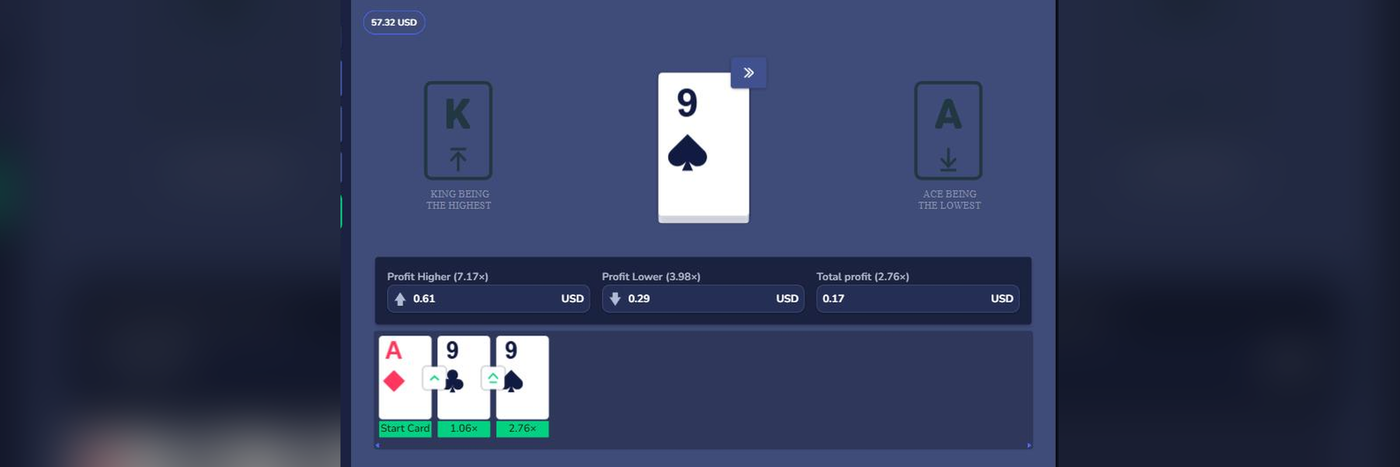
Hilo draws from a standard 13-rank ranking (Ace low through King high), and each next card is equally likely to be any of the 13 ranks. That makes the odds fully calculable for any reference card. From an Ace, Higher wins on any of the 12 higher ranks, a 12 in 13 chance, which Flush's own interface displayed as exactly 92.31% during testing. From a 9, a mid-table card, Higher-or-Same wins on the 4 ranks above 9 plus the 9 itself, 5 outcomes out of 13, which showed as exactly 38.46%; Lower-or-Same wins on the 8 ranks below plus the 9 itself, 9 outcomes out of 13, shown as exactly 69.23%. Both figures matched the interface to the decimal. The pattern holds for any reference card: count how many of the 13 ranks satisfy your bet, including a tie, and divide by 13.
This is also why Hilo strategy is really about card selection more than prediction skill: a reference card near the middle of the range (6 through 9) gives you two roughly balanced options, while a reference card near either end gives you one very safe, low-payout option and effectively no good alternative. There's no version of this game where guessing correctly is a skill; the only decision that matters is whether the odds on offer are worth the multiplier being paid.
How Flush prices each prediction, and how the streak multiplier actually compounds
Every prediction that isn't the boundary case pays out at close to fair odds, the reciprocal of your winning probability, minus Flush's edge. From the Ace, Higher's fair multiplier (no house edge) would be 13 divided by 12, or 1.0833x; Flush's interface showed 1.06x. Multiply 1.0833 by 0.98 and you get 1.0617, which rounds to the displayed 1.06x almost exactly, confirming the 98% RTP applies directly to that single prediction.
The more useful finding is what happens across a streak. After that first correct guess (cumulative multiplier 1.06x), a second prediction from a 9 using Higher-or-Same (win probability 5 in 13) showed a cumulative multiplier of 2.76x, not the 2.71x you'd get by applying a fresh 0.98 discount to that round on top of the already-discounted 1.06x. The number that actually reproduces 2.76x is this: multiply the two rounds' fair odds together first (13/12 times 13/5, which is 169/60, or 2.8167), and apply the 0.98 house-edge factor only once, to that combined figure. 2.8167 times 0.98 is 2.760, matching the interface exactly. The same check works for the Lower-or-Same option shown at the same point (cumulative fair odds of 13/12 times 13/9, or 1.5648, times 0.98, equals 1.5335, matching the displayed 1.53x). Flush's Hilo charges its 2% house edge once, against the compounded fair odds of your whole streak, rather than shaving a little off of each individual card. Functionally this means a longer streak isn't taxed any harder, round for round, than a short one; the same flat 98% applies to the entire chain of correct predictions at once.
What 98% RTP means over a full session
Across many streaks, wagering $100 total and cashing out (or busting) at various points, the expected return is $98, a $2 expected cost. That figure holds regardless of how long you tend to let streaks run or how conservative your card choices are, since every individual prediction is priced at the same 98% and the house edge doesn't compound worse the longer a streak goes. What does change with streak length is variance: a strategy of cashing out after one or two correct predictions produces a steadier, lower-swing result than pushing a streak to five or six correct calls in a row, where a single wrong guess erases the whole thing.
How a Hilo round is actually generated
The same Provably Fair system used across every Flush Original decides each card draw here too. Flush commits to a server seed before you bet, shown only in hashed form, paired with a client seed you control and can rotate at any time. A running count of total bets made with that seed pair acts as the nonce. Together, the server seed, client seed, and nonce fix every card in a streak before you place a single prediction. After you rotate to a new seed pair, Flush reveals the previous server seed in full, letting you recompute any past streak using the Verify tab or the linked Provably Fair Document.
The cash-out decision: why cashing out early doesn't change your average return
Because the 98% RTP applies uniformly whether you cash out after one correct card or ride a streak for ten, there's no version of "cash out early" or "let it ride" that changes your long-run expected return. What changes is the shape of your outcomes: cashing out after each win locks in smaller, more frequent profits with almost no chance of losing everything you've built up in that streak, while continuing exposes your entire accumulated multiplier to the next single card. Neither approach beats the other on average, and no pattern of when to stop improves the 98% baked into every individual prediction. The choice comes down to how much variance you want in your session, not a search for better odds.
How likely a long streak actually is
Because the win probability changes with every card, there's no single number for "the odds of a 5-card streak," but a worked example makes the shape of the risk concrete. Starting from a mid-table card and repeatedly choosing the safer of the two available options each time (typically somewhere in the 55% to 70% range depending on exactly where the new reference card lands) still means each additional correct call is an independent roll. Five correct calls in a row at a representative 60% each works out to roughly 0.6 raised to the fifth power, about 7.8%, meaning over 9 times out of 10 a streak like that ends before the fifth card. Push for ten correct calls at the same 60% each and the odds fall to well under 1%. None of this means the game is against you beyond its stated 2% edge, every individual card is still priced fairly relative to its own odds, but it does mean the multiplier displayed mid-streak is easy to overweight relative to how likely you actually are to keep it.
How Hilo compares to the rest of the Originals catalogue
Hilo's 98% RTP puts it in the middle of the pack of Originals games verified so far. Blackjack, played with correct basic strategy, tops the list at about 99.43%. Baccarat's Banker bet comes next at 98.94%, with Player close behind at 98.77%. Hilo's flat 98% sits just below both, ahead of single-zero Roulette (97.3%) and well ahead of double-zero Roulette (94.74%) and Baccarat's Tie bet (85.64%). What sets Hilo apart from every other game in that lineup is that its RTP doesn't depend on picking a specific bet type the way Baccarat's three bets or Blackjack's side bets do; every prediction on every card is priced at the same 98%, regardless of how favorable or risky the odds on that particular card happen to be. The only real lever in Hilo is how long you choose to let a streak run, a variance decision rather than an edge decision, similar in spirit to picking a bet type on Roulette but expressed through time rather than through a choice of wager.
Bankroll math: sizing for a streak-based game
Set a session bankroll you're fully prepared to lose, and size each new streak's opening bet as a small, fixed fraction of it, commonly 1% to 2%, the same guidance as any fixed-edge game. Hilo's particular risk is that a single wrong guess forfeits an entire streak's accumulated multiplier at once, which can make a long winning run feel larger than it is right up until it isn't; treat an unrealized streak multiplier as a paper gain, not a locked-in one, when deciding how much of your session bankroll it represents. Flush's panel also notes that as winnings approach the game's maximum limit, some bet options may be restricted or a cash-out forced, worth knowing if you're chasing an unusually long streak with sizable stakes.
Common Hilo mistakes
Treating a long streak as "safer" the further it goes, when the opposite is true: each additional correct prediction still needs to clear the same odds as before, and a single miss erases everything built up, regardless of length.
Choosing Higher or Lower from a near-boundary card (a 2 or a Queen, for instance) without registering how lopsided the odds are; the safer side of that bet pays very little precisely because it's very likely to hit.
Assuming a "hot" or "cold" pattern in recent card draws affects the next one. Every card is generated independently by the same seed-based Provably Fair system used across every Flush Original; nothing about a prior draw changes the odds of the next one.
Confusing "safer" with "better expected value." Every individual prediction Flush offers is priced at the same 98% RTP regardless of its win probability; a 92% chance at 1.06x and a 38% chance at 2.76x from the same reference card carry the same house edge, just different variance.
Letting an unrealized multiplier influence stake sizing on future streaks. A big number sitting mid-streak is still just a paper figure until you cash out; it shouldn't change how you size the next round's bet.
How to use this at Flush
Hilo sits at flush.com/p/flush-originals/hilo, alongside the rest of the Originals catalogue at flush.com/originals. Set your stake before starting a streak, watch the displayed win percentage for each option before committing, and use Skip Card if the reference card leaves you without odds you're willing to take. Open the Fairness panel any time to check your active client seed and hashed server seed, and rotate your seed pair periodically for a fresh, independently verifiable set of draws.
Responsible Gambling
Choosing when to cash out changes the shape of your results, not the 98% RTP built into every prediction. No streak length or card-selection habit removes the house edge or guarantees a winning session. Set a loss limit before you start playing, treat it as a hard stop, and step away if the game stops being fun. If gambling is causing you stress, financial strain, or is affecting your relationships or wellbeing, support is available around the clock: GamCare (0808 8020 133), BeGambleAware (0808 8020 133), the National Council on Problem Gambling (1-800-GAMBLER), and Gambling Therapy all offer free, confidential help.
How We Researched This
Methodology
This guide is built from Flush's own Hilo game page and its Game Info panel: both state 98% RTP, and the panel spells out the same-card-wins rule and its Ace/King boundary exceptions. Two live predictions were checked by hand against the 13-equally-likely-ranks model, matching displayed win chances exactly (92.31%, 38.46%, 69.23%). The cumulative multiplier matched a model applying the house edge once to the whole streak's compounded odds, not per round, reproducing the displayed 1.06x and 2.76x exactly. Confirmed live on flush.com, August 2026.
What To Know
Key Benefits
- The 98% RTP is confirmed identically in both the page title and the Game Info panel, with no discrepancy to account for.
- The exact win probability for any prediction is calculable by hand (count of favorable ranks out of 13), and was confirmed to match Flush's own displayed percentages exactly.
- The house-edge mechanic across a streak was independently verified: Flush applies its 2% edge once to the compounded fair odds of the whole streak, not separately to each card.
- Every prediction, regardless of its win probability, carries the same 98% RTP, so there is no bet-selection decision with a mathematically right answer, only a variance decision.
- Provably Fair round data lets you independently confirm any streak's card sequence wasn't adjusted after the fact.
Things To Watch
- A single incorrect prediction forfeits the entire streak's accumulated multiplier at once, unlike games where losses are capped to a single round's stake.
- Near-boundary cards (a 2 or a Queen, for example) offer very lopsided odds where the safer side pays very little.
- Flush may restrict bet options or force a cash-out as winnings approach the game's maximum limit.
- Cashing out early versus letting a streak ride changes the variance of a session, not its long-run expected return; neither approach improves on the flat 98% RTP.
Glossary
Key Terms
| Term | Definition |
|---|---|
| Bankroll | The total amount of funds set aside for a gambling session, used to size individual bets. |
| Boundary card | Ace (lowest) or King (highest), the two ranks where only one prediction direction is available since nothing is lower than an Ace or higher than a King. |
| Cash out | Ending a Hilo streak voluntarily to lock in the current multiplier's winnings, as opposed to continuing and risking it on another card. |
| Flat staking | Betting the same fixed unit size on every new streak rather than adjusting it based on wins or losses. |
| Higher or Same | The bet option that wins if the next card outranks the current one or matches it exactly, available on any non-boundary card. |
| House edge | The statistical advantage built into a casino game, expressed as the inverse of RTP. |
| Lower or Same | The bet option that wins if the next card ranks below the current one or matches it exactly, available on any non-boundary card. |
| Nonce | A counter, tracked on Flush as the total bets made with a seed pair, combined with the seeds to make every round's outcome unique. |
| Provably fair | A verification system letting players independently confirm a round's outcome was generated from the seed commitment published before play. |
| RTP | Return to Player: the theoretical percentage of wagered funds a game returns to players over time. |
| Skip Card | An option that swaps in a new reference card without placing a bet, used when the current card's odds aren't worth taking. |
| Streak | A sequence of consecutive correct predictions in Hilo; a single wrong guess forfeits the entire streak's accumulated multiplier. |
| Client seed | A value the player controls and can rotate, combined with the server seed to generate provably fair outcomes. |
| Server seed | A value generated by Flush and initially shown only in hashed form, revealed in full after rotation for independent verification. |
| Win multiplier | The cumulative payout multiplier attached to a Hilo streak, which compounds with each correct prediction and resets to zero on a miss. |
Why Trust This Guide
Flush Provably Fair System. Founded 2022, an in-house cryptographic fairness framework at flush.com. Publishes the hash-commit-reveal mechanism (client seed, server seed, nonce) used to generate every Flush Originals round and provides the seed data players need to verify a result independently. Reference: flush.com/fairness/ technical explainer.
FAQ
Frequently Asked Questions
Why does the win percentage change on every card in Hilo?
What happens if the next card matches the current one exactly?
Does letting a streak run longer lower my odds on each card?
Is it better to cash out after every win or let the streak ride?
Does a run of high or low cards make the next draw more predictable?
How do I verify a Hilo streak was fair?
Sources
- Flush Provably Fair explainer — accessedAugust 26, 2026
- GamCare — accessedAugust 26, 2026
- BeGambleAware — accessedAugust 26, 2026
- NCPG (1-800-GAMBLER) — accessedAugust 26, 2026
- Gambling Therapy — accessedAugust 26, 2026

Share This Post
Share this post for your chance to win!
Related Posts
Level up your knowledge

USDT Gambling: Which Network to Use and Why It Matters
USDT keeps your casino balance's dollar value flat, but which network you send it over changes your speed and fee dramatically. Here is what actually matters.
5 min read

TRON Gambling: How to Gamble With TRX
TRX settles in seconds for a fraction of a cent, the same network many USDT deposits already use. Here is what actually matters when gambling with TRX directly.
5 min read

Best Crypto Sports Betting: A Complete 2026 Guide
Crypto sports betting means funding a sportsbook with BTC, ETH, or a stablecoin instead of a card. Here is how it actually works, and how Flush's own sportsbook applies it.
5 min read