August 10, 2026 • 5 min read

Is Crypto Dead? Reality Check
Quick Answer
No, crypto is not dead. Total market cap sits above $2.52 trillion in 2026, institutional adoption keeps growing through ETFs and stablecoins, and every past drawdown that triggered dead crypto headlines was eventually followed by a recovery to new highs.
You must be 18+ to access this content. Please gamble responsibly.
Key Facts
| Total crypto market cap | Above $2.52 trillion as of 2026 |
| Bitcoin all time high | Roughly $126,000, early October 2025 |
| Bitcoin price, early August 2026 | Roughly $63,000 to $65,000 |
| Spot Bitcoin ETF assets under management | Roughly $80.8 billion |
| Institutional adoption | Roughly 86% of institutional investors hold or plan to hold digital assets (State Street survey) |
| Combined stablecoin market cap | Above $310 billion |
| Stablecoin growth forecast | Roughly 30% to 40% compound annual growth rate |
| Bitcoin drawdowns over 50% | At least six in its history, each followed by a recovery to new highs |
No, crypto is not dead. Total crypto market capitalization sits above $2.52 trillion in 2026, bitcoin has set a new all time high within the past year, and institutional money keeps flowing in through spot ETFs and corporate balance sheets. What has actually happened is more boring than a death: crypto went through another one of its brutal drawdowns, prices are well off their peak right now, and the same people who called it dead in 2018 and again in 2022 are saying it again, on schedule.
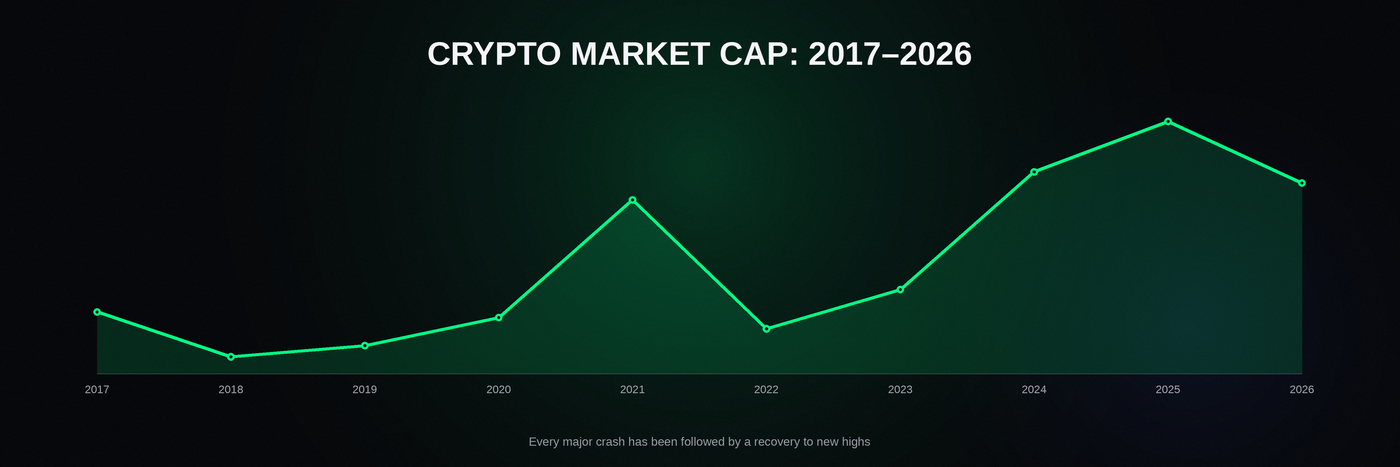
That said, is crypto dead is a fair question to keep asking, not a lazy one. Real projects have failed, real exchanges have collapsed, and real people have lost real money trusting bad actors in this space. A healthy amount of skepticism is warranted every cycle. The distinction this guide draws is between that legitimate skepticism and the recurring, factually inaccurate claim that the entire asset class has stopped functioning, which the data below simply does not support right now.
Where the Crypto Is Dead Narrative Comes From
Financial media has declared bitcoin or crypto broadly dead dozens of times since 2011, usually within days of a sharp price drop. The pattern is consistent enough to set a clock by: price falls 50 percent or more, headlines call it the end, then price recovers over the following year or two and sets a new high, and the cycle repeats. That does not mean every crash is automatically nothing to worry about, real money gets wiped out in every one of these drawdowns and some individual projects genuinely do go to zero. But conflating a cyclical price crash with the death of an entire asset class that now settles trillions of dollars in value has been wrong every single time it has been said so far, which is worth remembering the next time a headline says it with total confidence.
What the Market Actually Looks Like Right Now
Bitcoin hit its current all time high near $126,000 in early October 2025, then corrected sharply, trading around $63,000 to $65,000 as of early August 2026, roughly half of that peak. That kind of drawdown feels brutal if you bought near the top, and it is exactly the kind of move that generates dead crypto headlines every single cycle. But zoom out and the picture looks different: even at $63,000 to $65,000, bitcoin sits only modestly below its 2021 cycle peak of roughly $69,000, and far above the 2017 peak near $20,000. For the full price history behind these numbers, see our bitcoin all time high breakdown. A market that keeps setting higher highs across each multi year cycle, even while getting cut in half in between, does not match most people's definition of dead.
Institutional Money Has Changed the Picture
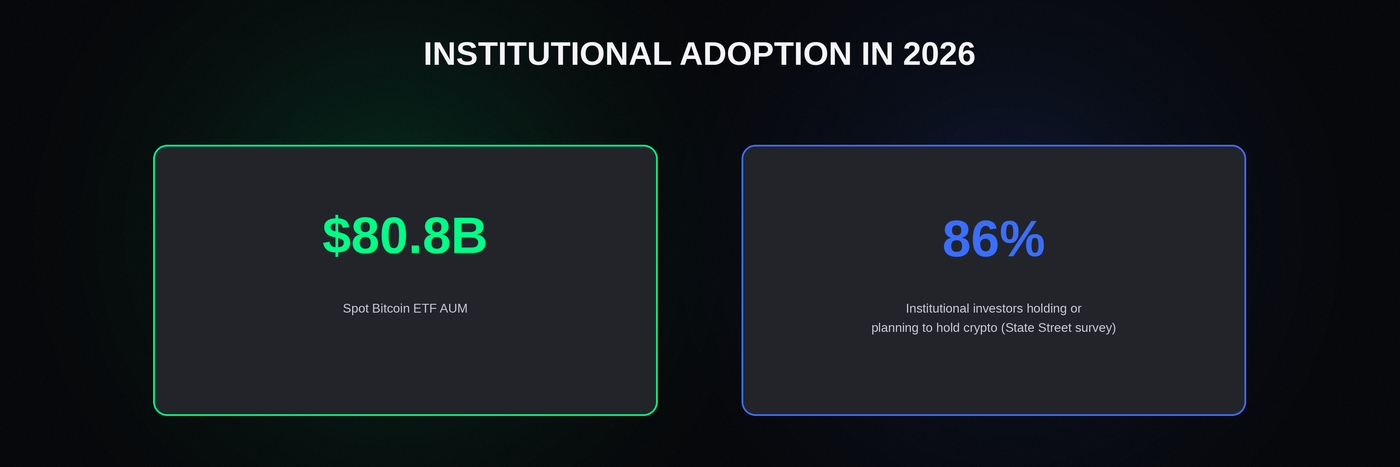
The 2026 version of crypto looks structurally different from the retail-driven speculation of 2017 or even 2021. Spot bitcoin ETFs, approved in the US starting January 2024, have accumulated somewhere around $80.8 billion in assets, giving ordinary brokerage account holders exposure without ever touching a crypto exchange. Survey data from State Street found roughly 86 percent of institutional investors either already hold digital assets or plan to add them, a number that would have been unthinkable a decade ago when most banks treated crypto as a reputational risk to avoid entirely. Corporate treasuries holding bitcoin as a balance sheet asset, once a novelty associated with a handful of outlier companies, has become a mainstream enough practice that it barely makes headlines anymore. None of this makes crypto immune to crashing, institutional money sells during downturns too, but it does mean there is a much deeper, stickier pool of capital anchoring the market than existed in any previous cycle.
Stablecoins Are the Quiet Growth Story
While price charts get all the attention, the more telling growth number in 2026 might be stablecoins, tokens like USDT and USDC that hold a steady one dollar value instead of floating with the market. Combined stablecoin market cap has pushed past $310 billion, and multiple analysts project 30 to 40 percent compound annual growth from here as more payment volume, remittances, and everyday transactions move onto crypto rails specifically because stablecoins remove the price volatility that scares off mainstream users. That is a genuinely different kind of adoption than a speculative price rally, it is people actually using crypto infrastructure to move money, which is a much harder trend to fake or hype into existence. Players who want to hold a stable balance while gaming rather than ride bitcoin's swings can already do that through stablecoin deposits at platforms like Flush.
What Would Actually Have to Happen for Crypto to Die
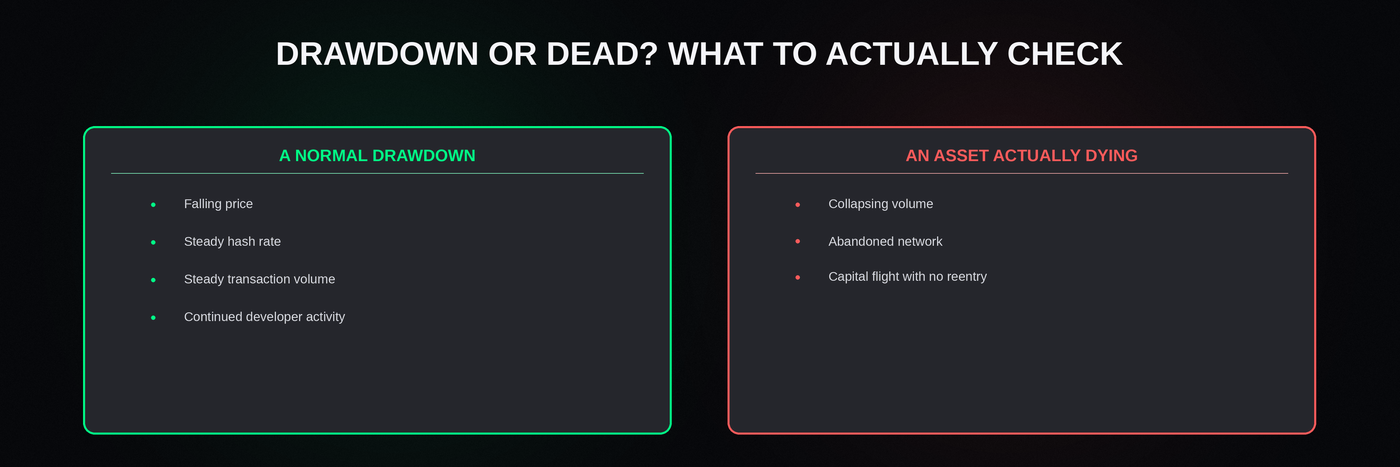
It's worth being precise about what dead would actually mean, because the word gets thrown around loosely. A genuinely dead asset class would need trading volume to collapse toward zero, the underlying networks to stop processing transactions, developers to abandon the software, and the capital currently parked in ETFs and corporate treasuries to exit entirely with nowhere else in crypto to go. None of that is happening. Bitcoin's network hash rate keeps climbing, meaning more computing power is securing the chain than ever before, transaction volume across major chains remains substantial, and new capital keeps entering even during the current drawdown. A price correction, even a severe one, is a completely different event from an asset class ceasing to function, and treating the two as interchangeable is where most dead crypto takes go wrong.
The Difference Between a Drawdown and Dying
Bitcoin has fallen more than 50 percent from a cycle peak on at least six separate occasions across its history, and every single time, the same drawdown that generated dead crypto headlines was eventually followed by a recovery and a new high, sometimes taking a year, sometimes taking closer to three. That track record is not a guarantee about what happens next, past cycles do not promise future ones will repeat, but it is a useful reality check against treating the current price sitting roughly half of October 2025's peak as evidence the whole asset class is finished. We cover what a specific drop actually does to the market and to crypto casino activity in more detail in our bitcoin price drop analysis.
Crypto Beyond Speculation: What Else Is Actually Being Built
Price is the easiest thing to headline, but it's a narrow slice of what's actually happening in crypto by 2026. Cross border remittances increasingly route through stablecoins because settlement takes minutes instead of the days a traditional wire transfer takes, at a fraction of the fee. Tokenized versions of traditional assets, from money market funds to real estate shares, have moved from concept to actual products offered by mainstream financial institutions. Decentralized applications process meaningful transaction volume independent of whether bitcoin's price is up or down that week. None of this gets the same attention as a price chart, since infrastructure adoption is inherently less dramatic than a 50 percent crash, but it's a better long term signal of whether an asset class is actually dying or just going through a rough quarter. An industry quietly building payment rails and financial products while everyone argues about the price chart doesn't look like one on its way out.
So Is Crypto Dead? What This Actually Means for You
If you're asking because you're deciding whether to hold, buy, or spend crypto you already own, the honest answer is that volatility is not going away, and anyone telling you otherwise is selling something. Crypto in 2026 is simultaneously more institutionally embedded than at any point in its history and still capable of losing half its value in a matter of months, both things are true at once. What it is not, by any reasonable reading of market cap, network activity, or capital flows, is dead. Whether you engage with it through investing, spending, or playing at a crypto casino, treat the volatility as real and budget for it accordingly rather than assuming either permanent doom or a guaranteed recovery.
Responsible Gambling
If tracking crypto prices or news makes you want to increase your exposure to the market, whether through investing or gambling, keep it within a budget you set in advance. Flush's responsible gambling tools include deposit limits, session timers, and self-exclusion, all adjustable directly from your account. Free, confidential support is available around the clock from GamCare (0808 8020 133) and BeGambleAware in the UK, and the National Council on Problem Gambling (1-800-GAMBLER) in the US, or via Gambling Therapy globally.
Crypto's obituary keeps getting written and keeps turning out to be premature. If you'd rather put the market's volatility to work through gameplay than just watch a portfolio chart, deposit and play at Flush's casino, where withdrawals process in minutes and every Originals round is independently verifiable.
How We Researched This
Methodology
This guide was researched via live web search on August 10, 2026, covering current total crypto market capitalization, spot Bitcoin ETF assets under management, institutional adoption survey data, and stablecoin market cap and growth projections. Price and market cap figures are snapshots that change daily and were cross-referenced against Flush's own published bitcoin price history article for internal consistency. Historical claims about past dead crypto declarations reflect well documented, widely reported market cycles rather than any single disputed source.
FAQ
Frequently Asked Questions
Is crypto dead in 2026?
Why do people keep saying crypto is dead?
What is crypto's total market cap right now?
Are institutions actually buying crypto in 2026?
Could crypto ever actually die?

Share This Post
Share this post for your chance to win!
Related Posts
Level up your knowledge

What Is the Highest Bitcoin Has Ever Been? ATH History
Bitcoin's all time high sits around $126,000, set in early October 2025. Here's the full timeline of its major peaks, and where the price stands now.
5 min read
Bitcoin Price Drop 2026: What It Means for Crypto Casinos
Bitcoin fell to a 21-month low in July 2026 after record ETF outflows. Here's what the drop means for crypto casino deposits, bankrolls, and withdrawal timing.
5 min read

Fear & Greed Index 2026: A Week of Market Fear
The Crypto Fear & Greed Index has held between 22 and 28 for over a week, deep in Fear to Extreme Fear territory. Here's what the mood gauge means for crypto casino bankroll management, not price direction.
5 min read