July 19, 2026 • 5 min read

Provably Fair Bitcoin Games: Which Types You Can Verify 2026
Quick Answer
Provably fair covers all 18 games in Flush's Originals catalogue, including Crash, Dice, Mines, Plinko, and Keno, using a hashed server seed, a client seed, and a nonce to generate each result. Slots and live tables run on separately audited RNG instead.
You must be 18+ to access this content. Please gamble responsibly.
Key Facts
| Total Originals games | 18, confirmed via the live Originals lobby: Plinko, Dice, Blackjack, Cross the Road, Mines, Limbo, Baccarat, Keno, Dragon Tower, Crash, Coin Flip, Diamonds, Roulette, Cross the Lake, Slider, Video Poker, Hilo, Wheel |
| Game types walked through here | Crash, Dice, Mines, Plinko, and Keno, as representative mechanical types |
| Fairness model | Client seed plus hashed server seed plus nonce, revealed after each round |
| What gets verified | Depends on game type: a single number, a multiplier curve, a full grid, a drop path, or a drawn set |
| Hash mechanism | A one-way cryptographic hash function locks the server seed before play |
| Scope at Flush | Provably fair applies to Originals; slots and live tables run on audited RNG with visible RTP |
| What you need to verify a round | Client seed, revealed server seed, nonce, and a hash calculator or the game's own verifier |
| RG tools | Deposit limits, loss limits, session timers, self-exclusion |
Provably fair only applies to certain kinds of casino games, and knowing which ones matters before you assume a result can be checked. Flush's Originals catalogue runs to 18 games in total, and every one of them uses the same underlying fairness mechanism. This guide walks through the game types where a player can independently verify a round, using Crash, Dice, Mines, Plinko, and Keno as the working examples since they represent the main mechanical patterns you will run into across the catalogue, then ends with a concrete step-by-step walkthrough you can run yourself after a single round. Provably fair proves a result was not altered after the fact. It does not prove a game is profitable, and it does not extend automatically to every game in a casino's library. Last verified July 2026.
What Provably Fair Actually Checks
For the full definition of provably fair, including why it exists and how the wider concept developed, see what provably fair actually proves. This section covers only the short version needed to understand the rest of this guide.
Every provably fair round rests on three inputs: a client seed the player controls, a server seed the operator controls, and a nonce that increases with each round. Before a round starts, the operator publishes a hashed version of the server seed, a value produced by feeding the seed through a cryptographic hash function. That value cannot practically be reversed to reveal the original seed, but it can be recomputed and compared once the real seed is disclosed. This is the hash-commit-reveal pattern: commit to a value in advance without showing it, then reveal it afterward so anyone can confirm nothing changed in between.
What changes from one game type to the next is not this underlying structure. It is what the seeds and nonce actually generate, and therefore what a player is checking when they verify a round. A single number is a much simpler thing to regenerate and compare than a full grid layout or a continuously climbing multiplier curve, which is exactly why the next section walks through each game type separately rather than treating "provably fair" as one uniform check. For the full technical breakdown of the hash math itself, see the provably fair algorithm guide, which goes deeper into the mechanics than this article needs to.
Which Game Types Are Provably Fair
Provably fair works cleanly on games where the seed pair and nonce can generate the entire outcome in one deterministic step. That description fits Originals-style games far better than it fits a physical card shoe or a live dealer's spin, which is why the game types below share a common thread: each one boils down to a value or a set of values that a hash function can produce directly.
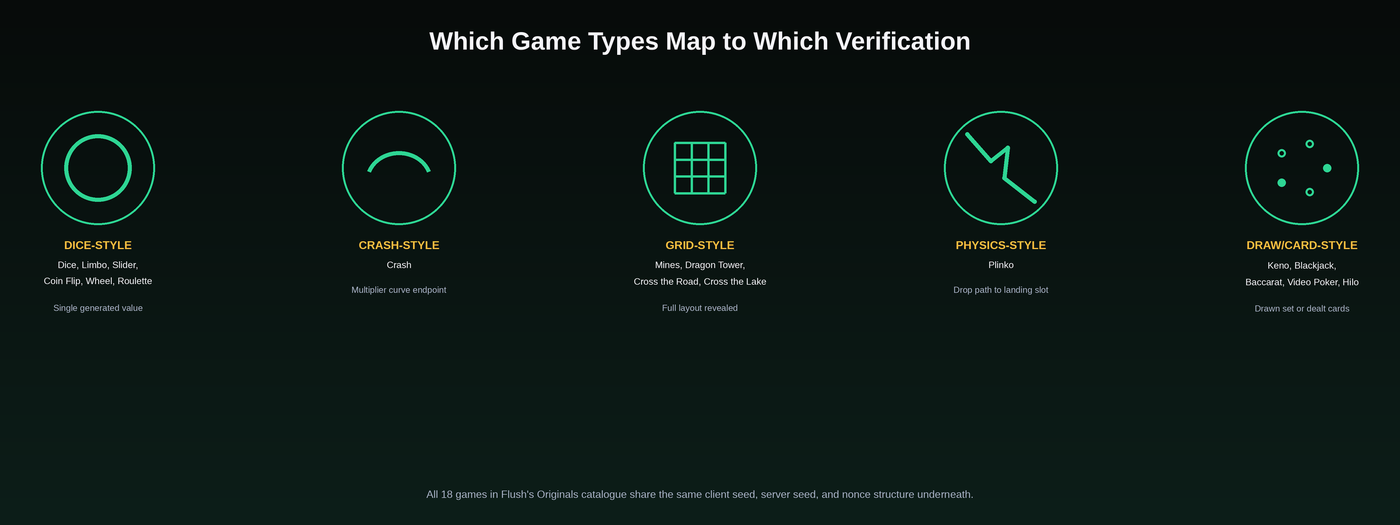
Dice-Style Games
A Dice-style round is the simplest case, and often the easiest starting point for learning to verify a result. The seeds and nonce generate a single number, typically expressed on a scale such as 0 to 100, and the player's chosen target (over, under, or a specific range) determines win or loss against that number. Because the entire outcome collapses to one figure, a Dice round is the fastest type to recompute by hand and a useful example for learning the process before applying it elsewhere. Flush's Dice game uses this exact structure, and it is the example used in the verification walkthrough below.
Crash-Style Games
A Crash-style round generates a multiplier curve rather than a single static number. The seeds and nonce determine the specific point at which the curve ends, the "crash point," before the round even begins, though that point stays hidden from players until it happens. Verifying a Crash round means recomputing that crash point from the revealed server seed, client seed, and nonce, and confirming it matches where the round actually ended. Flush's Crash game runs on this model, and the same recompute-and-compare logic applies regardless of when in the curve a player chose to cash out.
Mines and Grid-Style Games
Mines-style games generate a full grid layout rather than a single value: which tiles are safe and which conceal a mine, fixed before the first tile is ever revealed. Verifying a Mines round means recomputing the entire grid from the seed data and confirming every tile position matches what the round displayed, not just the tiles a player happened to reveal. This is a heavier calculation than Dice or Crash, but it follows the identical seed-hash-nonce structure underneath.
Plinko and Physics-Style Games
Plinko-style games generate a drop path, the specific sequence of left-right bounces a ball takes down a pegged board before landing in a payout slot. The seeds and nonce determine that entire path in advance, even though it displays as a physics-style animation. Verification means recomputing the path and confirming the final landing slot matches, rather than checking each individual bounce.
Keno and Draw-Style Games
Keno-style games generate a drawn set of numbers from a larger pool, similar in spirit to a lottery draw. The seeds and nonce determine exactly which numbers are drawn for that round, and verification means recomputing the full drawn set and confirming it matches what the round displayed, then checking that against the numbers the player selected beforehand.
Flush's Full Originals Catalogue
The five game types above cover the main mechanical patterns you will see, but Flush's Originals catalogue runs to 18 games in total: Plinko, Dice, Blackjack, Cross the Road, Mines, Limbo, Baccarat, Keno, Dragon Tower, Crash, Coin Flip, Diamonds, Roulette, Cross the Lake, Slider, Video Poker, Hilo, and Wheel. Every one of them runs on the same client-seed, server-seed, and nonce structure described in this guide, whether the result on screen is a single number, a climbing multiplier, a full grid, a drop path, a card hand, or a wheel spin. Titles like Limbo, Slider, Coin Flip, Roulette, and Wheel behave like the Dice-style case above: a single seed-generated value decides the round. Cross the Road, Cross the Lake, and Dragon Tower behave more like Mines, a progressive sequence where each step forward is generated in advance and simply revealed as you go. Blackjack, Baccarat, and Video Poker generate a full card sequence rather than a single number or grid, verified the same way: recompute the seed-derived deal and confirm it matches what you were dealt. Whichever title you play, the verification logic covered in the next section applies the same way. You can browse Mines, Plinko, and Keno directly alongside Dice and Crash to see the same fairness panel on each one.
How to Verify a Provably Fair Round Yourself
The process below uses Dice as the worked example, since a single-number result is the clearest way to see the mechanics without a grid or a curve adding extra steps. Once the pattern is clear, the same six steps apply to Crash, Mines, Plinko, and Keno rounds, only the value being recomputed changes.
Start by opening your bet history or the game's fairness panel and finding the round you want to check. Before that round was played, the game showed you a hashed server seed, a client seed, and a nonce. Write all three down exactly as displayed, since a single transcription error will produce a result that looks like a mismatch when the underlying data was actually correct.
The server seed stays hashed, and therefore unusable for verification, until you rotate to a new seed pair. Once you do, the previous server seed is revealed in full, and that is the point at which a round becomes checkable. Take the revealed server seed, your client seed, and the round's nonce, and feed all three into a hash calculator or the verifier tool built into the game itself. For a Dice round, the output is a single number on the game's stated scale. Compare that number to what the round actually showed you when you played it.
A match confirms the round was generated from data that existed before you placed the bet, and that nothing was changed afterward based on your choices. That is the entire claim provably fair makes, no more and no less. If the numbers do not match, do not assume you made an arithmetic mistake and move on. Double-check that you copied the seed and nonce values correctly, since that is the most common source of an apparent mismatch, and if a genuine discrepancy remains, raise it with support directly, since a legitimate operator retains full seed history specifically so a dispute like this can be investigated.
Provably Fair vs Plain RNG: Which of a Casino's Games Are Which
Not every game in a crypto casino's library is provably fair, and knowing the difference matters before you go looking for a verify button that will not appear. Provably fair currently applies to Flush's Originals catalogue, the games covered above. Flush's slots and live-dealer tables instead run on separately audited random number generators, with an RTP figure published per game in the lobby rather than a seed-and-nonce verification process. That split is not unique to Flush; it reflects how provably fair systems typically get built into a casino's own in-house games rather than into third-party slot titles licensed from outside studios, since the seed-and-hash mechanism has to be built directly into the game's code.
This distinction matters for what you can reasonably expect to check. RNG auditing and provably fair verification are answering different questions. An audited RNG has been tested by an independent lab to confirm its outputs are statistically random over a large sample, a check performed once, in advance, on the system as a whole. Provably fair verification is something a player does themselves, per round, after the fact, confirming that one specific result was not altered. A slot's RTP figure tells you what to expect over the long run; it does not let you personally recompute any single spin.
One further variation worth knowing about, even though it does not apply at Flush specifically: some smart-contract-based games run their logic directly on a public blockchain, which means a player can check a round's transaction on a block explorer instead of using a separate verifier tool at all. That is a stronger form of transparency in one sense, since the verification lives on a public ledger rather than a tool the operator provides, though it is a different model from the client-seed-and-server-seed structure covered in this guide.
How to Use This at Flush
All 18 games in Flush's Originals catalogue, including Crash, Dice, Mines, Plinko, and Keno, run on the hash-commit-reveal fairness model described above, with each game's own page showing the current client seed, hashed server seed, and nonce before every round. The Flush casino hosts the full library alongside these Originals, and demo mode is available on each Originals page for practicing the verification steps before staking anything real.
Deposits and withdrawals run in crypto, and none of that changes based on which games you play or whether you choose to verify a round. Rakeback, a Level Up Bonus, and periodic promotions apply across the Originals catalogue the same way they do elsewhere on the platform, separate from the fairness system covered in this guide.
Responsible Gambling
Provably fair proves a result was not tampered with. It says nothing about whether a game is profitable, and it does not change the house edge built into any Originals title. Independent research into how crypto-casino fairness claims hold up has found the same pattern repeatedly: the math checks out when a system is implemented correctly, but the house still keeps its edge, and players still lose over the long run on average, regardless of how carefully a round can be verified.
Set a bankroll and a stop-loss before a session starts, not partway through one. Flush's own responsible gambling resources include deposit limits, loss limits, session timers, and self-exclusion tools available in account settings. If gambling stops feeling like entertainment or starts affecting your finances, free and confidential support is available: GamCare (0808 8020 133 in the UK, gamcare.org.uk), BeGambleAware (same UK number, begambleaware.org), the National Council on Problem Gambling in the US (1-800-GAMBLER, ncpgambling.org), and Gambling Therapy for international support (gamblingtherapy.org). Never gamble more than you can afford to lose.
How We Researched This
Methodology
This guide is built from Flush's own Provably Fair explainer at flush.com/fairness/, cross-referenced against the live verification carried out for the mines-predictor guide in July 2026, plus independent research into how crypto-casino fairness claims are tested and reported industry-wide. Flush's Originals catalogue size was resolved on 2026-07-19 via a live screenshot of the actual Originals lobby: 18 games total. This guide names all 18 but keeps its deep, step-by-step verification coverage on five representative mechanical types (Crash, Dice, Mines, Plinko, Keno). The hash mechanism is described in general terms rather than naming a specific algorithm, since that detail was not independently confirmed live this session. No house-edge or RTP figures are invented.
What To Know
Key Benefits
- Knowing which game types are provably fair keeps you from expecting a verification feature on games that do not use one, like slots.
- A single verification method works the same way across Crash, Dice, Mines, Plinko, and Keno, since Flush Originals share one seed and hash structure.
- Recomputing a round yourself removes the need to accept a fairness claim at face value.
- Learning the hash-commit-reveal pattern once means you can apply it to any Originals-style game without relearning the process elsewhere.
- Understanding the provably fair versus RNG distinction helps you evaluate any casino's fairness claims, not just Flush's.
Things To Watch
- Provably fair proves a result was not altered after the fact. It does not prove a game is profitable or beatable long term.
- House edge applies to every provably fair game exactly as it does to any other casino game.
- Verification requires the server seed to be revealed, so a round can only be checked after it resolves, not before you place the bet.
- Not every platform's fairness claim holds up in practice; some advertised verifier tools do not work as described.
- Scope varies by operator; a game category being provably fair at one casino does not guarantee it at another.
Glossary
Key Terms
| Term | Definition |
|---|---|
| Provably fair | A verification system that lets a player independently confirm a game result was generated from seed values published before the round and not altered afterward. |
| Client seed | The portion of the seed pair the player controls, often generated automatically but changeable by the player. |
| Server seed | The portion of the seed pair the operator controls, shown only in hashed form before a round and revealed in full afterward. |
| Nonce | A counter that increases with each round, combined with the seeds to generate that specific round's result. |
| Hash function | A one-way cryptographic function that scrambles the server seed into a fixed, published value before a round, and that cannot practically be reversed to reveal the original seed. |
| Hash-commit-reveal | The overall scheme: a server seed's hash is published before play (the commit), and the full seed is disclosed after (the reveal), letting a player recompute and compare. |
| House edge | The built-in mathematical advantage a game keeps over the long run, expressed as a percentage of total wagers, unaffected by provably fair verification. |
| RNG (random number generator) | The system that produces a game's random outcome. Provably fair is a separate verification layer, not a replacement for RNG. |
| Audited RNG | A random number generator independently tested by a third party for statistical fairness, typically used on slots and live-dealer tables rather than Originals-style games. |
| RTP (return to player) | The theoretical percentage of total wagers a game returns to players over a long run, usually published for slots rather than Originals-style games. |
| Verifier | A tool, built into the game or offered separately, that recomputes a round's result from published seed and nonce values so a player can confirm a match. |
| Block explorer | A public tool for inspecting transactions on a blockchain, used to check smart-contract-based games directly rather than through a separate verifier. |
Why Trust This Guide
Sourced from Flush's own Provably Fair explainer at flush.com/fairness/, a live screenshot of Flush's actual Originals game lobby confirming the 18-game catalogue (2026-07-19), and independent research into how crypto-casino fairness claims are implemented and verified industry-wide.
FAQ
Frequently Asked Questions
Which casino games can be provably fair?
How do you verify a provably fair bet yourself?
Is provably fair the same as RNG?
Are provably fair games actually fair, or just marketing?
Can slot games be provably fair?
What happens if a provably fair check fails?
Sources
- GamCare — accessedJuly 19, 2026
- BeGambleAware — accessedJuly 19, 2026
- NCPG (1-800-GAMBLER) — accessedJuly 19, 2026
- Gambling Therapy — accessedJuly 19, 2026

Share This Post
Share this post for your chance to win!