August 26, 2026 • 5 min read

Roulette Strategy: House Edge & Bankroll Math 2026
Quick Answer
Roulette strategy on Flush means knowing the real RTP is 97.3%, the Game Info panel and wheel-math figure, not the 98% page-title figure, and picking whichever of the six bet types matches your preferred variance, since all six pay that same 97.3%.
You must be 18+ to access this content. Please gamble responsibly.
Key Facts
| Game | Roulette (single-zero wheel) on the Flush Originals catalogue |
| Mechanic | 37-pocket wheel (1-36 plus one green zero); six combinable bet types per spin |
| Page title RTP | 98%, the rounded headline figure used site-wide |
| Game Info panel RTP | 97.3%, the exact figure produced by a 36x straight-bet payout against 37 outcomes |
| Max win | x36, stated consistently in both the title and the panel |
| Bet types | Straight (36x), Dozen (3x), Column (3x), Half (2x), Color (2x), Parity (2x), all at the same 97.3% RTP |
| Fairness model | Provably Fair: client seed plus hashed server seed plus a bet-count nonce, revealed after each round |
| Suggested stake | 1% to 2% of session bankroll per spin, flat, across combined bet types |
Roulette Strategy: Bet Types, House Edge, and Bankroll Math 2026
Flush's Roulette page states 98% RTP in its title, the same rounded headline figure used across every game in the Originals catalogue. Open the in-game Game Info panel instead and the number changes to 97.3%. Neither figure is wrong. The 98% is the site-wide marketing shorthand; the 97.3% is the actual, mathematically exact return this specific wheel produces, and it isn't hard to verify by hand once you know how the wheel is built. This is a single-zero wheel, the format used in European and most online roulette, and every one of its six bet types pays out at the same 97.3% rate. That consistency, and the arithmetic behind it, is what this guide is actually about.
What Roulette is and how the house edge actually works
Flush's wheel has 37 pockets: the numbers 1 through 36, plus a single green 0. A straight bet, wagering on one specific number, pays 36x if it hits. Run the math on that: your true odds of hitting any one number are 1 in 37, so a perfectly fair payout, one with no house edge at all, would need to pay 37x. Flush pays 36x. The ratio between what it actually pays and what a fair game would pay is 36 divided by 37, which comes out to 97.297%, rounding to the 97.3% the Game Info panel states. That's not an estimate. It's the exact figure the wheel's structure produces, and it's the same math behind every other bet type on the table: a dozen or a column covers 12 numbers and pays 3x, where fair odds would require 37 divided by 12, or about 3.083x; a half, color, or parity bet covers 18 numbers and pays 2x, where fair odds would require 37 divided by 18, or about 2.056x. Work out the ratio for any of them and you land on the same 97.3%. This wheel doesn't favor one bet type over another. The house edge is baked in uniformly, at 2.7%, regardless of which of the six ways you choose to bet.
The six bet types Flush offers, and what each one actually pays
Flush's own Game Info panel lists exactly six ways to bet on a single spin, and you can combine any number of them on the same round:
Straight, a single number, pays 36x. The narrowest bet on the table and the only one that can turn a small stake into a large one in a single spin, at roughly a 1 in 37 chance per spin.
Dozen, covering 1 to 12, 13 to 24, or 25 to 36, pays 3x. Roughly a 32% chance per spin, a middle-ground bet between the single-number extreme and the near-even-money bets below.
Column, the three vertical columns of 12 numbers each on the table layout, also pays 3x, with the same roughly 32% chance as a dozen. Columns and dozens split the numbers differently but carry identical odds and identical payouts.
Half, either 1 to 18 or 19 to 36, pays 2x at roughly a 48.6% chance per spin, just under half because the green 0 belongs to neither half.
Color, red or black, pays 2x at the same roughly 48.6% chance, for the same reason: the 0 is green, not red or black, so it isn't covered by either color bet.
Parity, even or odd, pays 2x at the same roughly 48.6% chance, with the 0 again excluded from both.
Because every one of these six bets nets out to the same 97.3% RTP, choosing between them is entirely a question of variance, not expected value. A straight bet risks a long losing streak for a large payout when it hits; a half, color, or parity bet wins close to half the time for a smaller payout each time. Neither is the mathematically better choice. They're the same return, distributed very differently.
What 97.3% RTP actually means over many spins
A 97.3% RTP doesn't mean any single spin returns close to 97.3% of your stake. It means that across a large number of spins, the total returned converges toward 97.3% of the total wagered, with a lot of variance along the way on any individual bet type. Wager $100 total across a long session, spread across whichever mix of bet types you prefer, and the expected return is $97.30, a $2.70 expected cost for the entertainment, which is exactly the 2.7% house edge worked out earlier. That expected figure says almost nothing about what a short session of 20 or 50 spins will look like. A handful of straight-bet spins can swing a session well above or well below that number in either direction, which is precisely why the bankroll math below treats a stated RTP as a long-run planning figure rather than a promise about any particular sitting.
This is also why comparing bet types by "which one feels luckier" is a trap. Over a short sample, a straight-bet-heavy session and a color-bet-heavy session can produce wildly different-looking results purely from variance, even though both are drawing from the identical 97.3% long-run return. The only way to see that convergence in practice is a genuinely large number of spins, far more than a single session tends to include.
How a Roulette round is actually generated
The same Provably Fair system used across every Flush Original determines where the ball lands. Before you place a bet, Flush has committed to a server seed, shown to you only in hashed form, paired with a client seed you control and can rotate yourself. A running count of total bets made with that seed pair acts as the nonce. Together, the server seed, client seed, and nonce fix the spin's outcome before you place a single chip, and after you rotate to a new seed pair, Flush reveals the previous server seed in full so you can recompute any past spin and confirm it wasn't altered after the fact using the Verify tab or the linked Provably Fair Document.
Single zero versus double zero: why the wheel format matters
Flush's own Game Info panel is direct about this: "there is only one green outcome (zero), which reduces the house edge compared to formats with multiple zeros." That line matters more than it might read at first glance. A second zero pocket doesn't change any individual bet's payout, straight still pays the same multiplier either way, but it does change how many total pockets share the wheel, which lowers every bet's true winning odds without lowering the payout to match. The result is a bigger gap between fair value and actual payout, and a larger house edge. Flush's own catalogue includes a second wheel, a double-zero format covered in a separate guide, and comparing the two side by side is one of the clearest illustrations of how a single design choice, the count of zero pockets, moves the house edge on an otherwise identical game.
Choosing a bet type: variance versus hit frequency
There's no bet type on this wheel that beats the other five over the long run; the 97.3% RTP is identical across all six. What differs is how your bankroll experiences that return session to session. A player spreading stakes across color, half, and parity bets will see frequent small wins and losses, a smoother bankroll curve, and results that track close to the stated RTP relatively quickly. A player concentrating stakes on straight bets will see long stretches with no win at all, punctuated by an occasional large multiplier, and needs far more spins before their results start resembling the theoretical 97.3%. Neither approach is a mistake. It's a genuine preference between steadier, smaller outcomes and rarer, larger ones, and it's worth choosing deliberately rather than drifting into whichever bet type happens to look exciting on a given spin.
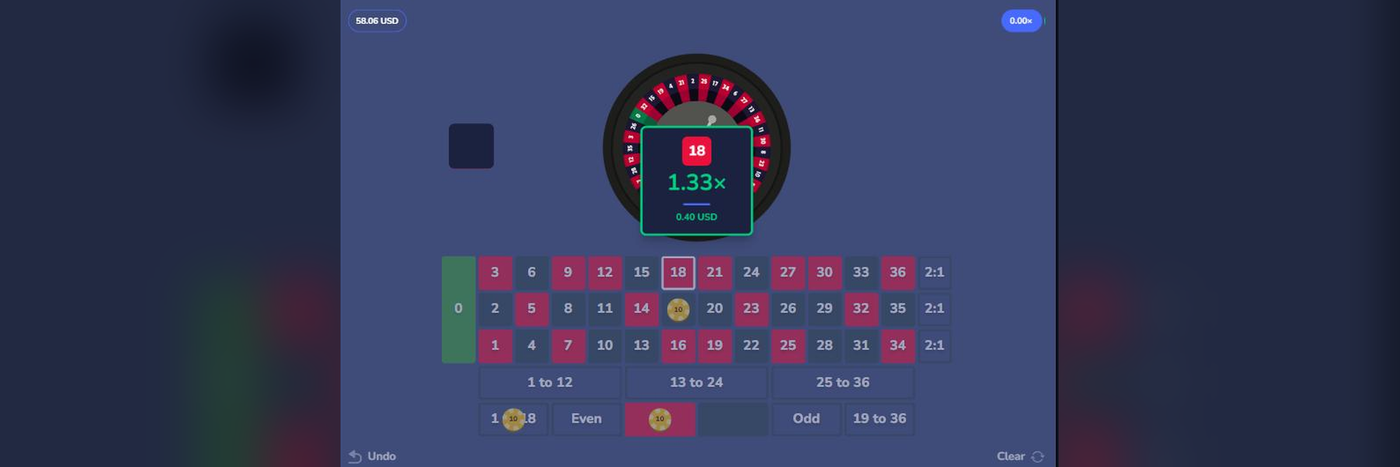
Combining several bet types on one spin, as the live example above does, is a way to shape that variance further: covering a color and a half bet together increases the chance that at least one wins on a given spin, while a straight bet layered on top keeps a shot at the larger payout alive without staking much on it.
Bankroll math: flat staking across a fixed-edge game
Set a session bankroll you're fully prepared to lose before you sit down, and size total bets per spin, across however many bet types you're combining, as a small, fixed fraction of it, commonly 1% to 2%. At a $100 bankroll, that's $1 to $2 in total stakes per spin, split across whichever bet types you've chosen, regardless of how the previous spin landed.
Flat staking doesn't change the 97.3% RTP or reduce the odds of any individual spin losing. What it does is keep a losing streak, which will happen periodically with any bet type, from consuming a disproportionate share of your bankroll before the game's built-in return has a real number of spins to play out over. Raising your stake after a loss to chase a recovery, or after a win because a bet type felt hot, reintroduces the same structural risk that stake-doubling systems carry in every fixed-edge game: the house edge on the next spin doesn't care what happened on the last one, and a losing streak long enough to matter is a normal, expected event over enough spins, not a signal that something is due to change.
Common Roulette mistakes
Treating the 98% headline RTP as the only number that matters, when the Game Info panel's 97.3% is the more precise figure and the one that actually matches the wheel's math.
Believing a number is "due" after a cold streak, or avoiding a color after several spins in a row landed the other way. Each spin is generated independently by the seed-based system described above; nothing about a prior spin changes the next one's odds.
Assuming a dozen or column bet is safer than a straight bet in some meaningful sense beyond variance. Both pay out at exactly the same 97.3% RTP as every other bet type on this wheel; a dozen bet just distributes that return in smaller, more frequent pieces.
Increasing stake size after a loss instead of holding a flat unit size, the same structural mistake that undermines a bankroll in every other fixed-edge game.
Confusing this single-zero wheel's math with a double-zero wheel's math. The bet types and payout multipliers look identical between the two formats, but the house edge is meaningfully different, and assuming the numbers carry over between them will throw off any bankroll math based on one wheel and applied to the other.
How to use this at Flush
Roulette sits at flush.com/p/flush-originals/roulette, alongside the rest of the Originals catalogue at flush.com/originals. Set a total stake and split it across whichever bet types match the variance you want before you spin, and use the "½" and "2×" controls next to Total Bet to adjust your combined stake quickly between rounds rather than re-placing every chip by hand. Open the Fairness panel any time to check your active client seed and hashed server seed, and rotate your seed pair periodically for a fresh, independently verifiable set of outcomes.
Responsible Gambling
Choosing a bet type changes the shape of your results, not the 97.3% RTP built into this wheel. No combination of bet types removes the house edge or guarantees a winning session. Set a loss limit before you start spinning, treat it as a hard stop, and step away if the game stops being fun. If gambling is causing you stress, financial strain, or is affecting your relationships or wellbeing, support is available around the clock: GamCare (0808 8020 133), BeGambleAware (0808 8020 133), the National Council on Problem Gambling (1-800-GAMBLER), and Gambling Therapy all offer free, confidential help.
How We Researched This
Methodology
This guide is built from Flush's own Roulette game page and its Game Info panel, both read directly: the title states 98% RTP, the panel states 97.3%. Verified by hand: a single-zero wheel has 37 outcomes, a fair straight-bet payout would be 37x, Flush pays 36x, and 36/37 = 97.297%, matching the panel exactly, with the same ratio holding across all six bet types. A live round combining a straight, color, and half bet landed on 18 for a 1.33x return, used as this guide's body image. The Fairness panel confirmed the seed/nonce mechanism. Confirmed live on flush.com, August 2026.
What To Know
Key Benefits
- The 97.3% RTP is mathematically verifiable by hand from the wheel's own structure (36x payout against 37 true outcomes), not just a stated figure to take on faith.
- All six bet types pay out at the exact same 97.3% RTP, so choosing between them is a genuine, low-stakes preference about variance rather than a decision with a right answer.
- A single-zero wheel carries a lower house edge than a double-zero format, and Flush states this distinction directly in its own Game Info panel.
- Provably Fair round data lets you independently confirm any spin's outcome wasn't adjusted after the fact.
- Multiple bet types can be combined on one spin, giving direct control over how variance is shaped without changing the underlying return.
Things To Watch
- The 98% headline RTP shown in the page title is a rounded, site-wide figure; the 97.3% Game Info panel figure is the one that actually matches this wheel's math.
- No bet type offers better expected value than another; a straight bet's larger payout is fully offset by its lower hit frequency.
- Short sessions can and do deviate substantially from the long-run 97.3% RTP in either direction, especially with straight-bet-heavy play.
- This guide covers Flush's single-zero Roulette specifically; its sister game, American Roulette, uses a double-zero wheel with different underlying odds despite similar-looking bet types.
Glossary
Key Terms
| Term | Definition |
|---|---|
| Bankroll | The total amount of funds set aside for a gambling session, used to size individual bets. |
| Color bet | A bet on all red or all black numbers, excluding the green zero, paying 2x. |
| Column bet | A bet on one of the three vertical columns of 12 numbers on the table layout, paying 3x. |
| Dozen bet | A bet on one of three groups of 12 consecutive numbers (1-12, 13-24, 25-36), paying 3x. |
| Flat staking | Betting the same fixed unit size on every spin rather than adjusting it based on wins or losses. |
| House edge | The statistical advantage built into a casino game, expressed as the inverse of RTP. |
| Half bet | A bet on 1-18 or 19-36, excluding the green zero, paying 2x. |
| Nonce | A counter, tracked on Flush as the total bets made with a seed pair, combined with the seeds to make every round's outcome unique. |
| Parity bet | A bet on all even or all odd numbers, excluding the green zero, paying 2x. |
| Provably fair | A verification system letting players independently confirm a round's outcome was generated from the seed commitment published before play. |
| RTP | Return to Player: the theoretical percentage of wagered funds a game returns to players over time. |
| Single-zero wheel | A roulette wheel with 37 pockets (1-36 plus one green zero), the format used in European and most online roulette. |
| Straight bet | A bet on a single specific number, paying 36x, the narrowest and highest-variance bet type on the table. |
| Client seed | A value the player controls and can rotate, combined with the server seed to generate provably fair outcomes. |
| Server seed | A value generated by Flush and initially shown only in hashed form, revealed in full after rotation for independent verification. |
Why Trust This Guide
Flush Provably Fair System. Founded 2022, an in-house cryptographic fairness framework at flush.com. Publishes the hash-commit-reveal mechanism (client seed, server seed, nonce) used to generate every Flush Originals round and provides the seed data players need to verify a result independently. Reference: flush.com/fairness/ technical explainer.
FAQ
Frequently Asked Questions
Why does Flush show two different RTP numbers for Roulette?
Is one bet type better than the others?
Does a color or number becoming "due" after a losing streak make it more likely to hit?
What's the difference between this Roulette and Flush's American Roulette?
Can I combine multiple bet types on one spin?
How do I verify a Roulette spin was fair?
Sources
- Flush Provably Fair explainer — accessedAugust 26, 2026
- GamCare — accessedAugust 26, 2026
- BeGambleAware — accessedAugust 26, 2026
- NCPG (1-800-GAMBLER) — accessedAugust 26, 2026
- Gambling Therapy — accessedAugust 26, 2026

Share This Post
Share this post for your chance to win!
Related Posts
Level up your knowledge

USDT Gambling: Which Network to Use and Why It Matters
USDT keeps your casino balance's dollar value flat, but which network you send it over changes your speed and fee dramatically. Here is what actually matters.
5 min read

TRON Gambling: How to Gamble With TRX
TRX settles in seconds for a fraction of a cent, the same network many USDT deposits already use. Here is what actually matters when gambling with TRX directly.
5 min read

Best Crypto Sports Betting: A Complete 2026 Guide
Crypto sports betting means funding a sportsbook with BTC, ETH, or a stablecoin instead of a card. Here is how it actually works, and how Flush's own sportsbook applies it.
5 min read