April 3, 2025 • 5 min read
Trump Tariffs: How Bitcoin, Asia and Europe Markets Reacted
Quick Answer
Global markets witnessed their sharpest decline since 2020 as tariff negotiations sparked widespread panic selling.
Key Facts
| Event | Liberation Day tariff announcement, April 2025 |
| Baseline Tariff | 10% on all US imports |
| Reciprocal Tariffs | 11% to 50% on about 60 countries |
| China Total Tariff | 54% (34% new + 20% existing) |
| Hang Seng | -13.2% to 19,828.30 |
| Nikkei 225 | -7.83% to 31,136.58 |
| Dow Jones | -2,231.07 points (5.5%) |
| Bitcoin Low | Below $78,000 |
| China Retaliation | 34% on all US imports |
| Countries Seeking Talks | Over 50 |
The Hang Seng Index plummeted 13.2% to 19,828.30, while Japan's Nikkei 225 closed down 7.83% at 31,136.58, marking one of the most significant drops in recent history.
Following the market turmoil, Bitcoin's value dropped 10%, falling below $78,000, retreating from its January peak of nearly $110,000. The US markets weren't spared either: on Friday, the Dow Jones Industrial Average fell 2,231.07 points (5.5%) and the S&P 500 declined 5.97% to 5,074.08.
This guide examines the ripple effects of Trump's latest tariff announcement across global markets, its impact on cryptocurrency values, and how various countries are responding to these significant economic shifts. You'll understand why these market movements matter and what they might mean for your investments.
Trump's Tariff Announcement: What Happened
President Donald Trump declared a national emergency over trade deficits on April 2, 2025, unveiling a sweeping new tariff system he described as "Liberation Day" for American manufacturing. The announcement, which came after weeks of speculation, includes two major components that will fundamentally reshape global trade relationships.
LIBERATION DAY RECIPROCAL TARIFFS 🇺🇸 pic.twitter.com/ODckbUWKvO
— The White House (@WhiteHouse) April 2, 2025
Details of the new global tariff structure
The new framework establishes a baseline 10% tariff on all imports to the United States, set to take effect on April 5. Additionally, Trump announced higher "reciprocal tariffs" ranging from 11% to 50% on approximately 60 countries deemed "worst offenders," scheduled to begin on April 9. These measures use the International Emergency Economic Powers Act (IEEPA), circumventing Congressional approval.
Key countries affected and tariff percentages
The tariffs hit major U.S. trading partners particularly hard:
- China: 34% new tariff (on top of existing 20% duties, totaling 54%)
- European Union: 20%
- Japan: 24%
- Vietnam: 46%
- Cambodia: 49%
Notably, Canada and Mexico received exemptions from the new baseline tariff but remain subject to previous 25% tariffs related to fentanyl and migration issues.
Trump's rationale: Addressing trade deficits
Trump justified these measures by citing America's persistent goods trade deficit, which exceeded USD 1.20 trillion in 2024. Despite Bitcoin's initial resilience compared to equity markets, the cryptocurrency eventually tumbled below $78,000 as Asian markets braced for impact.
The calculation method for country-specific tariffs follows a straightforward formula: take the trade deficit with a country, divide it by total imports from that country, then halve that percentage. For instance, with China's $295 billion deficit on $440 billion in imports, the calculation yielded a 34% tariff.
According to Trump, these tariffs will remain until "the threat posed by the trade deficit and underlying nonreciprocal treatment is satisfied, resolved, or mitigated". In response to mounting pressure, several nations have already indicated willingness to engage in tariff discussions, potentially opening pathways to new trade agreements.
Initial Market Reactions: US and Cryptocurrency
Wall Street experienced its most severe shock since the coronavirus pandemic as Trump's tariff announcement sent investors scrambling. The S&P 500 plunged almost 5% on Thursday, marking its worst single-day performance since June 2020. This dramatic sell-off immediately followed five weeks of consecutive declines amid growing tariff concerns.
Wall Street's immediate response
The tech-heavy Nasdaq suffered even more, dropping 6% in a single session. Over just two days, both major indexes fell by more than 10%. Since their post-election peaks, the S&P 500 and Nasdaq have declined 17.5% and 22.5% respectively, pushing the market toward bear territory. Consequently, more than $6 trillion in market valuation evaporated within 48 hours.
The "Magnificent Seven" tech giants bore the brunt, collectively losing $1.8 trillion in market capitalization. Tech moguls watched their personal fortunes evaporate, Elon Musk (Tesla), Jeff Bezos (Amazon), and Mark Zuckerberg (Meta) lost $110 billion, $37 billion, and $18 billion respectively.
Bitcoin's initial resilience compared to equities
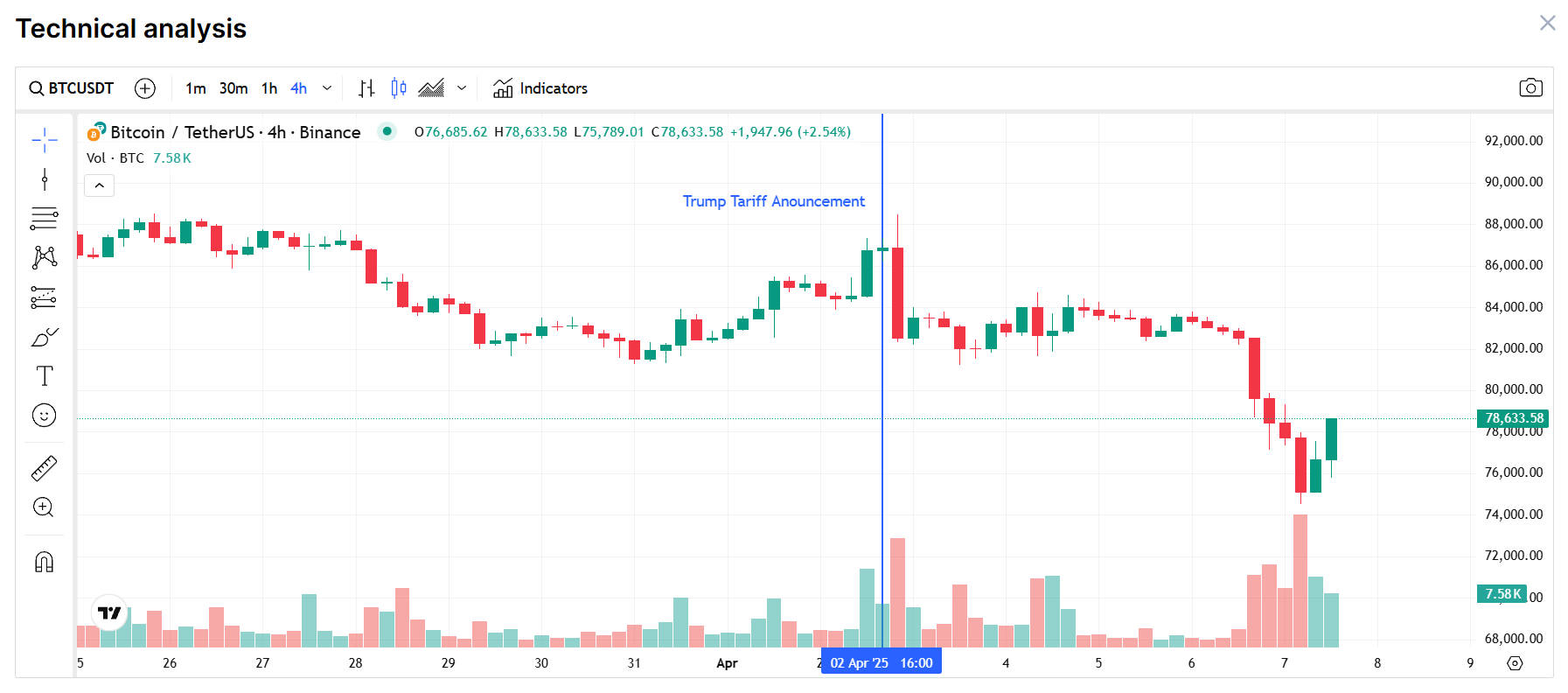
Initially, Bitcoin demonstrated remarkable resilience compared to traditional markets. While stocks cratered Thursday, Bitcoin merely dipped between $81,000 and $83,000, showing significantly less volatility than equities. By Friday, the cryptocurrency had rebounded to $84,600, surprising analysts who were "genuinely shocked" it wasn't crashing alongside stocks.
Nonetheless, this stability proved temporary. Come Sunday night, Bitcoin plunged below $78,000, dropping 10% since Trump's tariff announcement. This decline aligned with Asian markets' anticipated Monday opening, especially preceding Hong Kong's 13.2% nosedive.
Asian Markets Plummet in Response
Asian financial markets collapsed on Monday as fears of a global trade war intensified after Trump's tariff announcement and China's retaliatory measures. The shock waves felt across Asia-Pacific exchanges represented the most severe market reaction yet to the escalating tariff negotiations.
Hong Kong's HSI 13.2% nosedive
The Hang Seng Index led regional losses with a staggering 13.2% plunge to 19,828.30, marking its steepest one-day percentage drop since the 1997 Asian financial crisis. The tech sector suffered even more profound damage, with the Hang Seng Tech Index crashing 17.16% to 4,401.51. Major companies experienced devastating losses, Xiaomi tumbled 20.6%, Lenovo Group plummeted 22.9%, while tech giants Tencent and Alibaba fell 12.5% and 18.0% respectively.
Japan's Nikkei suspension after hitting circuit breakers
Japan's markets likewise faced extraordinary turmoil as the Nikkei 225 plunged 7.83% to hit an 18-month low of 31,136.58. Earlier in the day, trading in Japanese futures was temporarily halted when the market triggered circuit breakers at 8:45 am Tokyo time. The broader Topix index mirrored this collapse with a 7.79% fall to 2,288.66. Furthermore, Taiwan's stock market activated similar protective measures after suffering a near 10% drop, its biggest one-day percentage fall on record.
China's retaliatory measures and market impact
In response to Trump's tariffs, China imposed matching 34% duties on all US imports effective April 10. Moreover, Beijing implemented additional measures including export controls on rare earth metals, placing 11 American companies on its "unreliable entity list," and adding 16 US firms to export control restrictions. Chinese markets tumbled 7% before the country's sovereign wealth fund, Central Huijin, intervened to stabilize the market.
European Trading Session Follows Suit
European stock markets reeled on Monday, extending the global sell-off that began last week as tariff negotiations turned increasingly confrontational. Financial contagion from Asian markets struck Europe with extraordinary force, creating the continent's worst trading session since the COVID-19 pandemic began in March 2020.
Germany's DAX and France's CAC 40 steep declines
Germany's benchmark DAX plummeted 10% in the first few minutes of trading, subsequently stabilizing at approximately 4.23% down by mid-afternoon. Similarly, France's CAC 40 initially sank nearly 7% before recovering to a 4.51% decline. The broader Euro STOXX 50 fell 4.45% while the regional STOXX 600 dropped 4.66%.
As a trader remarked: "The bloodbath is in full swing... There is no safe haven; equity markets have entered a complete free-fall with no clear bottom in sight".
UK markets reaction
The FTSE 100 opened more than 5% lower, following its steepest fall in five years on Friday, ultimately settling at a 4.43% decline. Economic forecasters anticipate potentially severe repercussions, with KPMG economists predicting a 0.8% reduction in the UK's GDP growth for 2025.
Negotiation Signals Emerge Amid Chaos
Diplomatic channels worldwide have sprung into action amid market turbulence created by Trump's tariff announcement, with multiple nations signaling willingness to negotiate rather than retaliate outright.
Countries reaching out for tariff discussions
Over 50 countries have directly contacted the White House to initiate trade talks following Trump's sweeping tariff implementation. This remarkable level of engagement underscores the global economic stakes involved. Top administration officials, including National Economic Council Director Kevin Hassett, cited the Office of the U.S. Trade Representative as confirming this widespread diplomatic outreach.
Taiwan, facing a 32% tariff, has offered zero tariffs as the basis for negotiations rather than pursuing retaliatory measures. Vietnam, hit with a substantial 46% duty, requested a last-minute delay while appointing Deputy Prime Minister Ho Duc Phoc to serve as primary contact for reaching an agreement "as soon as possible".
Early diplomatic responses from major trading partners
Responses have varied across regions, though many prioritize negotiation over confrontation. Indonesia, Southeast Asia's largest economy, stated it would pursue diplomacy rather than retaliation. Israel's Prime Minister Benjamin Netanyahu expressed hope that Trump would ease the 17% tariff during their upcoming Washington meeting.
The European Union has adopted a dual approach. While European Commission President Ursula von der Leyen warned the EU is "prepared to defend its interests with proportionate countermeasures", many member states favor negotiations. Dutch Trade Minister Reinette Klever emphasized, "We need to get ourselves at the table with the Americans and see how we can lower these tariffs".
There Are No Tariffs on Bitcoin
Unlike traditional markets, Bitcoin operates without circuit breakers, trading halts, or government-imposed tariffs. This unfiltered exposure to market sentiment means Bitcoin's volatility isn't a failure of the blockchain, it’s a feature. The price freely rises and falls based on user conviction and fear, not centralized intervention. As global markets plunged following Trump's sweeping new tariff system, Bitcoin initially held steady, but eventually dipped below $78,000 as panic spilled over from equities to crypto. The price action highlights not a structural flaw, but the asset’s openness, anyone can enter or exit the market at will, even during extreme global uncertainty.
However, while there are no tariffs on Bitcoin itself, there are tariffs on Bitcoin’s critical infrastructure. Specifically, specialized mining machines, ASICs, are now more expensive to import from China, with Trump’s 54% total tariff on Chinese goods making upgrades costlier for miners reliant on overseas hardware. This could tighten margins for companies needing to modernize their fleets to remain competitive, especially smaller players who lack the capital to diversify supply chains.
Congrats to @Auradine_Inc on launching the Teraflux™ AH3880, the first U.S.-engineered hydro-cooled Bitcoin miner. MARA and Auradine are working together to ensure the United States' is the leader in Bitcoin infrastructure. https://t.co/V3yw44LoNL
— MARA (@MARAHoldings) March 25, 2025
Leading U.S. mining firms like Marathon Digital (MARA) anticipated this risk years ago and began advocating for domestic ASIC production. Their investment in U.S.-based Auradine, a company focused on building American-made Bitcoin mining equipment, is now looking prescient. If the trade war deepens, miners with a foothold in domestic tech could outpace competitors still reliant on Chinese imports. In a world of escalating tariffs and geopolitical uncertainty, Bitcoin’s permissionless nature may remain tariff-free, but the tools used to sustain it are anything but immune.
Brought to You by Flush, the Ultimate Bitcoin Casino Destination for Gaming Enthusiasts
At Flush, crypto deposits clear in minutes, withdrawals return on the same chain, and the lobby covers thousands of slots, full live dealer, and a sportsbook with 70+ sports markets. The welcome offer is a welcome bonus of up to 150%.
Flush's welcome offer: a bonus of up to 150%, tiered by deposit (see the bonus terms). Every slot spin counts toward the $10,000 weekly race.
Flush is where crypto-first gaming and real-money play meet. Whether you prefer slots, table games, live dealer, or our sportsbook with 70+ sports markets, the same wallet covers all of it. Sign up takes 90 seconds and the first-deposit bonus is waiting.
How We Researched This
Methodology
This article compiles publicly reported market data and official statements from the April 2025 tariff announcement. Tariff rates and the stated rationale come from the White House fact sheet and announcement, while index moves in the US, Asia and Europe draw on coverage from outlets such as AP, CNBC, the New York Times, Le Monde, the BBC and PBS. Bitcoin price levels reflect a public price chart at the time of writing. All figures describe a specific moment and have since moved; this is market commentary, not financial advice.
FAQ
Frequently Asked Questions
What tariffs did Trump announce on Liberation Day?
How did Bitcoin react to the tariff announcement?
How much did Asian markets fall?
How were the country-specific tariff rates calculated?
How did China respond to the US tariffs?
Are there tariffs on Bitcoin?
How many countries sought tariff talks with the US?

Share This Post
Share this post for your chance to win!
Related Posts
Level up your knowledge
American Bitcoin (ABTC) Explained: What the Company Is
American Bitcoin (ABTC) is a Nasdaq listed Bitcoin mining and treasury company tied to Hut 8 and the Trump family. Here's what the company actually does, stated as fact, not opinion.
5 min read
Japan Reclassifies Crypto as Financial Asset 2026
Japan's parliament reclassified crypto as a financial asset and cut its top crypto tax rate from 55% to 20%, effective 2028. Here is what it signals globally.
5 min read

Alberta Opens Regulated iGaming 2026: What It Signals
Alberta's regulated iGaming market launched July 13, 2026 with 22 operators live, several running crypto and stablecoin deposit rails on layer two networks.
5 min read