February 20, 2025 • 5 min read
Types of Bitcoin Addresses: Which One Should You Use?
Quick Answer
Bitcoin address types play a crucial role in how you interact with the cryptocurrency network, with Legacy addresses alone securing 43% of the total mined Bitcoin supply.
Key Facts
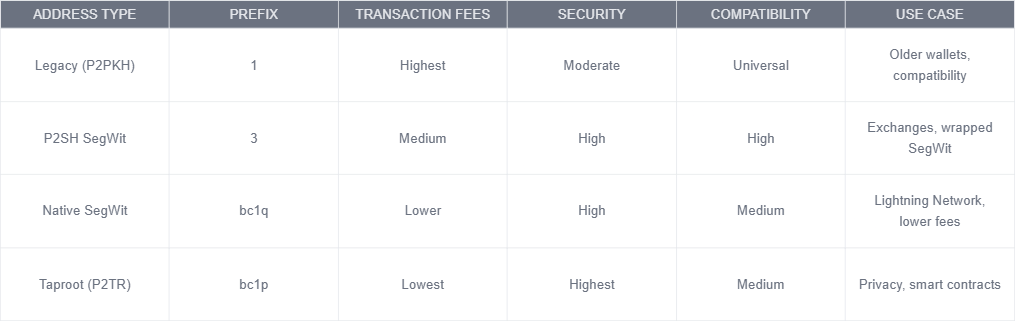
| Legacy (P2PKH) prefix | 1 |
| P2SH / Nested SegWit prefix | 3 |
| Native SegWit (Bech32) prefix | bc1q |
| Taproot (P2TR) prefix | bc1p |
| Taproot introduced | November 2021 |
| Taproot signatures | Schnorr |
| Native SegWit fee savings | ~38% vs. Legacy |
| Nested SegWit fee savings | ~26% vs. Legacy |
| Best choice for most users | Native SegWit (bc1q) |
Bitcoin addresses are alphanumeric strings, typically spanning 26 to 35 characters, that serve as unique identifiers for your transactions.
In fact, choosing the right BTC address type can significantly impact your transaction costs. SegWit addresses, for instance, reduce fees by 30-40% compared to Legacy addresses, while the newest Taproot addresses offer enhanced privacy and security features. However, with multiple options available, each starting with different characters like "1," "3," or "bc1", selecting the most suitable address type for your needs can be challenging.
This comprehensive guide breaks down everything you need to know about different Bitcoin address formats, their specific use cases, and how to choose the right one for your transactions.
Understanding Bitcoin Addresses
What is a Bitcoin Address?
Think of a Bitcoin address as your digital mailbox for receiving cryptocurrency. Essentially, it's a shorter, more manageable version of your public key. Unlike a digital wallet, a Bitcoin address cannot hold a balance directly, it merely points to where the funds should go.
Why Different Address Types Exist
The evolution of Bitcoin address formats stems from continuous network improvements. Initially, when Bitcoin started, people could send cryptocurrency to IP addresses. Nevertheless, this method proved vulnerable to man-in-the-middle attacks, leading to the development of more secure address formats. Additionally, newer address types emerged to accommodate various functionalities while maintaining compatibility across the network.
Key Components of a Bitcoin Address
Every Bitcoin address contains several crucial elements:
- Version prefix: Addresses start with specific characters (1, 3, or bc1) indicating their type.
- Public key hash: Forms the foundation of the address, creating a unique identity.
- Checksum: Ensures correctness and identifies typing errors.
- Base58 encoding: Removes potentially confusing characters for improved accuracy.
- Length verification: Contains between 26-35 characters for standard formats.
Furthermore, these addresses are case-sensitive and utilize cryptographic operations to generate private-public key pairs. Notably, the public key undergoes hashing algorithms to produce fixed-length, shorter representations, making data storage and transfer more efficient on the blockchain network.
Common Bitcoin Address Formats
Bitcoin addresses come in several formats, each evolving to improve efficiency, security, and usability. Below is a detailed breakdown of the most common Bitcoin address types, their structure, benefits, and potential drawbacks.
1. Legacy Addresses (P2PKH - Pay-to-Public-Key-Hash)
Prefix: 1
Example: 1A1zP1eP5QGefi2DMPTfTL5SLmv7DivfNa
Legacy addresses, also known as P2PKH (Pay-to-Public-Key-Hash), are the original Bitcoin addresses introduced by Satoshi Nakamoto. They are still widely used but are considered outdated due to higher transaction fees and larger space requirements on the blockchain.
How They Work
- A Legacy address is derived from the hash of the public key.
- To spend Bitcoin from a Legacy address, the sender must provide both the full public key and a digital signature to validate the transaction.
Pros:
- Universally supported by all Bitcoin wallets and exchanges.
- Straightforward and easy to understand.
Cons:
- Higher transaction fees due to larger signature sizes.
- Consumes more block space, making transactions less efficient.
- Less private, as public keys are exposed upon spending.
2. Script Addresses (P2SH - Pay-to-Script-Hash) & Nested SegWit
Prefix: 3
Example: 3J98t1WpEZ73CNmQviecrnyiWrnqRhWNLy
P2SH (Pay-to-Script-Hash) allows more advanced spending conditions, such as multi-signature wallets, time-locked transactions, and SegWit compatibility.
How They Work
- Instead of paying to a public key hash (like P2PKH), P2SH addresses pay to a script hash, requiring additional unlocking conditions when spending.
- When spending from a P2SH address, the sender must provide the full script and required signatures to validate the transaction.
Nested SegWit (P2SH-P2WPKH & P2SH-P2WSH)
One common use of P2SH is "Nested SegWit," which allows SegWit transactions while still being compatible with older wallets that do not support Native SegWit (bc1q).
How does this work?
- The address looks like a regular P2SH address (3 prefix),
- But inside, it contains a SegWit script, giving partial SegWit benefits while keeping backward compatibility.
Pros:
- Widely supported by Bitcoin wallets and exchanges.
- Enables multi-signature and advanced scripts.
- Allows SegWit usage even in old wallets that don’t support Bech32 (bc1q).
- Lower fees than Legacy P2PKH addresses (~26% savings).
Cons:
- Slightly less efficient than Native SegWit (bc1q).
- Not all wallets support spending from these addresses.
3. Segregated Witness Addresses (SegWit - P2WPKH & P2WSH)
Segregated Witness (SegWit) addresses reduce transaction fees, improve scalability, and fix transaction malleability issues.
Native SegWit (P2WPKH & P2WSH)
Prefix: bc1q
Example: bc1qxy2kgdygjrsqtzq2n0yrf2493p83kkfjhx0wlh
Native SegWit addresses, also known as Bech32, are the most efficient SegWit format. They offer the lowest fees but may not be supported by some older wallets and exchanges.
Pros:
- Lowest transaction fees (~38% savings vs. Legacy).
- Reduces blockchain congestion by optimizing transaction size.
- Improves security by fixing malleability issues.
Cons:
- Not all wallets and services support Bech32 addresses.
4. Taproot Addresses (P2TR - Pay-to-Taproot)
Prefix: bc1p
Example: bc1p5cyxnuxmeuwuvkwfem96l9znp9p8p3szxpeypq0f32tft7lq03sqxkvdr
Taproot addresses, introduced in November 2021, represent the latest advancement in Bitcoin’s address formats. They improve privacy, efficiency, and flexibility, making them ideal for advanced smart contracts and complex spending conditions.
How They Work
- Taproot utilizes Schnorr signatures, which allow multiple signatures to be aggregated into one.
- This makes multi-signature transactions indistinguishable from regular transactions, significantly improving privacy.
- Taproot also enables more efficient scripting, reducing blockchain congestion.
- Makes complex transactions (multi-signature, Lightning Network, Silent Payments) indistinguishable from simple ones, enhancing privacy.
Pros:
- Better privacy: Complex transactions look identical to simple transactions on the blockchain.
- Lower fees compared to older formats.
- Enhanced smart contract capabilities.
Cons:
- Not yet widely supported by all wallets and exchanges.
- Requires a Taproot-compatible wallet to generate and use these addresses.
Choosing the Right Address Type
Wallet Compatibility
Most modern Bitcoin wallets support multiple address formats, yet compatibility issues persist. Generally, newer wallets default to Native SegWit (bc1q) addresses, offering enhanced functionality and lower fees. However, older wallets might only recognize Legacy addresses, making it crucial to verify compatibility before transactions.
Use Case Considerations
- Regular Transactions: Native SegWit (bc1q) addresses work best for everyday transactions, providing optimal fee efficiency.
- Exchange Interactions: Nested SegWit (3) addresses offer broader compatibility with exchanges and services.
- Advanced Features: Taproot (bc1p) addresses support sophisticated functions like multi-signature transactions and enhanced privacy features.
- Maximum Security: If security is your top priority, consider using hashed address types such as P2PKH, which keep the public key hidden until funds are spent, and avoid reusing addresses. Additionally, for those concerned about future quantum threats, quantum-resistant cryptographic solutions are worth following as they develop.
Final Thoughts
Bitcoin address types offer distinct advantages based on your specific needs. Legacy addresses provide broad compatibility, while SegWit addresses reduce transaction costs significantly. Though Taproot addresses represent the latest technology with enhanced privacy features, Native SegWit addresses currently stand as the most practical choice for most users.
Brought to You by Flush, the Ultimate Bitcoin Casino Destination for Gaming Enthusiasts
Flush runs as a Bitcoin-first online casino with a smooth play experience and a real-money lobby. The slot library spans the major studios, the live dealer floor uses Evolution, and the sportsbook covers 70+ sports markets. Deposits and withdrawals stay on crypto rails throughout.
New at Flush? The welcome offer is a welcome bonus of up to 150%, plus every slot spin enters you into the $10,000 weekly race.
Flush brings Bitcoin and traditional casino play together in one place. Browse the slot library, claim the welcome offer, and start with a deposit in BTC, ETH, USDT, or any of the other supported coins. Crypto deposits clear in minutes and withdrawals settle on the same network you came in on.
How We Researched This
Methodology
This explainer compares the main Bitcoin address formats (Legacy P2PKH, P2SH and Nested SegWit, Native SegWit and Taproot) based on how each is defined in the Bitcoin protocol: address prefixes, how funds are locked and spent, and the resulting differences in fees, privacy and wallet compatibility. Fee savings are approximate figures quoted in the article and depend on transaction structure and network conditions. Wallet and exchange support changes over time, so confirm compatibility before sending funds. This is not financial advice.
FAQ
Frequently Asked Questions
What is a Bitcoin address?
What do the prefixes 1, 3 and bc1 mean?
Which Bitcoin address type has the lowest fees?
What are Taproot addresses?
Why would I use a P2SH address?
Which Bitcoin address type should most people use?

Share This Post
Share this post for your chance to win!
Related Posts
Level up your knowledge

Bitcoin Futures Explained
Bitcoin futures let traders speculate on price without owning the coin, using leverage that cuts both ways. Here is how regulated futures, perpetuals, margin, and liquidation actually work, and why futures are not a substitute for owning bitcoin outright.
5 min read
BlackRock Bitcoin Price Prediction: Fact-Check
Viral headlines claim BlackRock predicted a specific Bitcoin price, but the reality blends several distinct statements from different executives. Here is what Larry Fink and Rick Rieder have actually, verifiably said, sourced and separated from unverified claims.
5 min read

Bitcoin Hyper: Legit or Hype?
Bitcoin Hyper markets itself as a Bitcoin Layer 2 on a Solana-compatible chain, but it has no live mainnet, an anonymous team, and price speculation running well ahead of any working product. Here is a fact-checked, non-cynical look at where it actually stands.
5 min read