August 31, 2026 • 5 min read

Video Poker Strategy: Optimal Play and Bankroll Math 2026
Quick Answer
Video Poker strategy means holding the cards with the highest expected value against Flush's fixed Jacks or Better paytable, then staking flat and sticking to a bankroll plan. Flush states 98% RTP; no hold decision changes that number, only how close a session comes to it.
You must be 18+ to access this content. Please gamble responsibly.
Key Facts
| Game | Video Poker (Jacks or Better) on the Flush Originals catalogue |
| Mechanic | Five-card deal, choose cards to hold, single draw replaces the rest |
| Stated RTP | 98%, shown directly on Flush's Video Poker game page |
| Minimum paying hand | A pair of Jacks or better (1x stake) |
| Top payout | Royal Flush, 800x stake |
| Fairness model | Provably Fair: client seed plus hashed server seed plus a bet-count nonce, revealed after each round |
| Suggested stake | 1% of session bankroll per hand, flat |
| Related Originals | Crash, Dice, Mines, Plinko, Keno |
| RG tools | Deposit limits, loss limits, session timers, self-exclusion |
Video Poker Strategy: Optimal Play and Bankroll Math 2026
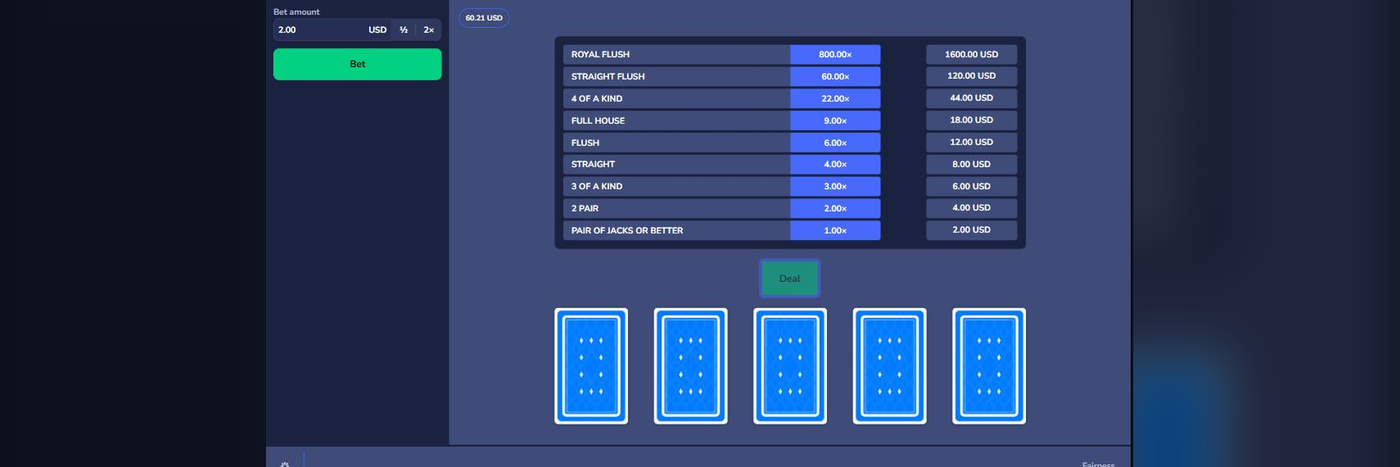
Video Poker on Flush Originals runs on a fixed, fully visible paytable: deal five cards, choose which ones to hold, draw once to replace the rest, and get paid according to the hand that results. Flush states the game's return directly on its own page, 98% RTP, a figure most of the Originals catalogue does not expose in the same way. The paytable itself pays a pair of Jacks or better at 1x stake up through a Royal Flush at 800x, with Four of a Kind, Full House, Flush, Straight, Three of a Kind, and Two Pair filling in the steps between. Every round runs on the same client seed, hashed server seed, and nonce system used across the rest of Flush's in-house catalogue, Crash, Dice, Mines, Plinko, and Keno among them. No hold decision changes the 98% figure baked into that paytable; what a hold decision changes is how close any given session comes to it. This guide covers how the paytable math actually works, which hold decisions carry real expected-value weight, and the bankroll discipline that determines how long a session lasts.
What Video Poker is and how the paytable math works
Underneath the card-flipping animation sits a single fixed table of payouts, shown in full before the first card is dealt. Flush's version pays a pair of Jacks, Queens, Kings, or Aces at 1x the stake, the minimum hand that returns anything at all. From there the table climbs: Two Pair at 2x, Three of a Kind at 3x, a Straight at 4x, a Flush at 6x, a Full House at 9x, Four of a Kind at 22x, a Straight Flush at 60x, and a Royal Flush, the rarest hand in the deck, at 800x.
That shape, a wide base of small, relatively common payouts and a narrow, steep top end, is what defines a Jacks-or-Better-style paytable generally, and it is exactly the structure Flush's own in-game panel shows for this game specifically. Every hand is scored against this same table regardless of bet size; the stake scales the dollar payout, not the odds of landing any particular hand.
Flush states this game's return to player as 98% directly on the game's own page, a figure most of the Originals catalogue does not surface in the same explicit way. That number describes the theoretical long-run outcome across a very large number of hands, played with consistent hold decisions. It says nothing about what the next single hand pays, and no adjustment to how you hold changes the number itself.
How a Video Poker round is actually generated
The same Provably Fair mechanism used across every Flush Original governs Video Poker, and Flush's own Fairness panel on the game screen makes the specific values involved visible and checkable.
Before a deal, Flush generates a server seed and publishes a hashed version of it. A hash function scrambles that seed into a fixed string that reveals nothing about the original value, and the scrambling is one-directional: straightforward to compute forward, effectively impossible to reverse. That is what stops Flush from quietly altering the server seed after cards have been dealt or held, since a different seed would produce a hash that no longer matches the one already published before the round.
Your client seed, editable directly in the Fairness panel, combines with that server seed and a nonce, tracked on Flush's Video Poker screen as the running total of bets made with the current seed pair, to determine the exact five cards dealt and the exact replacement cards drawn. Change any one of the three inputs and both the deal and the draw change completely.
After a round resolves, Flush reveals the server seed that was used. From there you can rerun the same computation yourself, combining the revealed seed, your client seed, and that round's bet count, and confirm the cards match what was actually dealt and drawn. A mismatch would mean the round was altered after cards were held, which the published hash before the deal is specifically designed to make provable. For the full explanation of how this mechanism works across every Flush Original, see what Provably Fair actually proves.
Hold decisions: the math that actually carries weight
Video Poker does not have a risk-level or row-count setting the way some other Flush Originals do. The one decision that shapes every hand is which of the five dealt cards to hold before the single draw, and that decision has real, calculable expected-value differences behind it, not just intuition.
A hand already containing a made pair of Jacks or better is a hold on its own; drawing three new cards hoping for something bigger than a guaranteed 1x return usually gives up more expected value than it adds, unless the discarded cards were also carrying real draw potential of their own, such as a second pair or a run toward a straight or flush. A hand with four cards to a flush or a straight is typically a stronger hold than a made low pair, since the completed hand pays more (6x for a flush, 4x for a straight) and the draw odds of completing a four-card draw in a single card are meaningfully high.
Kickers, the extra unpaired cards held alongside a partial hand, are where a lot of expected value quietly leaks away. Holding a kicker "just in case" alongside a pair reduces the number of cards drawn, which lowers the chance of improving to Two Pair, Three of a Kind, or better. The higher-value approach is almost always to draw the full complement of replacement cards a hand's structure allows, rather than holding extra cards that do not contribute to the hand actually being pursued.
None of this changes the 98% figure Flush states for the game. What it changes is how close a given session's results land to that number. A player making the higher-expected-value hold on every hand is playing closer to that stated return than a player holding by feel, over enough hands for the difference to show up.
Bankroll math: flat staking and why doubling systems fail
Fixed-fraction staking is the most useful habit available in a game with a built-in house edge. Set a session bankroll before opening the game, divide it by roughly 100, and use that figure as a flat stake for every hand regardless of how the last one resolved. At a $100 bankroll that is a $1 stake per hand.
This approach is specifically sized to survive a realistic run of below-minimum hands, deals where even the best possible hold does not reach a pair of Jacks or better. A flat 1% stake leaves meaningful bankroll remaining through that kind of stretch, room for the paytable's more frequent small pays and rarer large ones to average out toward the stated return rather than ending a session early on a bad run of cards alone.
Stake-doubling systems fail on Video Poker for the same structural reason they fail on every other fixed-paytable Flush Original: a doubling sequence assumes a short losing streak and a payout close to even money to recover it cleanly. A pair of Jacks or better pays exactly even money, 1x stake, but a meaningful share of dealt hands do not reach even that after the draw. A losing run of eight or ten hands in a row is a normal outcome over a full session, not a rare one, and a doubling sequence starting at $1 reaches $256 after eight losses and $1,024 after ten, numbers that outrun most bankrolls long before a big hand arrives to justify the escalation.
Common Video Poker mistakes
Three patterns account for most of the bankroll damage a Video Poker session can produce.
Holding a kicker alongside a made pair or a partial hand is the most common, and the quietest. It feels cautious, keeping a high card "in case nothing else hits," but it reduces the number of cards drawn and lowers the odds of actually improving the hand. The higher-value play is almost always the full draw a hand's structure supports.
Chasing a Royal Flush from a weak starting position is the second. Four cards to a Royal Flush is a strong hold; two or three unrelated high cards hoping to build toward one is not, and usually gives up better, more probable holds already available in the same hand, like a pair or a made straight or flush draw, for a payout that is genuinely rare even with a full four-card draw toward it.
Skipping a bankroll figure entirely is the third, and it is the same mistake that shows up across every Flush Original. Deciding a session bankroll before the first hand, and using Flush's built-in limit tools to enforce it, turns that decision into a structural one rather than something decided under pressure mid-session.
How to use this at Flush
Flush's Video Poker sits inside the Originals catalogue alongside Crash, Dice, Mines, Plinko, and Keno, all built on the same client seed, server seed, and nonce fairness model described above. Deposits and stakes run in crypto through Flush's cashier, which supports multiple coins for funding a session directly from a wallet.
Rakeback claims every 30 minutes, a Level Up Bonus, and periodic Daily, Weekly, and Monthly bonuses run alongside the core game, on top of a Welcome Bonus for new accounts. Specific promotional terms and current offers are worth checking directly on the promotions page before a session, since offer structures and eligibility change over time. Demo mode is available for testing hold decisions and a flat-stake plan before committing real funds; the Video Poker game page itself has the toggle.
Responsible Gambling
Optimal hold decisions and bankroll discipline change how close a Video Poker session lands to the stated 98% return, not the house edge underneath it. A well-played hand does not guarantee a payout, and a flat stake does not guarantee a winning session.
Set a bankroll and a stop-loss before the session starts, not partway through a losing streak. Flush's own responsible gambling resources sit alongside deposit limits, loss limits, session timers, and self-exclusion tools in account settings. If gambling stops feeling enjoyable or starts affecting your finances, free and confidential support is available: GamCare (0808 8020 133 in the UK, gamcare.org.uk), BeGambleAware (same UK number, begambleaware.org), the National Council on Problem Gambling in the US (1-800-GAMBLER, ncpgambling.org), and Gambling Therapy for international support (gamblingtherapy.org). Never gamble more than you can afford to lose.
How We Researched This
Methodology
This guide is built from Flush's own Video Poker game page, which states 98% RTP in the page title and renders its full paytable on load, both read directly rather than estimated. The Fairness panel was opened to confirm the client seed, hashed server seed, and bet-counter mechanism matches Flush's Provably Fair system. Hold-decision reasoning follows standard video poker expected-value mathematics applied to Flush's own posted paytable rather than a generic one. Flush's Originals catalogue and game URL pattern were confirmed live on flush.com in August 2026.
What To Know
Key Benefits
- Video Poker's fixed, fully visible paytable means every hold decision can be evaluated against a known payout table before you draw.
- Flush states Video Poker's return directly on the game page (98% RTP), a rarer level of transparency than most of the Originals catalogue offers.
- Provably fair round data lets you independently confirm a deal and draw were fixed before you acted, not adjusted based on which cards you held.
- A minimum-paying hand of a pair of Jacks or better means a wide range of common hands return at least the stake.
- Understanding the paytable's shape explains why some holds that feel cautious are actually the mathematically worse choice.
Things To Watch
- No hold decision changes the 98% RTP built into the paytable itself; correct holds only move you closer to what that number already implies over many hands.
- A pair of Jacks or better is the minimum paying hand. Anything below that returns nothing regardless of how the hold was played.
- The paytable's steep top end, an 800x Royal Flush against a 1x minimum pay, means most sessions are shaped by many small returns and rare large ones.
- Provably fair verification proves a deal was not altered after you held your cards. It does not predict or influence a future deal.
Glossary
Key Terms
| Term | Definition |
|---|---|
| Jacks or Better | The video poker variant where a pair of Jacks, Queens, Kings, or Aces is the lowest hand that still pays. |
| Hold | A card kept from the original deal, not replaced in the draw. |
| Draw | The single replacement of every card not held, resolving the final five-card hand. |
| Paytable | The fixed table of multipliers paid for each qualifying hand, shown before the deal and unchanged by any hold decision. |
| Client seed | The portion of the provably fair seed pair the player controls, often randomized by the browser. |
| Server seed | The portion of the provably fair seed pair Flush controls. Published in hashed form before a deal, revealed in full after. |
| Nonce | A counter, tracked on Flush as the total bets made with a seed pair, used with the seeds to generate that specific deal's result. |
| Hash function | A one-way mathematical function that scrambles the server seed into a fixed published string before a deal, provably unchangeable afterward. |
| RTP | Return to Player: the share of total wagers a game pays back over the long run. Flush states Video Poker's RTP as 98%. |
| House edge | The built-in mathematical advantage a game keeps over the long run; the inverse of RTP, so a 98% RTP implies a 2% house edge. |
| Provably fair | A verification system letting players independently confirm a deal's outcome was generated from the seed commitment published before play. |
| Flat staking | Betting the same fixed amount every hand regardless of recent wins or losses. |
| Stake-doubling system | A staking approach that doubles the bet after every loss, aiming to recover past losses with a single win. |
| Session bankroll | The fixed amount of money set aside for a single play session, sized to survive a realistic losing streak. |
| Flush Originals | Flush's in-house catalogue of provably fair games, including Crash, Dice, Mines, Plinko, Keno, and Video Poker. |
Why Trust This Guide
Flush Provably Fair System. Founded 2022, an in-house cryptographic fairness framework at flush.com. Publishes the hash-commit-reveal mechanism (client seed, server seed, nonce) used to generate every Flush Originals round and provides the seed data players need to verify a result independently. Reference: flush.com/fairness/ technical explainer.
FAQ
Frequently Asked Questions
Can you actually win at Video Poker?
Does which cards I hold change the house edge?
Is Video Poker better odds than other Flush Originals?
What is optimal hold strategy and does it guarantee a profit?
How do I verify a Video Poker round was fair?
What is a sensible bankroll for Video Poker?
Sources
- Flush Provably Fair explainer — accessedAugust 26, 2026
- GamCare — accessedAugust 26, 2026
- BeGambleAware — accessedAugust 26, 2026
- NCPG (1-800-GAMBLER) — accessedAugust 26, 2026
- Gambling Therapy — accessedAugust 26, 2026

Share This Post
Share this post for your chance to win!
Related Posts
Level up your knowledge

USDT Gambling: Which Network to Use and Why It Matters
USDT keeps your casino balance's dollar value flat, but which network you send it over changes your speed and fee dramatically. Here is what actually matters.
5 min read

TRON Gambling: How to Gamble With TRX
TRX settles in seconds for a fraction of a cent, the same network many USDT deposits already use. Here is what actually matters when gambling with TRX directly.
5 min read

Best Crypto Sports Betting: A Complete 2026 Guide
Crypto sports betting means funding a sportsbook with BTC, ETH, or a stablecoin instead of a card. Here is how it actually works, and how Flush's own sportsbook applies it.
5 min read