December 16, 2025 • 5 min read

Wyoming Crypto Bank Seeks Full Court Review of Fed Denial
Quick Answer
A Wyoming chartered crypto bank has filed a petition requesting a full court review of a recent federal appeals decision that upheld the Federal Reserve’s denial of its application for a master account.
Key Facts
| Bank | Custodia Bank |
| Charter | Wyoming state chartered |
| Court | Tenth Circuit Court of Appeals |
| Request | Rehearing en banc (full court review) |
| Earlier ruling | Three judge panel sided with the Federal Reserve |
| Dispute | Denial of a Fed master account |
| Fed response | No public comment on the petition |
The petition filed by Wyoming chartered Custodia Bank represents a significant escalation in the legal battle between crypto focused banks and U.S. financial regulators.
The petition asks the full Tenth Circuit Court of Appeals to reconsider an earlier ruling issued by a three judge panel that sided with the Federal Reserve.
Bank Challenges Earlier Appeals Court Decision
The crypto bank, Custodia Bank, is seeking a rehearing en banc, a legal process that requires the full panel of appellate judges to review the case rather than the original three judge panel. Custodia argues that the earlier decision misinterpreted federal banking law and set a troubling precedent for state chartered institutions.
At the center of the dispute is the Federal Reserve’s refusal to grant Custodia access to a master account, which would allow the bank to directly access the U.S. payment system. Without such access, banks are forced to rely on intermediary institutions, significantly limiting their operational capabilities.
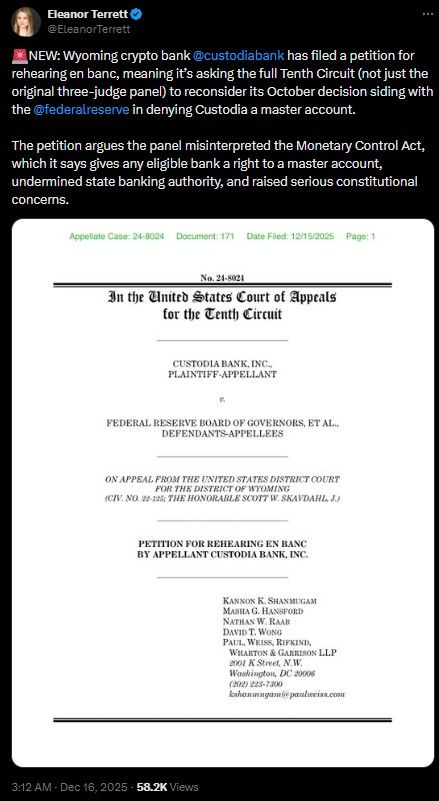
Custodia Bank files a petition seeking a full Tenth Circuit review of the Federal Reserve decision denying access to a master account.
Why Fed Master Accounts Matter
Master accounts are essential infrastructure for banks operating in the United States. They enable direct settlement with the Federal Reserve, access to payment rails, and participation in the broader financial system.
Custodia contends that denying a master account to a legally chartered Wyoming bank undermines the dual banking system, which allows both state and federally chartered institutions to operate under U.S. law. The bank argues that the Federal Reserve exceeded its authority by applying discretionary standards not explicitly outlined in statute.
Broader Implications for Crypto Banks
The case has become a focal point for crypto friendly banks seeking clarity on their access to core financial infrastructure. A ruling in Custodia’s favor could strengthen the position of state chartered crypto banks and limit the Federal Reserve’s discretion in approving master accounts.
Conversely, if the denial is upheld, regulators would retain broad authority to block crypto focused institutions from direct access to payment systems, potentially slowing innovation and pushing activity offshore.
Legal experts note that the outcome could influence future litigation involving other digital asset banks and financial technology firms.
Regulatory Tensions Remain High
The petition highlights ongoing tensions between emerging crypto banking models and federal regulators. While several states have moved to support digital asset innovation through specialized charters, federal agencies have taken a more cautious approach, citing financial stability and risk management concerns.
Custodia maintains that it has met all applicable regulatory requirements and that its business model complies with existing banking laws. The Federal Reserve has not publicly commented on the petition.
Conclusion
The request for a full court review marks a pivotal moment in the ongoing dispute over crypto bank access to the U.S. financial system. The decision by the Tenth Circuit on whether to rehear the case could shape the regulatory landscape for state chartered crypto banks and define the limits of federal oversight.
As the legal process unfolds, the case is expected to remain closely watched by regulators, lawmakers, and the broader crypto industry.
How We Researched This
Methodology
This news piece summarizes Custodia Bank's petition asking the full Tenth Circuit Court of Appeals to rehear its case against the Federal Reserve, based on the petition's stated arguments and the earlier three judge panel ruling that upheld the Fed's denial of a master account. Background on master accounts and the dual banking system reflects how these concepts are generally described in U.S. banking law. The case was ongoing at the time of writing, and this article is informational, not legal advice.
FAQ
Frequently Asked Questions
What is Custodia Bank asking the court to do?
Why was Custodia Bank denied a Fed master account?
What is a Federal Reserve master account?
Why does the Custodia case matter for crypto banks?
Has the Federal Reserve responded to the petition?

Share This Post
Share this post for your chance to win!
Related Posts
Level up your knowledge
American Bitcoin (ABTC) Explained: What the Company Is
American Bitcoin (ABTC) is a Nasdaq listed Bitcoin mining and treasury company tied to Hut 8 and the Trump family. Here's what the company actually does, stated as fact, not opinion.
5 min read

Japan Reclassifies Crypto as Financial Asset 2026
Japan's parliament reclassified crypto as a financial asset and cut its top crypto tax rate from 55% to 20%, effective 2028. Here is what it signals globally.
5 min read

Alberta Opens Regulated iGaming 2026: What It Signals
Alberta's regulated iGaming market launched July 13, 2026 with 22 operators live, several running crypto and stablecoin deposit rails on layer two networks.
5 min read