August 17, 2026 • 5 min read

Bitcoin Futures Explained
Quick Answer
A bitcoin future is a contract to buy or sell bitcoin at an agreed price on a future date, without needing to hold the coin itself. Leverage makes futures far riskier than simply owning bitcoin outright.
You must be 18+ to access this content. Please gamble responsibly.
Key Facts
| What it is | A contract to buy or sell bitcoin at an agreed price on a future date, without necessarily holding the coin |
| Regulated futures | Fixed expiry, standardized terms, overseen by a securities/commodities regulator (e.g. CME) |
| Perpetual futures | No expiry date; tracks spot price via a periodic funding rate between longs and shorts |
| Margin | The smaller upfront amount posted to open a leveraged position; the exchange effectively lends the rest |
| Liquidation | Automatic forced closure of a position when losses exhaust the posted margin |
| Basis | The gap between futures price and spot price, used as a market sentiment signal |
| Open interest | Total value of outstanding futures contracts; rising alongside price can signal leverage-driven moves |
| Key risk | Leverage amplifies both gains and losses; liquidations are permanent even if the price later recovers |
A bitcoin future is a contract that lets two parties agree today on a price to buy or sell bitcoin at a specific point in the future, without either side needing to hold the actual coin until settlement. Futures let traders speculate on bitcoin's price in either direction, hedge existing exposure, and use leverage to control a larger position than their cash would otherwise allow, but that same leverage is what makes futures dramatically riskier than simply buying and holding bitcoin outright.
What a Futures Contract Actually Is
A futures contract is a standardized agreement to buy or sell an asset at a predetermined price on a set future date, or in bitcoin's case, often with no expiry at all through a structure called a perpetual future. The buyer of a contract profits if the price rises above the agreed level by expiry, and the seller profits if it falls below. Unlike buying bitcoin on a spot exchange, where you own the actual asset the moment the trade settles, a futures contract is a derivative, its value is derived from bitcoin's price without either party necessarily ever touching the underlying coin. This is what makes futures useful for speculation and hedging alike: a miner expecting to sell bitcoin in three months can lock in today's price using a futures contract to protect against a price drop, while a trader with no bitcoin at all can still bet on the price falling by selling, or "shorting," a contract they never intend to hold to physical delivery.
Regulated Futures vs Perpetual Futures
Bitcoin futures exist in two structurally different forms, and mixing them up is one of the most common sources of confusion for newcomers. Regulated futures, like the contracts traded on the CME, have a fixed expiry date, standardized contract sizes, and settle either in cash or through physical delivery, all under the oversight of a securities or commodities regulator. These contracts are the ones institutional investors and publicly traded companies typically use, since they come with clearer legal and accounting treatment. Perpetual futures, by contrast, are a crypto-native invention with no expiry date at all, designed to track spot price indefinitely through a mechanism called the funding rate, a periodic payment exchanged between long and short position holders that pushes the contract price back toward the actual spot price whenever the two drift apart. Perpetuals dominate crypto-native trading volume because they never force a position closed at expiry, but they also tend to carry less regulatory oversight and, on many platforms, considerably higher available leverage than regulated futures allow.
How Leverage and Margin Actually Work
The defining feature of futures trading, and the source of most of its risk, is leverage. Instead of paying the full value of a position upfront, a trader posts a smaller amount called margin, and the exchange effectively lends the rest. Ten times leverage means a ten percent move in bitcoin's price translates into roughly a full account-value swing on the position, in either direction. That amplification cuts both ways: a trader correctly predicting a price move captures a return many multiples larger than they would have holding spot bitcoin, but a trader on the wrong side loses their margin far faster too. When the price moves against a leveraged position enough that the remaining margin can no longer cover potential losses, the exchange automatically closes it through liquidation, a forced sale that happens regardless of what the trader believes the asset is actually worth long term. This liquidation mechanic is also one of the biggest structural drivers behind sharp, sudden price moves in bitcoin itself, since a cascade of forced liquidations can push price sharply in one direction within minutes.
Regulated Futures vs Perpetuals vs Spot: A Practical Comparison
Choosing between spot bitcoin, regulated futures, and perpetual futures comes down to what a trader is actually trying to accomplish. Buying spot bitcoin means owning the actual asset outright, with no expiry, no funding payments, and no liquidation risk beyond the price simply going to zero, but also no leverage unless borrowed separately. Regulated futures suit traders and institutions who want defined expiry dates, standardized contract terms, and regulatory oversight, often for hedging a known future cash flow rather than pure speculation. Perpetual futures suit active traders comfortable with ongoing funding rate costs or income, in exchange for flexible leverage and no forced expiry, but they demand active risk management since a position left unmonitored can be liquidated entirely. None of these three is inherently the "right" choice, they serve different purposes, and conflating them, treating a leveraged perpetual position the same way you'd treat holding spot bitcoin in a wallet, is one of the more expensive mistakes newcomers make. For a deeper look at bitcoin's actual historical price swings that leveraged futures traders are underwriting, our guide on bitcoin's all-time high price history is a useful companion read.
Why Futures Markets Matter Beyond Just Trading
Bitcoin futures markets do more than give traders a way to speculate, they generate genuinely useful price signals for the entire market. The difference between the futures price and the spot price, known as the basis, reflects how bullish or bearish leveraged traders are positioned as a group, and extreme funding rates in either direction have historically preceded sharp reversals as overcrowded positions get squeezed out. Open interest, the total value of outstanding futures contracts, is another widely watched signal, since rapidly rising open interest alongside a rising price can indicate a market being driven more by leverage than by genuine spot demand, a combination that has historically set up sharper corrections. Regulated bitcoin futures were also a meaningful step in bitcoin's broader institutional adoption story, since they gave large funds and corporations a way to gain price exposure through familiar, regulated instruments well before spot bitcoin ETFs existed. Our breakdown of how bitcoin dominance shifts over market cycles touches on some of the same positioning dynamics that show up in futures open interest data.
The Risk Side Nobody Should Skip
Futures trading is not a more sophisticated way to hold bitcoin, it is a fundamentally different and considerably riskier activity, and the leverage that makes it attractive is exactly what causes most retail futures traders to lose money over time. A position that would have been perfectly fine held as spot bitcoin through a volatile week can get entirely liquidated at high leverage before the price ever recovers, permanently locking in a loss that a spot holder would have simply ridden out. Funding rate costs on perpetuals can also quietly erode a position held open for a long stretch, even if the underlying price prediction eventually proves correct. Anyone considering futures for the first time should understand that the leverage cuts losses just as sharply as it amplifies gains, and should never treat a leveraged futures position as a substitute for simply owning bitcoin outright if the goal is long-term exposure rather than short-term speculation.
Responsible Gambling
Set a budget before you start and treat it as entertainment spending, not a way to recover losses. Flush's responsible gambling tools include deposit limits, session timers, and self-exclusion, all adjustable directly from your account. Free, confidential support is available around the clock from GamCare (0808 8020 133) and BeGambleAware in the UK, and the National Council on Problem Gambling (1-800-GAMBLER) in the US, or via Gambling Therapy globally.
Futures contracts let traders bet on bitcoin's price without touching the coin itself, but leverage magnifies both wins and losses, and liquidations are permanent. If holding and spending bitcoin directly is more your speed than a leveraged derivatives position, funding a crypto deposit at Flush and playing provably fair games at Flush's casino puts the odds in plain view instead of behind a margin call.
How We Researched This
Methodology
This guide was researched via web search in August 2026 covering standard futures contract mechanics, the structural differences between regulated exchange-traded futures such as CME contracts and crypto-native perpetual futures, margin and liquidation mechanics, and how futures open interest and funding rates function as market sentiment signals.
FAQ
Frequently Asked Questions
What is a bitcoin future in simple terms?
What is the difference between spot bitcoin and bitcoin futures?
What is a perpetual futures contract?
How does leverage increase risk in bitcoin futures?
Are bitcoin futures regulated?

Share This Post
Share this post for your chance to win!
Related Posts
Level up your knowledge
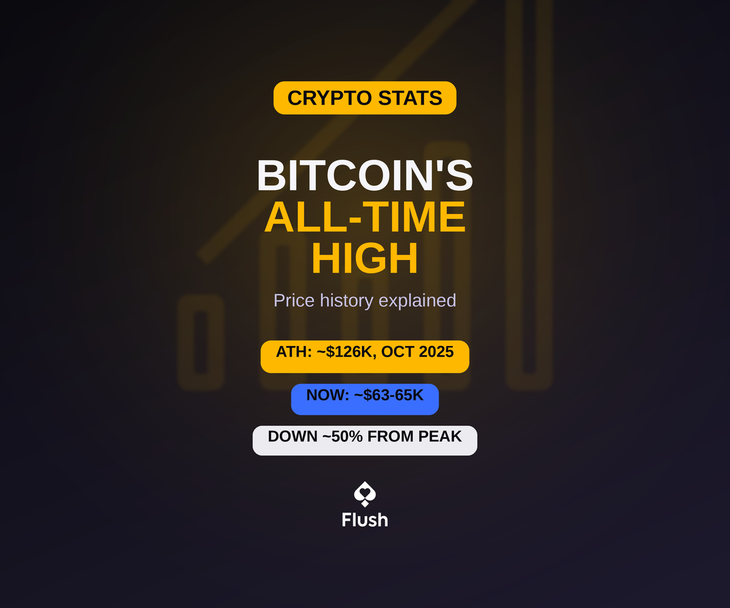
What Is the Highest Bitcoin Has Ever Been? ATH History
Bitcoin's all time high sits around $126,000, set in early October 2025. Here's the full timeline of its major peaks, and where the price stands now.
5 min read
What Is Bitcoin Mining? Guide
Bitcoin mining explained in plain terms: how proof of work secures the network, why ASIC hardware replaced home computers, how halvings shrink the block reward, and whether mining is still profitable in 2026.
5 min read
Bitcoin Crash: What Happens When BTC Dumps
What actually causes a bitcoin crash, how leveraged liquidations amplify the fall, and what history says about recovery, from the 2018 crash through the October 2025 to 2026 correction.
5 min read