August 14, 2026 • 5 min read

Gambling Taxes Guide: How to Deduct and Prove Losses
Quick Answer
In the US, gambling winnings are always taxable income, but losses are only deductible if you itemize, and only up to the amount of winnings reported. Rules vary by state; this is general information, not personalized tax advice.
You must be 18+ to access this content. Please gamble responsibly.
Key Facts
| Winnings taxability | All gambling winnings are taxable income regardless of amount or whether a W-2G was issued |
| Loss deduction condition | Losses are deductible only if you itemize on Schedule A, capped at total reported winnings |
| No carryforward | Excess losses beyond winnings cannot be carried forward to a future tax year |
| W-2G slot/bingo threshold | Generally triggered at $1,200 or more in winnings |
| W-2G poker tournament threshold | Generally triggered at $5,000 or more after the buy-in |
| Recordkeeping standard | IRS generally expects a contemporaneous log of sessions, not reconstructed memory |
| State tax variation | State treatment of gambling winnings and loss deductions varies significantly by state |
| Crypto complication | Crypto gambling can trigger a separate capital gains or loss event on top of the gambling result |
In the United States, gambling winnings are taxable income and must be reported in full, but gambling losses can only be deducted if you itemize deductions on Schedule A, and even then only up to the amount of winnings you report, never more. This article explains the general mechanics of how that works. It is not personalized tax advice, tax rules vary by state and by individual circumstances, and anyone with a real filing to prepare should talk to a qualified tax professional rather than relying on a blog post.
The Core Rule: Winnings Are Always Income, Losses Are Conditional
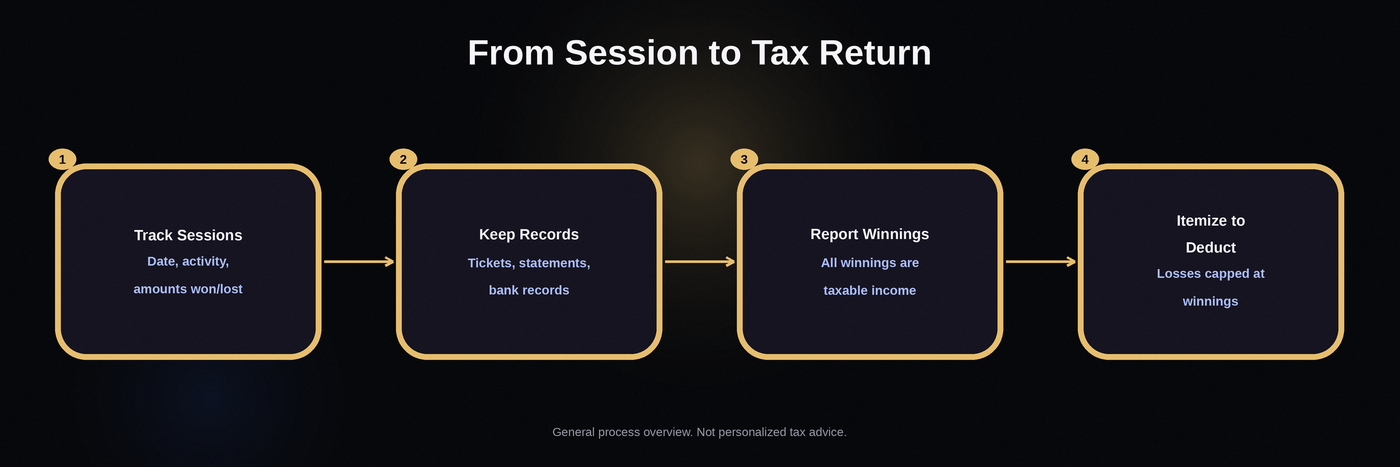
The IRS treats gambling winnings as taxable income the moment you win, regardless of the amount, the game, or whether the platform issues you any paperwork. That includes casino winnings, sports betting payouts, poker tournament winnings, lottery prizes, and crypto casino winnings converted to a dollar value at the time received. Losses work completely differently and are far more restrictive. You can only deduct gambling losses if you itemize your deductions instead of taking the standard deduction, and even then the deduction is capped at the total amount of gambling winnings you reported that year. If you won 5,000 dollars across the year and lost 8,000 dollars, you can only deduct 5,000 of those losses, not the full 8,000, and you cannot carry the extra 3,000 forward to a future tax year. This asymmetry surprises a lot of people the first time they encounter it, and it is the single most important mechanic to understand before doing anything else with gambling taxes.
Standard Deduction vs Itemizing: Why This Decision Matters
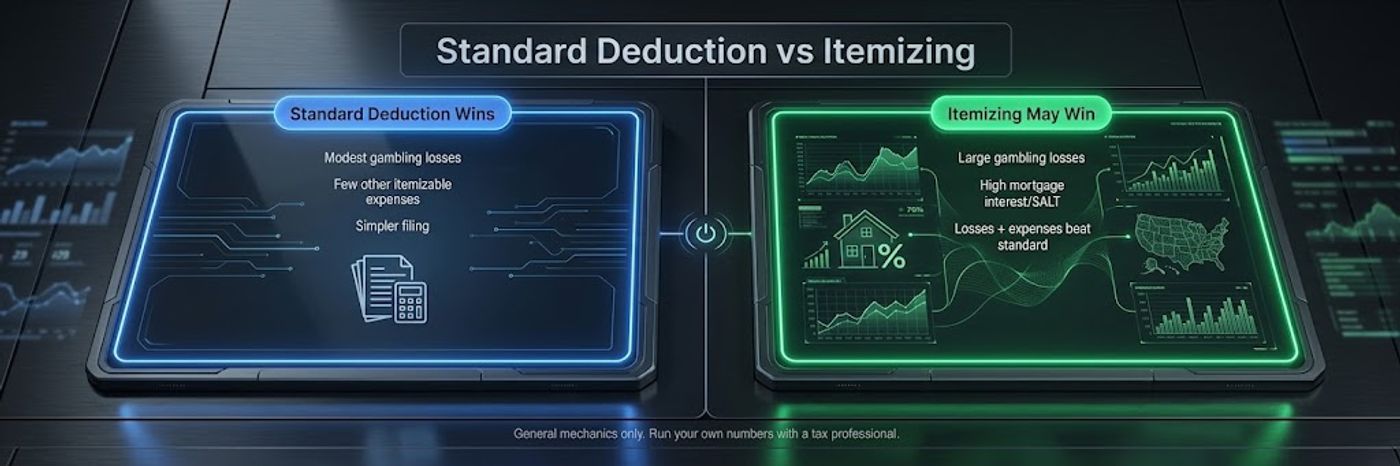
Because gambling losses are only deductible if you itemize, the standard deduction versus itemizing decision becomes the real gatekeeper for whether a loss deduction helps you at all. Most filers in the US take the standard deduction because it is larger than their itemizable expenses combined. If your gambling losses, added to your other itemizable expenses like mortgage interest, state and local taxes, and charitable donations, do not add up to more than the standard deduction, itemizing to claim gambling losses will not actually lower your tax bill, since you would be giving up the larger standard deduction to do it. This is why a lot of recreational gamblers with modest losses never end up itemizing, the math simply does not favor it, even though they are legally entitled to try. Anyone with significant enough losses that itemizing might genuinely beat the standard deduction should run the numbers with a tax professional rather than guessing, since the comparison depends on your full financial picture, not gambling activity in isolation.
What Records You Actually Need to Prove Losses
The IRS does not take a gambler's word for reported losses. Documentation requirements are specific, and the burden of proof sits with the taxpayer, not the casino or sportsbook. The IRS generally expects a contemporaneous diary or log of gambling sessions, meaning records kept at the time of play rather than reconstructed months later from memory. A usable log records the date, the type of gambling activity, the name and address of the establishment or platform, the names of anyone who can corroborate you were there if applicable, and the amounts won and lost for each session. Beyond the log itself, supporting documentation matters: wagering tickets, statements from betting platforms, bank withdrawal and deposit records tied to gambling activity, and any official tax forms issued to you. For crypto casino activity specifically, that means keeping your own transaction history alongside platform statements, since converting between crypto and dollar value at the time of each win adds a layer of record-keeping that traditional cash gambling does not require. Waiting until filing season to try to reconstruct a year of sessions from memory is a common and largely avoidable mistake.
Form W-2G and When Casinos Report to the IRS
Certain gambling wins trigger a mandatory Form W-2G, which the payer sends both to you and to the IRS, meaning the win is already on the IRS's radar independent of anything you report yourself. Thresholds vary by game type: table games like blackjack, baccarat, and craps generally do not trigger automatic W-2G reporting regardless of the amount won, while slot machine and bingo wins of 1,200 dollars or more, keno wins of 1,500 dollars or more, and poker tournament wins of 5,000 dollars or more after deducting the buy-in typically do. Sports betting and other wagers can trigger a W-2G at 600 dollars or more if the payout is at least 300 times the wager. Importantly, receiving no W-2G does not mean a win is not taxable, every dollar of gambling income is reportable regardless of whether a form was issued, the threshold only determines whether the casino is required to report it directly to the IRS as well. This is a common point of confusion worth being precise about: the absence of paperwork is not the absence of a tax obligation.
State Taxes Add Another Layer
Everything above covers federal tax treatment, but most states with an income tax also tax gambling winnings, and the details vary considerably from state to state. Some states allow a deduction for gambling losses that mirrors the federal rule, some do not allow it at all even if you itemize federally, and a handful of states with no income tax naturally sidestep the issue entirely for residents. Nonresident gamblers can face an additional wrinkle: winning in a state where you do not live can sometimes trigger a nonresident filing obligation in that state on top of your home state's return, particularly for larger wins subject to state-level withholding. Because state rules genuinely differ this much, and because they change from year to year as state legislatures adjust tax codes, this guide cannot responsibly give a state-by-state breakdown. A tax professional licensed in your state is the right resource for that layer specifically, especially if you gambled in a state other than where you file your primary return.
Professional Gambler Status: A Different Set of Rules Entirely
A small number of gamblers qualify as professional gamblers for tax purposes, meaning gambling is their trade or business rather than a recreational activity, based on factors like the frequency, consistency, and business-like manner in which they gamble, alongside their intent to earn a livelihood from it. Professional status changes the tax treatment substantially: business expenses beyond just wagering losses become deductible, gambling activity gets reported on a Schedule C rather than as miscellaneous income and itemized losses, and self-employment tax considerations come into play. Qualifying for professional gambler status is a genuinely fact-specific determination that the IRS and courts have litigated repeatedly, and claiming it incorrectly can create real problems on audit. This is one of the clearest areas in the entire gambling tax picture where a qualified tax professional's judgment matters far more than a general guide like this one can responsibly provide. Courts have generally looked at factors like whether the gambler kept detailed business-like records, whether they had other significant income sources supporting a hobby classification instead, how much time was devoted to gambling activity, and whether the pattern of behavior looked like someone pursuing profit systematically rather than playing recreationally. Getting this classification wrong in either direction, claiming professional status without meeting the bar, or failing to claim it when the facts genuinely support it, can mean paying substantially more tax than necessary or drawing unwanted audit attention, which is exactly the kind of high-stakes judgment call that belongs with a licensed preparer rather than a general information guide.

Crypto Gambling Adds a Layer of Complexity
Gambling with cryptocurrency does not change the basic rules above, winnings are still taxable income and losses are still only deductible up to winnings if you itemize, but it adds a genuine complication most cash gambling does not involve: the crypto itself may also trigger separate capital gains or losses independent of the gambling activity. If you bought bitcoin at one price, held it, then used it to fund a crypto deposit and later withdrew winnings, you potentially have two separate taxable events layered on top of each other, the gambling win or loss itself, and any change in the crypto's dollar value between when you acquired it and when you used or withdrew it. This is exactly the kind of situation where the general information in this guide is not enough, and getting a tax professional who understands both gambling tax rules and crypto tax rules involved is the responsible move rather than guessing at how the two interact. Our guide on how to spend bitcoin covers the practical side of moving crypto in and out of everyday use, including gambling, though it is not a substitute for tax guidance on the reporting side.
Responsible Gambling
Set a budget before you start and treat it as entertainment spending, not a way to recover losses. Flush's responsible gambling tools include deposit limits, session timers, and self-exclusion, all adjustable directly from your account. Free, confidential support is available around the clock from GamCare (0808 8020 133) and BeGambleAware in the UK, and the National Council on Problem Gambling (1-800-GAMBLER) in the US, or via Gambling Therapy globally.
This guide covers general mechanics only, it is not personalized tax advice, and gambling tax rules vary by state, by filing status, and by individual financial circumstances well beyond what any general article can account for. If you have real winnings or losses to report, talk to a qualified tax professional before filing. For the funding side of things, deposits and withdrawals at Flush's casino clear in minutes, and our guide on how bitcoin gambling actually works covers the mechanics of moving crypto in and out of a gambling account if you want the fuller picture before your next session.
How We Researched This
Methodology
This guide was researched via web search in August 2026 covering general IRS treatment of gambling winnings and losses, Form W-2G reporting thresholds, the standard deduction versus itemizing mechanic, professional gambler classification factors, and how cryptocurrency gambling adds separate capital gains considerations. It is intentionally general and hedged throughout, since gambling tax outcomes depend heavily on individual and state-specific facts that a general guide cannot responsibly resolve.
FAQ
Frequently Asked Questions
Can you write off gambling losses on your taxes?
Do you have to report gambling winnings under a certain amount?
What records do I need to prove gambling losses?
Does gambling with crypto change how taxes work?
Is this article personalized tax advice?

Share This Post
Share this post for your chance to win!
Related Posts
Level up your knowledge

How Bitcoin Gambling Works 2026: Complete Guide
Bitcoin gambling means depositing, wagering, and withdrawing with BTC instead of fiat. Here is how deposits, withdrawals, wallets, and provably fair systems actually work.
5 min read

How to Spend Bitcoin in 2026: A Practical Guide
Bitcoin isn't just something to hold. Here's how to actually spend it in 2026, from Lightning payments and crypto debit cards to funding online play directly.
5 min read

Provably Fair Bitcoin Games: Which Types You Can Verify 2026
Which crypto game types are actually provably fair, what the hash-commit-reveal check confirms for each one, and a step-by-step walkthrough for verifying a Flush Originals round yourself.
5 min read