August 9, 2026 • 5 min read

How to Play Valorant: Beginner Guide
Quick Answer
Valorant is a free tactical shooter with one-life rounds, four agent roles (Duelist, Controller, Initiator, Sentinel), and a credit-based economy. Install via the Riot Client, start in Unrated to learn maps and agents, then unlock Competitive once your account levels up.
You must be 18+ to access this content. Please gamble responsibly.
Key Facts
| Cost to play | Free to play, no paywall on competitive features |
| Platforms | PC, PlayStation 5, Xbox Series X|S |
| Round format | Single life per round, best of to 13 |
| Agent roles | Duelist, Controller, Initiator, Sentinel |
| Anti-cheat | Riot Vanguard, kernel-level, PC only |
| Ranked unlock | Requires account level + phone verification |
| Starting queue | Unrated (no visible rank) |
| Active map pool | Roughly 7 to 8 maps, rotates over time |
Valorant is a free to play, five versus five tactical shooter from Riot Games that mixes precise, Counter-Strike style gunplay with character abilities that add utility, vision control, and area denial on top of the raw aim. It has no matchmaking cost and no paywall on competitive features, so the only real barrier to entry is understanding how the game actually works before you queue into a match with strangers who already do. This guide covers installing the game, the core mechanics, the four agent roles, the economy system, and what to expect from your first few matches.
Installing and Setting Up Valorant
Valorant runs on PC through Riot's own client, and on PlayStation 5 and Xbox Series X|S through each platform's standard store. On PC, you create or link a Riot Account, download the Riot Client, and install Valorant through it, which also installs Riot Vanguard, the game's kernel level anti-cheat driver. Vanguard runs at boot on PC and cannot be disabled while Valorant is installed, which is worth knowing before you install it on a shared or work machine. On console, installation goes through the standard PlayStation Store or Xbox marketplace listing, and Vanguard is not part of the console build.
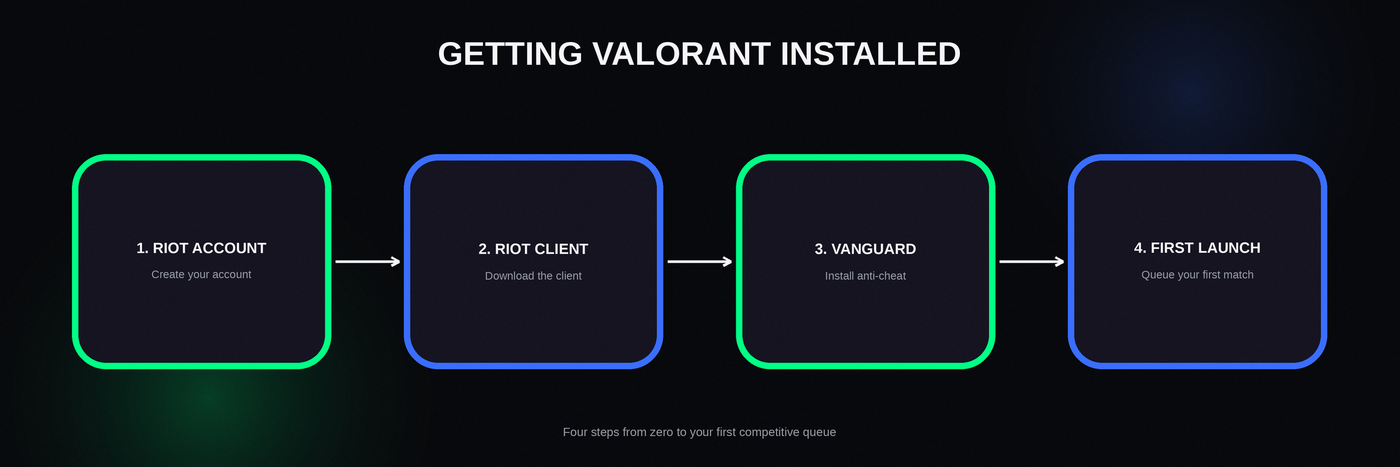
Once installed, spend a few minutes in the settings menu before your first match. Turning on the crosshair customization panel, adjusting your mouse sensitivity to something you can consistently track with, and binding your ability keys to something comfortable will save you from fumbling controls mid-round later. Riot also gates ranked play behind an account level requirement and a phone number verification, so new accounts need to play a handful of unranked matches before competitive unlocks.
The Basics: How a Round Works
Every Valorant match is a best of series played to 13 rounds on standard competitive settings, with teams swapping between attacking and defending sides at the halfway point. Attackers carry the Spike, a bomb that must be planted at one of the map's designated sites and detonated, or the round is won by eliminating the entire enemy team, running out the round timer while holding the Spike unplanted, or successfully defusing a planted Spike as the defending side. Each round opens with a buy phase where both teams spend in-game credits on weapons, armor, and ability charges before the round timer starts.
Unlike a respawn based shooter, Valorant rounds are single life: get eliminated once, and you spectate for the rest of that round regardless of how it plays out. That single elimination format is what makes positioning and information gathering so much more valuable than raw reflexes alone, since a single bad peek costs you the entire round, not just a few seconds of respawn timer.
The Four Agent Roles
Every agent in Valorant belongs to one of four roles, and understanding what each role is supposed to do is the fastest way to stop feeling lost in your first matches.
Duelists
Duelists are built to create space and get the first pick in a fight. Agents like Jett, Reyna, Raze, and Neon carry mobility or aggressive utility meant to let them enter a site or angle before the rest of the team. New players are often drawn to duelists first because they feel the most active, but they are also the least forgiving role to learn on, since a duelist who enters badly usually just dies first.
Controllers
Controllers place smokes and other vision-blocking utility to cut off angles and slow down a push. Omen, Viper, Astra, and Brimstone all fall into this role, and a controller's job is less about getting kills and more about shaping where fights happen so the rest of the team fights on favorable terms. This role rewards map knowledge over mechanical skill, which makes it a reasonable pick for a beginner who wants to contribute without needing tournament level aim yet.
Initiators
Initiators gather information and soften up a site before an entry, using flashes, recon darts, or tripwires. Sova, Skye, Breach, and KAY/O all fit here, and their utility is meant to set up kills for teammates as much as get kills themselves. A good initiator makes every other role's job easier by removing the guesswork before a push.
Sentinels
Sentinels hold ground, watch flanks, and provide defensive utility like healing or trip alarms. Killjoy, Cypher, Sage, and Chamber belong to this role, and they are often the most beginner-friendly agents in the game since much of their kit is passive or defensive rather than requiring a perfectly timed aggressive play.
Understanding the Economy System
Every round, both teams earn credits based on the round's outcome, kills, and whether the Spike was planted, and those credits carry over between rounds up to a cap. This creates a resource management layer on top of the shooting: teams that win rounds get richer and can afford better weapons and full utility, while teams on a losing streak often have to decide between spending everything on a full buy they cannot really afford, or saving credits entirely for a stronger round later, commonly called an eco round.
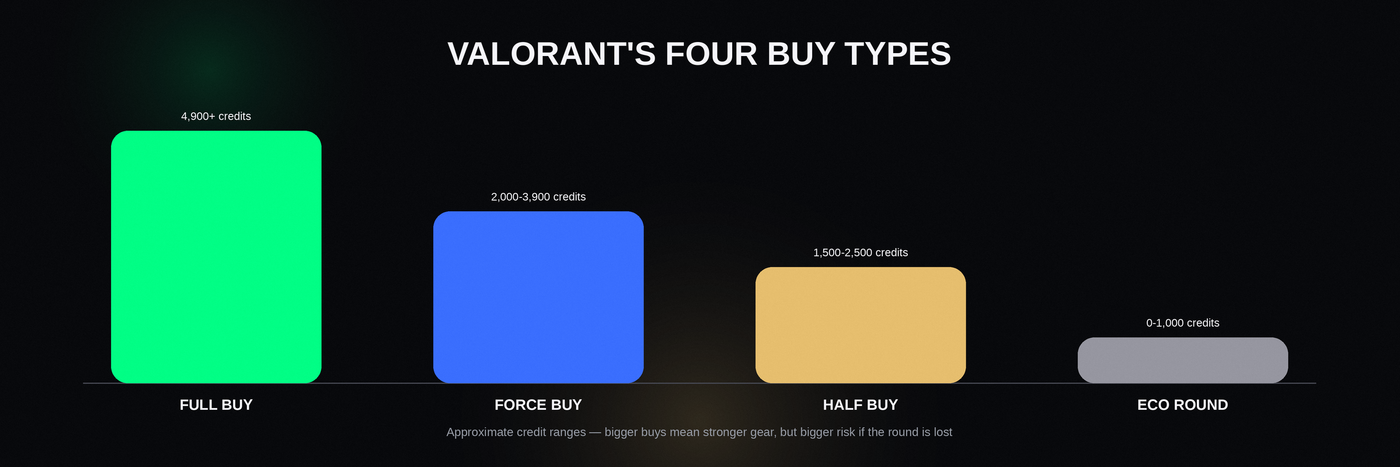
A force buy is when a team spends most or all of its credits despite not having a full bankroll, usually to avoid falling further behind or to punish an opponent who is also low on credits. Reading the economy, both your own and the opposing team's, is one of the clearest signs of an experienced Valorant player, since it lets you predict whether the enemy team is likely to have full utility and rifles or is running with pistols and no abilities.
Your First Matches: What to Expect
New accounts start in Unrated queue, which uses the same maps and rules as competitive but without a visible rank attached, making it the right place to learn agent kits and map layouts without the added pressure of a rank on the line. Riot's matchmaking in Unrated is looser than in competitive, so expect a wider range of skill levels in your early matches. Spend this period trying different agents across all four roles rather than locking into one immediately, since your first few hours are the cheapest time to figure out what playstyle actually suits you.
Once you unlock Competitive, expect placement matches that set your initial rank before you start climbing or dropping normally. Competitive adds voice communication expectations, stricter accountability for mistakes since every round matters more to your rank, and generally sweatier lobbies than Unrated. There is no rule that says you need to rush into ranked immediately, and plenty of experienced players still warm up in Unrated or the Swiftplay quick mode before a ranked session.
Learning the Maps
Valorant's competitive map pool rotates over time, but at any given point you are typically choosing between seven or eight active maps, each with a distinct layout, number of sites, and callouts that regular players use to communicate position quickly. Learning callouts before you learn deep strategy pays off immediately, since a teammate calling out a rotation only helps you if you know which part of the map they mean. Spend time in the practice range or a few unranked matches on each map specifically to learn site layouts, common defender positions, and where utility usually gets thrown, rather than trying to absorb all of it from a single match.
Map knowledge compounds with role knowledge. A Controller who knows exactly where a site's chokepoints are can smoke far more efficiently than one guessing at general area, and an Initiator who knows the common flank routes on a given map gets far more value from a recon dart than one throwing blind. None of this needs to be memorized on day one, but treating map learning as its own skill, separate from aim and game sense, will speed up your climb noticeably.
Tips for a Smoother Learning Curve
Watching a replay of your own match, even briefly, teaches you more about positioning mistakes than another ten matches played on autopilot. Muting comms when a lobby turns toxic is always available and does not affect your ability to play, and reporting genuinely disruptive players afterward helps the wider matchmaking pool more than staying in a bad conversation does. If you are deciding what to play Valorant on, our guide to whether Valorant supports crossplay explains how PC and console are handled separately, and once you have a few matches under your belt, our Neon agent guide is a good next read if the duelist role appeals to you.
Dialing in your mouse settings is worth doing early rather than fighting an uncomfortable sensitivity for weeks. Our eDPI calculator guide explains how to translate a sensitivity feel you already like from another game into Valorant's specific yaw value, so you are not guessing at a number from scratch.
Beyond playing the game yourself, Valorant also has one of the largest esports scenes in gaming through VCT, and once you understand the fundamentals covered here, watching professional matches becomes a lot more readable. Flush's esports sportsbook covers match odds across VCT alongside CS2, League of Legends, and Dota 2 for anyone who wants to follow the competitive side of the game they are learning to play.
Responsible Gambling
If you are new to betting on esports, set a budget before you start and treat it as entertainment spending, not a way to recover losses. Flush's responsible gambling tools include deposit limits, session timers, and self-exclusion, all adjustable directly from your account. Free, confidential support is available around the clock from GamCare (0808 8020 133) and BeGambleAware in the UK, and the National Council on Problem Gambling (1-800-GAMBLER) in the US, or via Gambling Therapy globally.
Every current Valorant pro started exactly where you are now: installing the client, fumbling the first few rounds, and slowly learning what each agent and role actually does. Once the fundamentals click, following the competitive scene and betting on VCT matches at Flush's esports sportsbook is a natural next step.
How We Researched This
Methodology
This guide draws on Riot Games' official onboarding documentation and current client behavior (account level gating, Vanguard installation, queue types) verified as of August 2026, cross-referenced against community new-player guides for role and economy explanations. Agent role assignments and buy-type terminology reflect the game as it currently exists in the client; specific agents may be added, reworked, or moved between roles in future updates, so treat the agent examples given per role as illustrative of the current roster rather than permanent.
FAQ
Frequently Asked Questions
Is Valorant free to play?
What agent role should a beginner start with?
How long before I can play ranked in Valorant?
What is the Valorant economy system?
Do I need a gaming PC to play Valorant?

Share This Post
Share this post for your chance to win!
Related Posts
Level up your knowledge
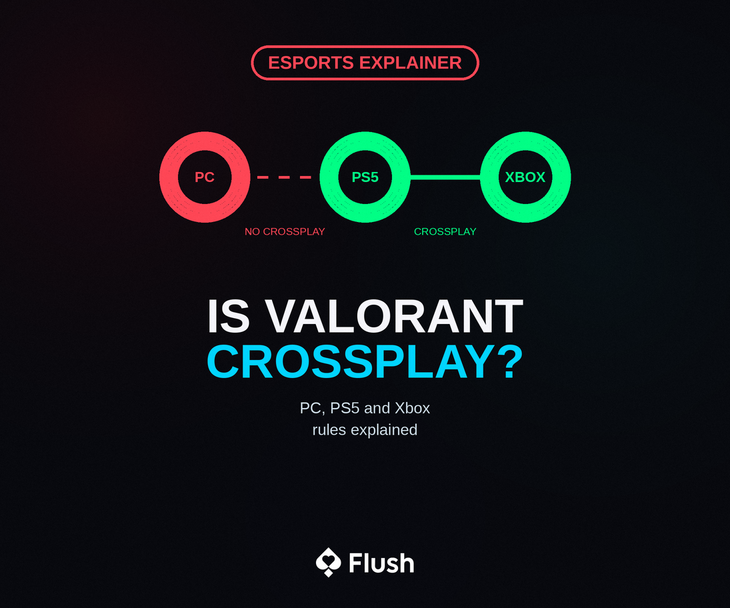
Is Valorant Crossplay? PC, PS5, and Xbox Explained 2026
Valorant has no crossplay between PC and console, but PlayStation 5 and Xbox Series X|S players share the same lobbies. Here is how it works in 2026.
5 min read
eDPI Calculator: Valorant, CS2, and LoL Formulas Explained
eDPI equals mouse DPI multiplied by in-game sensitivity. See the exact formula and a worked example for Valorant, CS2, and League of Legends.
5 min read
How Much Have I Spent on Valorant? Checker Guide
Riot's Purchase History tool for Valorant gives you an exact real money total in seconds once you log in. Here is how to check what you have spent.
5 min read