August 15, 2026 • 5 min read

Is Day Trading Gambling? Stocks, Options, Fantasy Sports
Quick Answer
Day trading shares gambling's variance, edge problems, and psychological pull, but also involves real skill and ownership of a productive asset, unlike a slot machine's fixed math. It sits on a spectrum, not a clean yes or no.
You must be 18+ to access this content. Please gamble responsibly.
Key Facts
| Retail day trading outcomes | Most frequent retail day traders lose money over time versus institutional participants |
| Short-dated options | The majority of short-dated retail options contracts expire worthless |
| Daily fantasy sports | Legally classified as skill-dominant in the US, similar to poker |
| DFS money distribution | A small share of highly skilled players wins most of the money on major platforms |
| Casino house edge | Fixed and disclosed on most games; skill cannot change it by design |
| Blackjack/poker exception | Skill can shift the edge in blackjack and poker unlike pure chance games |
| Key distinguishing questions | Is there a real edge, enough time for skill to show, and a sensible stake size |
| Shared psychological risk | Loss-chasing and variance-driven overconfidence appear across all four activities |
Day trading shares real structural similarities with gambling: both put money at risk on an uncertain short-term outcome, both can trigger the same dopamine-driven urge to chase losses, and both have an edge that sits with whoever holds the informational or structural advantage. But day trading also involves owning a claim on a real, productive asset and a skill ceiling that genuinely separates good traders from bad ones over time, something a casino game's fixed house edge does not allow for. The honest answer is that it depends heavily on how it's done, not a clean yes or no.
What Actually Makes Something Gambling
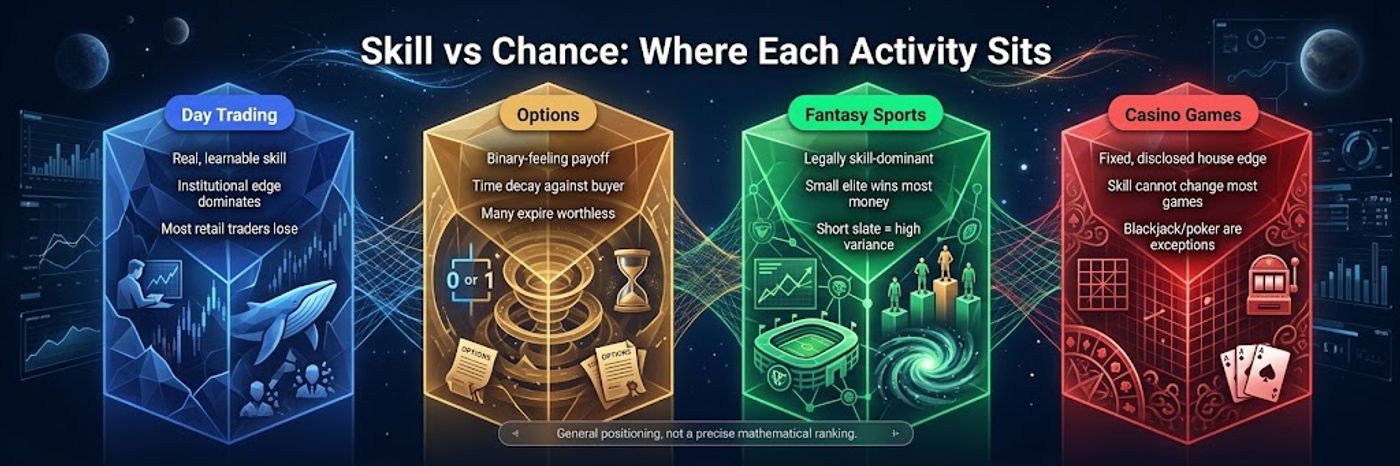
Before comparing activities, it helps to define the term instead of using it loosely. Gambling, in the strict sense, means staking money on an outcome that is uncertain, where the odds are generally fixed against the player over the long run, and where skill either cannot change the outcome at all or only changes it at the margins. A slot machine has a fixed return to player built into its math; no amount of skill moves that number. Chess for money is the opposite end of the spectrum, almost pure skill with very little chance once both players are strong. Most of the activities worth comparing here, day trading, options trading, fantasy sports, and casino games, sit at different points along that same spectrum rather than falling cleanly into "investing" on one side and "gambling" on the other.
Day Trading: Real Skill, Real Edge Problems
Day trading involves buying and selling securities within the same session, trying to profit from short-term price movement rather than a company's long-term value. There is genuine skill available here: reading order flow, understanding how news catalysts move a stock, managing position size, and having the discipline to cut losses quickly are all learnable, differentiating skills. That is meaningfully different from a casino game, where no amount of study changes your expected return on a single spin of roulette. The problem is that day trading's skill ceiling does not protect most participants, because the traders on the other side of most trades are increasingly institutional players and algorithms with faster data, lower transaction costs, and more capital to absorb short-term losses. Retail day trading study after study has shown the large majority of frequent day traders lose money over time, not because the skill does not exist, but because the field is stacked against smaller, slower participants competing against those with a genuine structural edge. That is closer to a poker table full of professionals than a casino floor, skill matters enormously, but most amateurs are still going to lose to it.
Options Trading: A Different Kind of Leverage
Options add another layer worth separating out from plain day trading. Buying a call or put option is a bet with a defined, often binary-feeling payoff structure: the option can expire completely worthless, which happens to the majority of short-dated retail options contracts. That payoff shape, a fixed premium at risk against a chance of a large multiple return or a total loss, resembles a casino bet more closely than owning shares does. Options also carry time decay working against the buyer every single day the position is held, a mechanical cost that exists independent of whether the trader is right about market direction. Selling options, rather than buying them, flips this dynamic and can behave more like running the house, collecting small consistent premiums against the risk of a rare large loss, which is structurally closer to how a casino or a sportsbook actually makes money over time.
Fantasy Sports: Skill Framed as a Legal Distinction
Daily fantasy sports occupies an unusual legal position in the United States specifically because regulators have accepted the industry's argument that it is predominantly a game of skill rather than chance, which is the same legal test that separates poker from slot machines in several jurisdictions. In practice, daily fantasy outcomes are influenced by real skill, player research, salary cap optimization, understanding matchups, but a single day's slate is also short enough that variance can dominate any one outcome regardless of how well researched the lineup was. The data backs this up: a small percentage of highly skilled, often semi-professional players win the large majority of the money on major platforms, while casual weekly players lose consistently, a pattern that looks a great deal like sports betting or poker rather than a stock market where skilled long-term investors are not competing directly against each other for a shared, capped prize pool.
Casino Gambling: The Cleanest Comparison
Casino games sit at the far end of the spectrum from something like value investing. Slots, roulette, and most table games have a fixed, disclosed house edge that skill cannot overcome, by design. Games like blackjack and poker complicate that picture slightly, since basic strategy and card counting can shift blackjack's edge, and poker is played against other players rather than the house, making it a genuine skill game over a large enough sample, similar in spirit to how provably fair systems let players verify a game's math rather than take a casino's word for it. What casino gambling shares with day trading and options is not the presence or absence of skill, it is the psychological experience: the dopamine hit of a win, the urge to chase a loss with a bigger bet, and the way short-term variance can make a bad decision look good or a good decision look bad purely by chance. If you want a closer look at that specific psychological overlap, our guide on whether online blackjack is rigged breaks down how a fixed house edge actually works in practice and why the games are provably fair rather than secretly stacked.
Where the Line Actually Sits
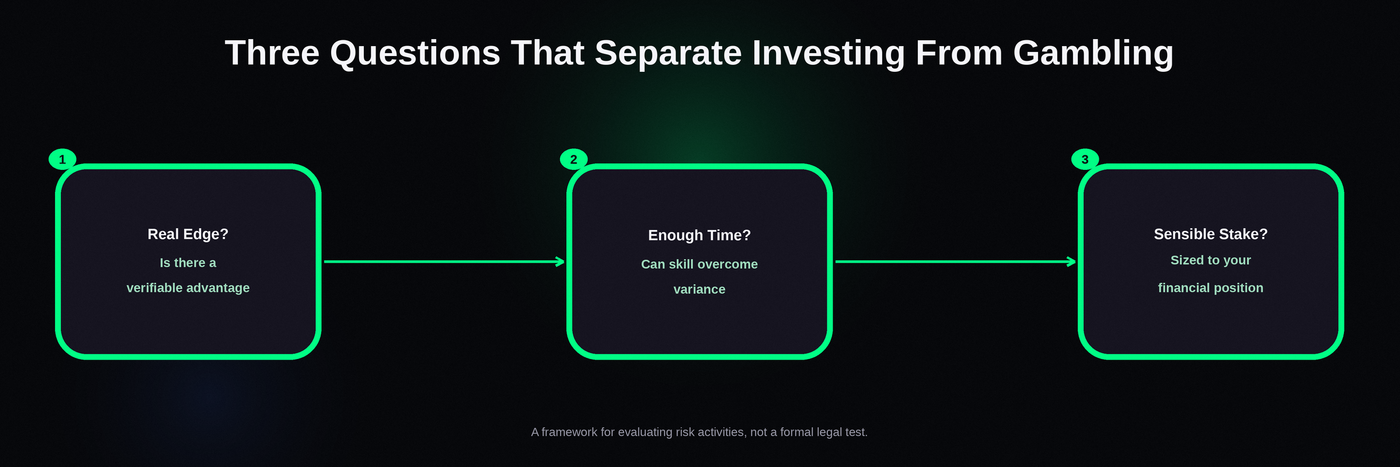
The clearest way to separate these activities is not skill versus chance in isolation, but three questions together: is there a real, verifiable edge available to a skilled participant, is the time horizon long enough for skill to statistically overcome variance, and is the amount being staked appropriately sized relative to the person's actual financial position. A professional trader running disciplined risk management with defined stop losses over years is doing something meaningfully different from someone opening a trading app for the first time and putting a paycheck into a single leveraged options position on a rumor. Both technically fall under "day trading," but they are not remotely the same activity in practice, and lumping them together as either pure investing or pure gambling misses the point. Bankroll math matters here regardless of which of these activities someone is doing, our breakdown of dice game bankroll math covers the same variance and staking principles that apply just as directly to a trading account as to a casino balance.
The Honest Takeaway
Calling day trading "just gambling" oversimplifies an activity that includes both genuine, learnable skill and structural disadvantages that make most participants losers over time, which is a more complicated picture than a slot machine's fixed math. Calling it "definitely not gambling" ignores the very real psychological and structural overlap, especially in short-dated options and undisciplined position sizing. The more useful framing treats all of these activities, day trading, options, fantasy sports, and casino gambling, on the same spectrum of skill, edge, and variance, and asks the same risk management questions of each one: what is the real edge, how large is the sample needed for skill to show up, and is the stake sized sensibly. Anyone treating any of these as a reliable income source without those questions answered honestly is taking on more risk than they likely realize, whichever activity it is.
Responsible Gambling
Set a budget before you start and treat it as entertainment spending, not a way to recover losses. Flush's responsible gambling tools include deposit limits, session timers, and self-exclusion, all adjustable directly from your account. Free, confidential support is available around the clock from GamCare (0808 8020 133) and BeGambleAware in the UK, and the National Council on Problem Gambling (1-800-GAMBLER) in the US, or via Gambling Therapy globally.
Whether it's a leveraged options position or a round of Plinko, the same bankroll discipline applies: know your edge, size your stakes sensibly, and never treat either one as a way to fix a financial hole. If casino games are more your speed than a trading terminal, Flush's casino runs every game provably fair, so the odds are disclosed and verifiable rather than hidden behind a black box.
How We Researched This
Methodology
This guide compares day trading, options trading, daily fantasy sports, and casino gambling using publicly reported retail trading loss studies, standard options mechanics, the legal skill-game framework used for daily fantasy sports in the US, and disclosed casino house edge math. It deliberately avoids collapsing all four into a single verdict, since each involves a different mix of skill, edge, and variance.
FAQ
Frequently Asked Questions
Is day trading considered gambling?
Is options trading riskier than day trading stocks?
Is daily fantasy sports gambling or skill?
Can skill overcome the house edge in day trading?
What determines whether an activity counts as gambling?

Share This Post
Share this post for your chance to win!
Related Posts
Level up your knowledge
Is Crypto Dead? Reality Check
Crypto's obituary gets written every cycle. Here is what the 2026 data on market cap, institutional adoption, and stablecoin growth actually says about whether it is dead or just going through another drawdown.
5 min read
How Bitcoin Gambling Works 2026: Complete Guide
Bitcoin gambling means depositing, wagering, and withdrawing with BTC instead of fiat. Here is how deposits, withdrawals, wallets, and provably fair systems actually work.
5 min read

Bitcoin Crash: What Happens When BTC Dumps
What actually causes a bitcoin crash, how leveraged liquidations amplify the fall, and what history says about recovery, from the 2018 crash through the October 2025 to 2026 correction.
5 min read