June 1, 2026 • 5 min read
What Is RTP in Slots
Quick Answer
RTP (return to player) is the share of all money wagered on a slot that it pays back over millions of spins. A 96% RTP slot returns EUR96 per EUR100 wagered on average, which means a 4% house edge; it does not predict a single session.
Key Facts
| RTP formula | Total returned / total wagered x 100 |
| Example | 96% RTP = 4% house edge |
| Lowest RTP listed at Flush | 94% |
| Top tier examples | Chicken+, Mines+, Limbo+ at 97.5% |
| Land-based slot RTP | Commonly 85-88% |
| Sweet Bonanza 2500 | 96.52% RTP, High volatility, 25,000x max win |
| Bash Bros | 96.26% RTP, Low volatility, 10,000x max win |
| San Quentin Manhunt | 96.15% RTP, High volatility, 46,532x max win |
| Le Digger vs Le Digger 94 | 96.26% vs 94.29% |
| Certification simulation | 10 to 50 million spins |
| Supported cryptocurrencies | 10 |
Quick Answer: RTP (return to player) is the percentage of all money wagered on a slot that the game pays back to players over millions of spins. A slot with 96% RTP returns EUR96 for every EUR100 wagered, on average, over time, across all players. It does not tell you what happens in your session. It tells you the house edge built into the game.
Table of Contents
1. What Does RTP Actually Mean?
2. How RTP Works: The Mechanics
3. Why RTP Matters for Your Bankroll
4. RTP in Practice: Real Examples at Flush
5. Common Mistakes and Misconceptions
6. How to Use RTP at Flush
7. The Crypto Casino Angle
8. Responsible Play
What Does RTP Actually Mean?
Return to player is the number that tells you, before you spin a single reel, how much of your money a slot is designed to keep.
Think of it like a swimming pool with a slow drain. Players pour money in. The slot returns most of it, redistributed as wins across every player who spins that game. But the drain never stops. On a 96% RTP slot, 4% of everything wagered flows out permanently to the house. That 4% is the house edge.
The number exists because game providers, Pragmatic Play, Hacksaw, Nolimit City, are required to publish it. Independent testing labs like eCOGRA, BMM, and GLI audit every slot before it goes live, running simulations across tens of millions of spins to verify the RTP matches what the provider claims. The figure you see in a game's paytable is not a marketing estimate. It is a tested, certified measurement.
What it is not is a session guarantee. A 96.5% RTP slot does not mean you will get back EUR96.50 from every EUR100 you personally spend today. It means that across every player who has ever spun that game, billions of spins combined, the payout rate trends toward 96.5%. Your 200-spin session this evening is a tiny sample. In that window, you might walk away up 300%. You might lose your entire stake. Both outcomes are consistent with a 96.5% RTP game.
That distinction, long-run average versus short-run session, is where most players get it wrong. The rest of this guide is built around making sure you do not.
How RTP Works: The Mechanics
The formula behind return to player is straightforward:
RTP% = (Total returned to players / Total wagered) x 100
In practice: a slot processes EUR10,000,000 in total wagers across all players over its lifetime. It pays out EUR9,650,000 in wins. Divide EUR9,650,000 by EUR10,000,000, multiply by 100, you get 96.5% RTP. The house kept EUR350,000. That is the 3.5% house edge on the other side of the equation.
The critical detail is the denominator. That EUR10,000,000 figure takes years of real-money play across thousands of players to accumulate. The RTP certification labs simulate it artificially, running 10 to 50 million spin cycles before a game launches. Your 100-spin session tonight contributes a fraction of a fraction of a percent to that total. Which is why your session result and the published RTP figure can look nothing alike.
The RTP Spectrum at Flush
Not all slots are built equal. Here is how the catalog at Flush breaks down across RTP tiers, using verified game data:
At the top, games in the exceptional tier (97%+ RTP, house edge below 3%) include Chicken+ (97.5%), Mines+ (97.5%), and Limbo+ (97.5%). The above-average tier (96-96.99% RTP, house edge 3-4%) covers the bulk of the catalog's strongest titles, including Dragon Pots Megaways (96.58%), Sweet Bonanza 2500 (96.52%), and Great Ghosts! (96.50%). The below-average tier (94-95.99%, house edge 4-6%) consists primarily of reduced-RTP variants such as Le Digger 94 (94.29%) and Dynasty of Death 94 (94.29%). Flush lists nothing below 94% RTP.
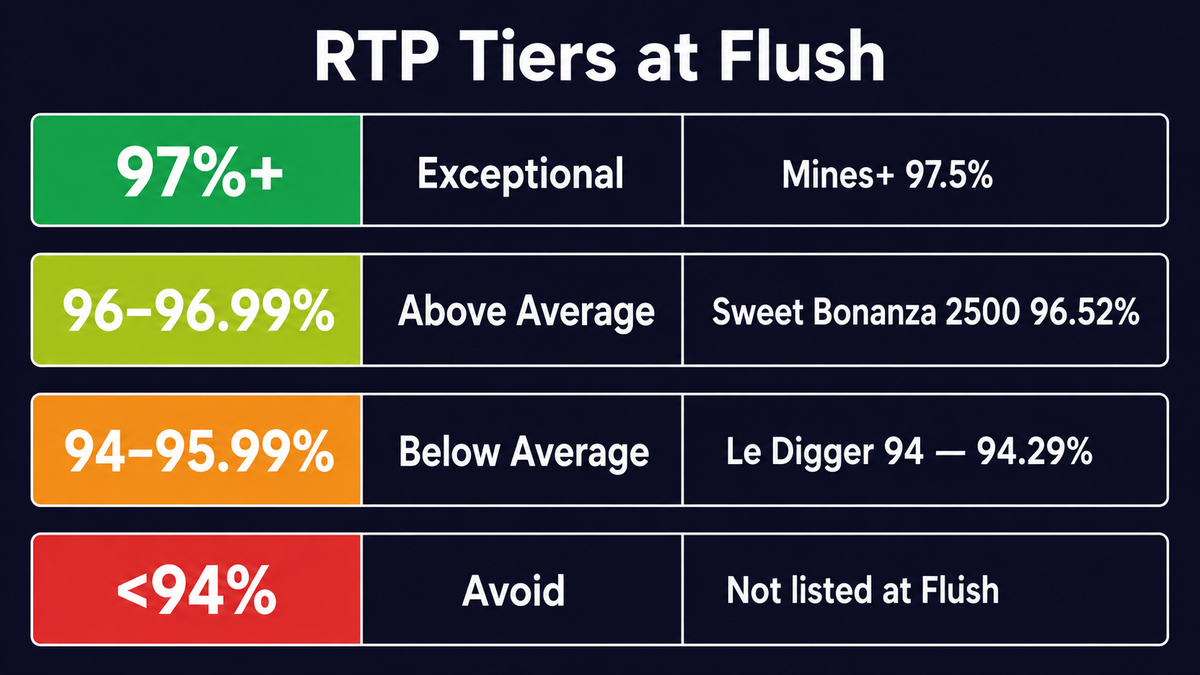
RTP tiers at Flush, from exceptional (97%+) to below average (94-95.99%). No games below 94% are listed.
One thing worth knowing about that bottom tier: the "94" variants in Flush's catalog are deliberate reduced-RTP versions of existing games. Le Digger 94 is the same slot as Le Digger, rebuilt with a 94.29% RTP instead of 96.26%. Some casino operators choose to offer the lower-RTP version to players who do not check. At Flush, both versions are labelled clearly. You can see which you are loading before you bet.
The top of the catalog is also worth noting. Flush does not list anything below 94% RTP. Traditional land-based slot machines commonly run at 85-88%. A physical slot in an airport or a high-street venue might be keeping 12-15 cents of every euro wagered. Online crypto slots at 96%+ RTP are a structurally different product.
Where to Find the RTP for Any Game
Every slot at Flush displays its RTP inside the game's info panel, the "i" button on the game interface. Click it before you spin. The paytable section will show the certified RTP figure sourced directly from the provider's documentation. If the game has a bonus buy feature, check whether the RTP listed applies to the base game, the bonus buy mode, or both. Some providers publish separate figures for each.
The rule: never rely on third-party aggregator sites for RTP data. Always verify against the provider's official game sheet or the in-game paytable. Figures on review aggregators are frequently outdated or rounded incorrectly.
Why RTP Matters for Your Bankroll
RTP is not an abstract statistic. Over a real session, the difference between a 92% and a 96.5% RTP slot shows up as actual money, or the absence of it.
Two Players, Same Budget, Different Games
Run the same session on two different slots and the math separates quickly.
Player A deposits EUR500 and plays a slot with 92% RTP, common at traditional online casinos, and standard on most land-based machines. They bet EUR0.50 per spin and play 1,000 spins over two hours. Total wagered: EUR500. Expected return at 92%: EUR460. Expected loss: EUR40.
Player B deposits EUR500 and plays a slot with 96.5% RTP at Flush, close to the catalog average. Same EUR0.50 bet, same 1,000 spins. Total wagered: EUR500. Expected return at 96.5%: EUR482.50. Expected loss: EUR17.50.
Same session length. Same stakes. The RTP difference costs Player A an extra EUR22.50 before volatility even enters the picture.
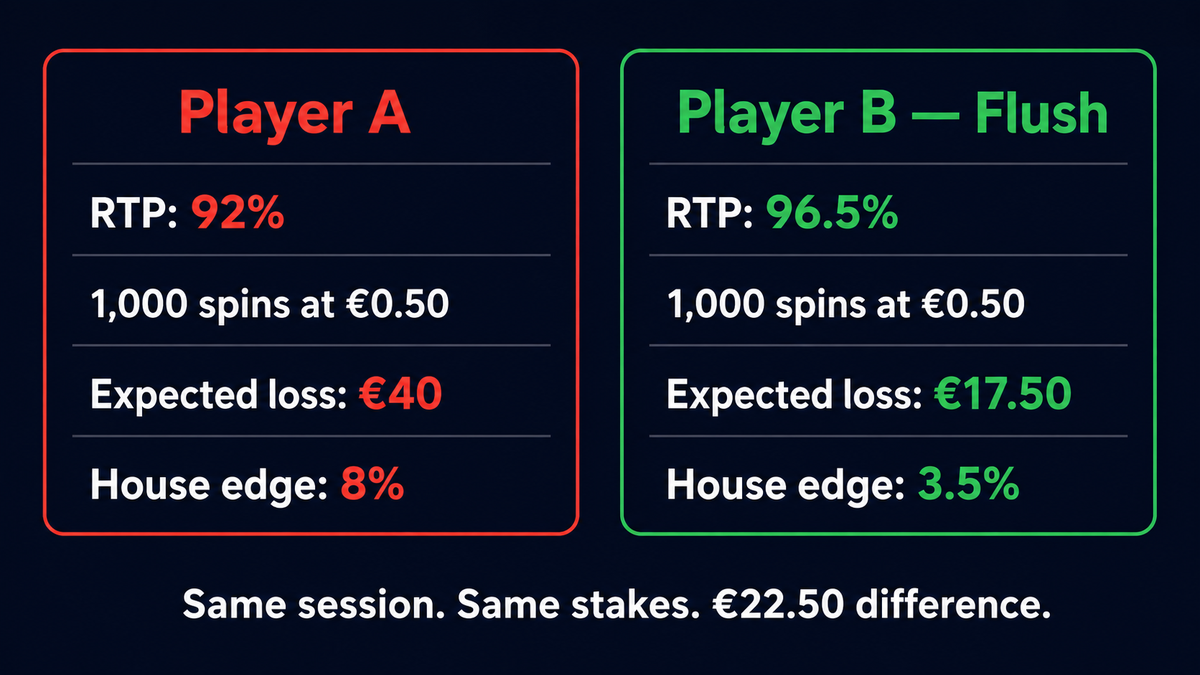
Same session, same stakes. The RTP gap costs Player A an extra EUR22.50 per 1,000 spins.
Scale that up. A player who puts through EUR2,000 a month in total wagers:
At EUR2,000 in monthly wagers, the gap is EUR90: EUR160 expected loss at 92% versus EUR70 at 96.5%. At EUR5,000, it widens to EUR225 (EUR400 versus EUR175). At EUR10,000, the structural advantage reaches EUR450 per month (EUR800 versus EUR350).
That EUR450 monthly gap on a EUR10,000 wager volume is the structural advantage of playing on a higher-RTP platform, compounded across every session.
The Session Length Effect
RTP's influence compounds with time. In a 10-spin session, luck dominates completely, you might hit a 200x win on spin three and finish miles ahead of any RTP prediction. In a 1,000-spin session, the law of large numbers starts pulling results toward the theoretical average. In 10,000 spins, you are getting close to the published figure.
This means short sessions on high-volatility slots are where RTP matters least and variance matters most. Long grinding sessions on low-volatility slots are where RTP shows up most clearly in your ending balance.
Practical implication: if you are playing short, high-stakes sessions chasing a big bonus feature, RTP is less immediately relevant than max win potential and volatility. If you are playing longer sessions at lower stakes, testing games, practising bet sizing, grinding through a bankroll, every percentage point of RTP is real money over time.
The Crypto Bankroll Advantage
At a traditional online casino, currency conversion and payment processing fees eat into your effective bankroll before your first spin. A EUR500 deposit via bank transfer might arrive as EUR492 after fees. A withdrawal might take 3-7 days and arrive short after exchange rate movement.
At Flush, you deposit BTC, ETH, or any of the 10 supported cryptocurrencies and the full amount is in your account the moment the transaction confirms. No conversion loss on deposit. No bank delay on withdrawal. The RTP you see is the RTP you are actually playing against, nothing is silently trimmed by the payment layer before it reaches the game.
RTP in Practice: Real Examples at Flush
Reading RTP as a number is one thing. Seeing how it behaves differently across three contrasting games makes it usable. Here are three slots from the Flush catalog, same platform, same withdrawal speed, very different experiences, chosen specifically to show how RTP interacts with volatility and session type.
Sweet Bonanza 2500, Pragmatic Play
RTP: 96.52% | Volatility: High | Max win: 25,000x | Min bet: EUR0.20
Sweet Bonanza 2500 is the evolved version of one of the most-played slots in the Pragmatic Play catalog. The 96.52% RTP sits comfortably above the Flush catalog average, but the High volatility rating means that return is distributed unevenly, long dry stretches in the base game, then clusters of multiplier wins during the free spins bonus.
The 25,000x max win is the headline. On a EUR1 bet, that is EUR25,000 in a single bonus round. On a EUR5 bet, EUR125,000. Flush has no withdrawal cap, so if that number lands, it goes to your wallet in full.
Who it suits: players with a medium-to-large session bankroll who can sustain 50-100 dry spins waiting for a bonus trigger. The 96.52% RTP is working in your favour across the session, but you need enough runway to reach the features where most of that return is concentrated.
Read the Fortune Ace slot review at Flush
Bash Bros, Hacksaw Gaming
RTP: 96.26% | Volatility: Low | Max win: 10,000x | Min bet: EUR0.10
Bash Bros runs at Low volatility, which changes everything about how its 96.26% RTP feels in practice. Where Sweet Bonanza 2500 front-loads its return into infrequent bonus features, Bash Bros distributes wins more regularly across the base game. You will not often see 500x hits, but you will also not sit through 80 blank spins waiting for something to happen.
The practical result: your bankroll moves more slowly in both directions. Sessions feel more controlled. For players testing bet sizing, learning a new stake level, or simply wanting longer play time from a fixed crypto budget, the Low volatility profile at 96.26% RTP gives you the most spins per unit wagered.
The 10,000x max win is achievable but not the primary reason to load this game. You are here for session stability, not a lottery-style jackpot.
Who it suits: casual players, new Flush users testing the platform via demo before depositing, or anyone working with a smaller BTC or ETH balance who needs their stake to last.
Read The Count slot review at Flush
San Quentin Manhunt, Nolimit City
RTP: 96.15% | Volatility: High | Max win: 46,532x | Min bet: EUR0.20
San Quentin Manhunt sits at the aggressive end of the Flush catalog. The 46,532x max win is one of the highest in the current lineup, on a EUR1 bet that is EUR46,532 from a single triggered feature. The 96.15% RTP sits at the lower end of the catalog's above-average tier but still well ahead of industry standard for a slot with this volatility profile.
Nolimit City builds its high-volatility slots differently from Pragmatic Play. The xNudge and xBet mechanics mean the path to the big features is mechanical and skill-adjacent, you can use the xBet option to increase your chances of triggering a bonus at a known cost, effectively buying a higher probability of reaching the feature where the RTP is concentrated.
The trade-off is session length. San Quentin Manhunt can run 100-150 spins between meaningful bonus triggers. Your bankroll needs to survive that runway. On a EUR0.50 bet, 150 spins costs EUR75 in expected play, budget accordingly.
Who it suits: experienced players with a larger crypto balance, comfortable with extended cold stretches and chasing a high-multiplier outcome rather than consistent small returns.
Read the Mental slot review at Flush
At a Glance: Three Games, Three Profiles
Sweet Bonanza 2500 (96.52% RTP, High volatility, 25,000x max win) suits medium-to-large bankrolls and bonus chasers. Bash Bros (96.26% RTP, Low volatility, 10,000x max win) fits smaller bankrolls and longer sessions. San Quentin Manhunt (96.15% RTP, High volatility, 46,532x max win) is built for experienced players targeting a large single outcome. The RTP spread across all three is just 0.37 percentage points. Volatility profile shapes the session experience far more than that gap.
The RTP figures across all three sit within 0.37 percentage points of each other. In isolation that gap looks trivial. Over 1,000 spins at EUR1 per spin, it is EUR3.70 in expected difference. The volatility profile, how and when those returns arrive, has a far larger practical impact on your session than the RTP spread between these three games.
Which is exactly why understanding RTP without understanding volatility gives you half the picture. The two metrics work together. For a full breakdown of how volatility affects session structure and bankroll sizing, see the slot volatility guide.
Common Mistakes and Misconceptions
RTP is one of the most misunderstood numbers in casino gaming. Five specific myths cause players to make worse decisions, bigger losses, shorter sessions, wrong game choices. Here is each one broken down.
Myth 1: "High RTP means I will win more often"
Why people believe it: The word "return" implies frequency. If a slot returns 96.5%, it feels like it should be paying out on 96.5% of spins.
The truth: RTP measures value returned, not win frequency. A slot can have 96.5% RTP and pay out on fewer than 1 in 5 spins, most of the return is concentrated in infrequent large wins rather than spread across regular small ones. This is exactly how High volatility slots work. San Quentin Manhunt returns 96.15% to players over millions of spins, but individual sessions can run 100+ spins without a meaningful payout. Win frequency is a separate metric called hit rate or hit frequency. Some providers publish it alongside RTP. A Low volatility slot like Bash Bros has a higher hit frequency than San Quentin Manhunt despite having a similar RTP. The two numbers measure different things entirely.
Myth 2: "RTP applies to my session"
Why people believe it: If a slot is certified at 96.5%, it feels reasonable to expect roughly EUR96.50 back from every EUR100 spent in a single sitting.
The truth: RTP is calculated across tens of millions of spins. Your 100-spin session is statistically insignificant against that sample size. In 100 spins at EUR1 per spin, you might lose EUR100 completely, that is a valid outcome on a 96.5% RTP slot. You might also win EUR800. Both results are entirely consistent with the published figure because your session is too small a sample for the long-run average to assert itself. The practical implication: never use RTP to predict your session result. Use it to compare games before you choose one, and to understand the structural house edge you are playing against.
Myth 3: "Two slots with the same RTP play the same"
Why people believe it: 96.5% equals 96.5%. The math is identical, so the experience should be identical.
The truth: RTP tells you the total return. It says nothing about the shape of that return. Two slots can share a 96.5% RTP and deliver completely different session experiences depending on their volatility. A Low volatility slot at 96.5% returns that figure through frequent small wins, your bankroll oscillates steadily, rarely spiking or crashing. A High volatility slot at 96.5% concentrates the same total return into rare, large wins separated by extended losing streaks. Mathematically equivalent over 10 million spins. Experientially, almost nothing alike over 200 spins.
Myth 4: "The casino adjusts RTP in real time"
Why people believe it: When players go on a losing streak, the instinct is that the casino has tightened the game to reduce payouts. It feels like the only logical explanation for a prolonged cold run.
The truth: RTP is set by the game provider and locked into the game's certified code before it ever reaches any casino. It cannot be modified by the operator at the game level. Changing it would require a new build, new certification from an independent testing lab, and regulatory approval. That process takes months. What actually happens during cold streaks is normal variance. At Flush, provably fair verification adds a further layer of transparency: every spin result can be independently verified against a published hash. There is no mechanism for real-time RTP adjustment, and the cryptographic record proves it.
Myth 5: "Bonus buy gives you better RTP"
Why people believe it: Paying to skip directly to the bonus feature feels like it should improve your odds, you are accessing the high-payout part of the game directly.
The truth: This depends entirely on the specific game, and the answer varies. Some slots have identical RTP in base game and bonus buy mode. Others have a marginally different RTP for the bonus buy version, occasionally higher, occasionally lower. The only way to know is to check the provider's official game sheet. What the Flush catalog makes visible is something more important: some games are listed in two explicit RTP versions. Le Digger runs at 96.26% RTP. Le Digger 94 is the same game at 94.29%, a deliberate lower-RTP variant. That 2% difference is not a bonus buy effect. It is a separate product with a different certified RTP built in from the start.
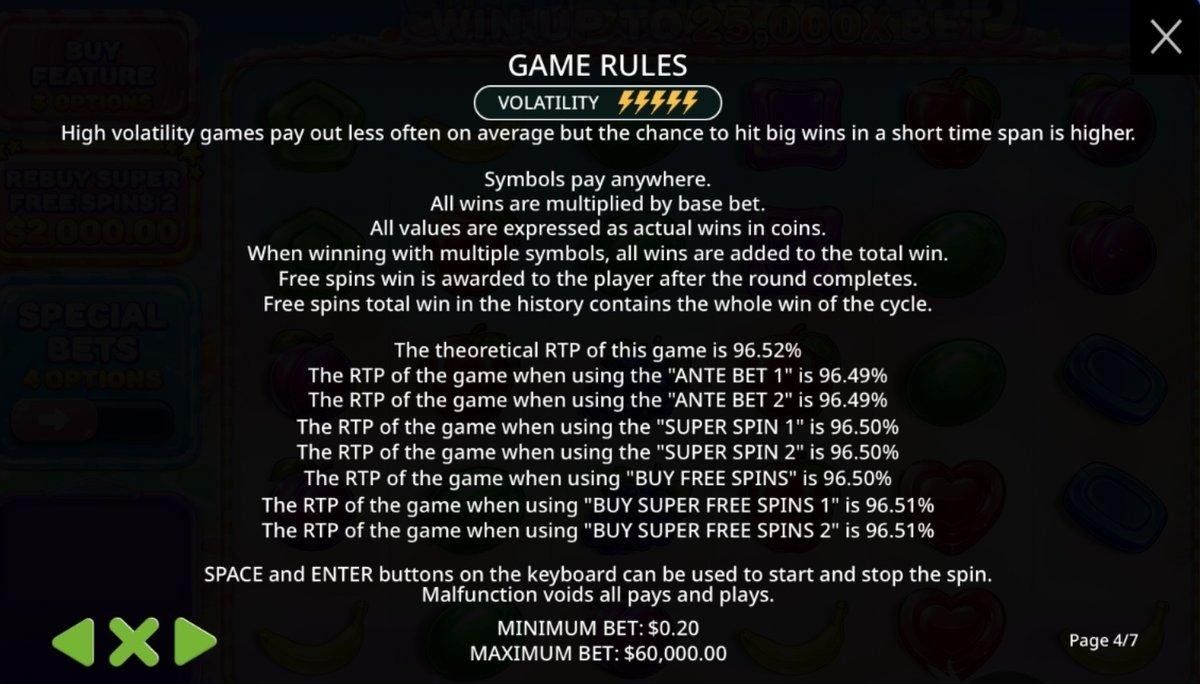
Real paytable screenshot showing RTP breakdown per bet mode. Base game: 96.52%. Bonus buy modes: 96.49% to 96.51%. Always check before using bonus buy.
How to Apply RTP at Flush
Knowing what RTP is and knowing how to use it before you spin are two different things. Here are four steps that turn the theory into a practical pre-session routine.
Step 1: Check the RTP Before You Load the Game
Every slot at Flush displays its certified RTP inside the game's info panel. Hit the "i" button on any game interface before placing a bet. The paytable section shows the RTP figure sourced directly from the provider's documentation, not a third-party estimate, not a rounded approximation.
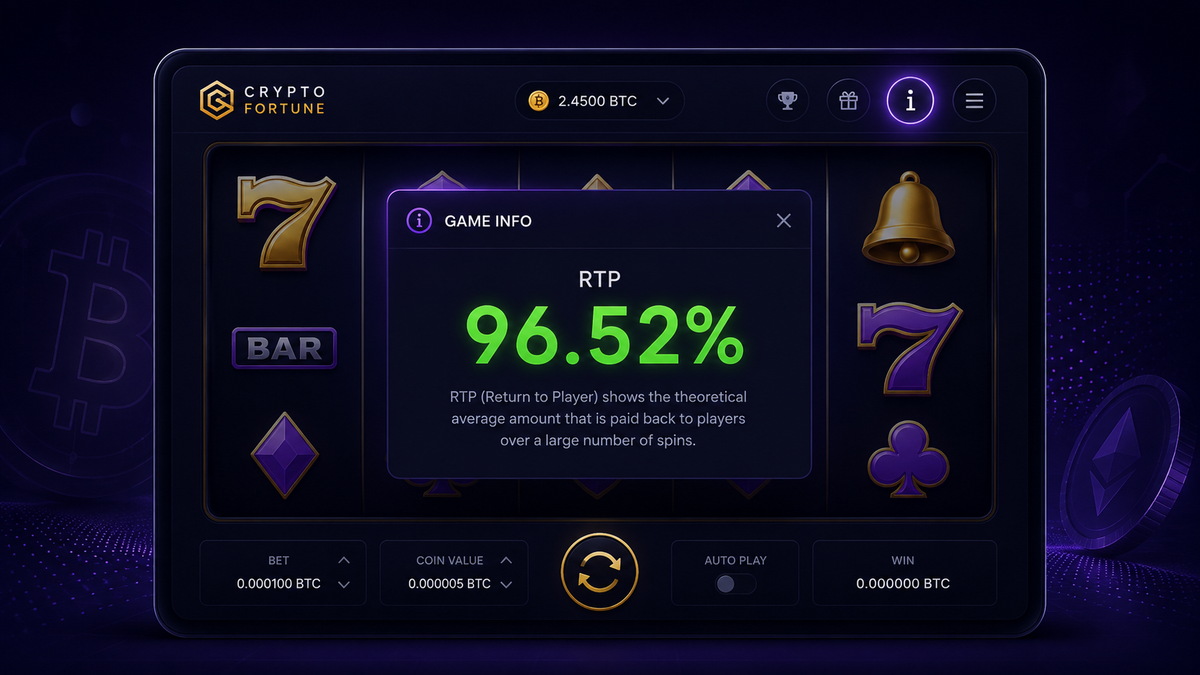
The info panel inside any Flush slot. RTP is listed under Game Info. Check it before your first spin.
Two things to verify at this step:
Which version are you loading? The Flush catalog lists both standard and reduced-RTP variants for some titles. Le Digger and Le Digger 94 are the same game engine. The RTP is 96.26% on one and 94.29% on the other. That 2% difference is EUR20 per EUR1,000 wagered. Check the game code or title suffix before you confirm.
Does the game have a bonus buy, and does the RTP change for it? Some providers publish a separate RTP for bonus buy mode. It can be higher or lower than the base game figure. If you are planning to use the bonus buy, verify the specific RTP that applies to it in the game sheet. Never assume the headline figure covers both modes.
Step 2: Match RTP With Volatility and Your Bankroll
RTP and volatility work together. A 96.5% RTP on a High volatility slot means most of that return is concentrated in infrequent bonus features. You need enough bankroll to reach them. A 96.26% RTP on a Low volatility slot like Bash Bros distributes returns more evenly across the session, a smaller bankroll can survive longer.
Use this as a starting framework:
Low volatility slots require a minimum of 50x your base bet in session bankroll, with bet sizing at 2-3%; the RTP is felt steadily throughout the session. Medium volatility requires 100x base bet, bet sizing at 1.5-2%; returns arrive in clusters. High volatility demands 150x base bet, bet sizing at 1-1.5%; most of the return is concentrated in bonus feature triggers. Xtra High volatility requires 200x base bet, bet sizing at 0.5-1%; meaningful returns rarely arrive outside major bonus events.
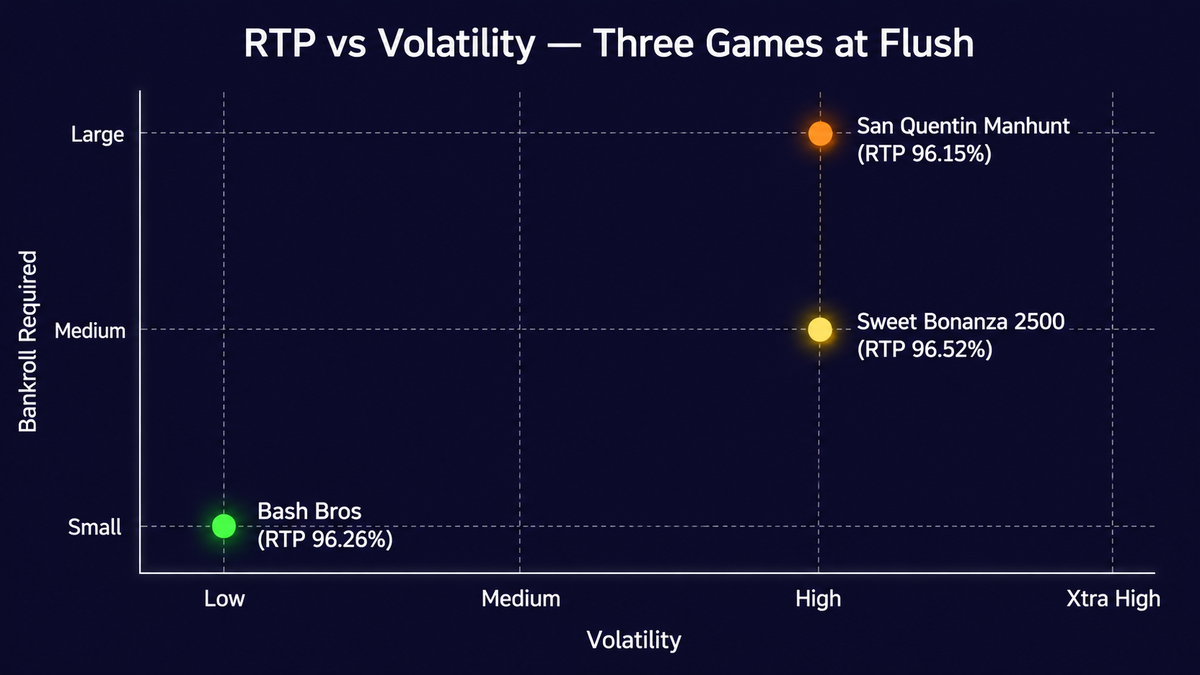
RTP vs Volatility for three Flush games. Bash Bros (Low vol, small bankroll), Sweet Bonanza 2500 (High vol, medium bankroll), San Quentin Manhunt (High vol, large bankroll).
If your session bankroll is 0.05 ETH and you want to play a High volatility slot, a bet size of 1% per spin gives you 100 spins of runway, the minimum needed to realistically reach a bonus trigger. Drop below that and variance can end your session before RTP has any chance to work in your direction.
For a full framework on bet sizing across volatility tiers and stop-loss rules, see the slot volatility guide.
Step 3: Test the Game Free Before Betting Real Crypto
Every slot at Flush has a free demo, no account needed, unlimited spins, full game functionality including bonus features. Use it.
Demo play serves a specific purpose in RTP terms: it lets you feel the volatility profile before real money is involved. Twenty minutes on the Sweet Bonanza 2500 demo tells you more about how its High volatility distributes returns than any written description. You will experience the dry spells in the base game. You will see how the multiplier bombs behave during free spins. You will know whether the session rhythm suits how you want to play before your first real bet.
This matters most on High and Xtra High volatility games where the gap between your session experience and the published RTP figure is widest. The demo costs you nothing and removes the worst outcome: funding your account, loading a high-volatility slot you have never played, and busting in 30 spins because the cold streak length caught you off guard.
Step 4: Set Your Stop-Loss Based on RTP Math, Not Gut Feel
Before your first real spin, decide two numbers: your stop-loss and your session target. Write them down before the game loads. Once either is hit, the session ends.
Stop-loss calculation: Take your session bankroll and multiply by 0.4. That is your maximum acceptable loss. On a 0.1 ETH session bankroll, your stop-loss is 0.04 ETH. If your balance hits 0.06 ETH, you close the game regardless of how close a bonus trigger feels.
Why 40%? A 96.5% RTP slot has a 3.5% house edge per spin. Over 200 spins at 1% bankroll per bet, the expected loss is approximately 7% of session bankroll. Losing 40% in a session means variance has run significantly against you. That is the signal to stop, not because the game is broken, but because continuing into a deep hole is how small losses become large ones.
Session target: set a win target at 50-80% above starting bankroll. If you start with 0.1 ETH and hit 0.16 ETH, take the win and close the session. Variance that has run in your favour can reverse just as quickly. The RTP math does not stop working because you are ahead.
Try any slot at Flush free first, no account needed for the demo. Check the RTP in the info panel, pick a volatility that matches your bankroll, and when you are ready to play for real, deposit BTC, ETH, or any of 10 supported cryptos. Wins go back to your wallet instantly.
The Crypto Casino Angle
RTP figures are published by providers and certified by labs. But the platform where you play affects how much of that theoretical return you actually experience. Three structural advantages at Flush change the RTP equation in ways a traditional online casino cannot match.
Advantage 1: Provably Fair Verification
At a traditional casino, you take the RTP figure on trust. The game is certified, the lab is reputable, but you have no independent way to verify that a specific spin outcome was generated fairly.
At Flush, provably fair cryptographic verification means every spin result is tied to a published hash that you can independently verify after the fact. The algorithm that determines your spin outcome is mathematically transparent. There is no mechanism for real-time manipulation, and the cryptographic record proves it, spin by spin.
For RTP purposes, this means the certified figure is not just a promise on a PDF. It is a commitment backed by public, verifiable cryptography. The house edge you are playing against is exactly what the game sheet says it is.
Advantage 2: No Payment Layer Eating Your Bankroll
Traditional casino players lose money before their first spin. Bank transfer fees, currency conversion spreads, and payment processor charges trim the effective bankroll that reaches the game. A EUR500 deposit can arrive as EUR488 after processing. A winning withdrawal can shrink between the casino account and your bank over 3-7 days of processing time.
At Flush, you deposit directly in your crypto of choice. The full amount hits your account the moment the transaction confirms on-chain. When you withdraw, the full win amount goes to your wallet instantly, no bank intermediary, no conversion loss, no waiting period during which exchange rate movement can reduce your actual return.
Advantage 3: Multi-Currency Bankroll Flexibility
Crypto price movement affects your real-money value between sessions. If you hold ETH and its value increases 15% between your Monday and Friday sessions, your effective bankroll in fiat terms has grown without a single spin. If it drops, the reverse is true.
Managing this is straightforward at Flush. Stablecoin deposits, USDT or USDC, remove crypto price volatility from your bankroll entirely. You deposit a fixed fiat-equivalent amount, play against the published RTP, and withdraw the same stablecoin. Your session result reflects the game's RTP and your variance alone, not ETH price movement on top of it.
For players who want exposure to crypto upside between sessions, BTC or ETH deposits make sense. For players who want a clean, RTP-only session environment, stablecoin play isolates the variable you are actually trying to manage.
Flush supports 10 cryptocurrencies: BTC, ETH, SOL, BNB, LTC, USDT, USDC, TRX, POL, and DOGE. Deposits are instant. Withdrawals process instantly. No bank delays, no KYC verification, no maximum withdrawal limits. Your deposits and withdrawals never appear in your banking history.
Responsible Play
RTP is a tool for making smarter game choices. It becomes a problem when players misuse it to justify continued play, specifically when they treat the long-run average as a debt the game owes them in the short term.
Five warning signs that RTP thinking has become harmful:
1. Chasing your "owed" return. If you have lost EUR100 on a 96.5% RTP slot and find yourself thinking "I am owed EUR96.50 back, I just need to keep spinning", stop. The game owes you nothing. Each spin is independent. Past losses have no influence on future outcomes.
2. Increasing bet size after a cold streak. The logic runs: "The RTP has to catch up, so a bigger bet will capture more of the return when it comes." It will not. The RTP does not catch up. Variance resolves randomly, not compensatorily. Bigger bets after losses accelerate losses, not recoveries.
3. Using RTP to justify playing below your stop-loss. "This game is 96.5% RTP, it cannot stay cold forever" is not a reason to continue past a loss limit you set for yourself. The stop-loss exists precisely because variance can stay against you longer than your bankroll can survive.
4. Choosing games purely by RTP without checking volatility. A 97.5% RTP game with Xtra High volatility can produce a 200-spin losing streak. If your bankroll cannot survive that, the high RTP figure is irrelevant to your actual session.
5. Playing longer than planned because you are "close to even". Being EUR20 down on a 96.5% RTP session and extending play to recover it is chasing losses by another name. The expected value of additional spins is negative regardless of your current balance.
RTP is a statistical tool, not a promise. Use it to choose games smarter, not to rationalise staying longer.
Responsible Gambling
Gambling is entertainment, not a way to make money. Always set a budget before you play and never chase losses. If gambling stops being fun, take a break.
Free help is available 24/7:
GamCare: gamcare.org.uk | 0808 8020 133
GamStop: gamstop.co.uk (free self-exclusion for UK players)
BeGambleAware: begambleaware.org
Flush supports responsible gambling. Players must be 18 or over.
How We Researched This
Methodology
This guide explains RTP using the standard formula (total returned divided by total wagered) and worked bankroll examples built from that formula. Game figures for RTP, volatility, max win and minimum bet come from the slots' in-game info panels and the provider data shown in the Flush catalog, covering titles from Pragmatic Play, Hacksaw Gaming and Nolimit City. Background on certification refers to independent testing labs such as eCOGRA, BMM and GLI. RTP is a long-run average, can differ between game versions and bonus buy modes, and does not predict individual session results.
FAQ
Frequently Asked Questions
What does RTP mean in slots?
How is RTP calculated?
Does RTP tell me what I will win in one session?
Does a higher RTP mean I will win more often?
Can a casino change a slot's RTP in real time?
What are the 94 versions of slots at Flush?
Where can I find a slot's RTP?
How much does the RTP difference cost in practice?

Share This Post
Share this post for your chance to win!
Related Posts
Level up your knowledge
USDT Gambling: Which Network to Use and Why It Matters
USDT keeps your casino balance's dollar value flat, but which network you send it over changes your speed and fee dramatically. Here is what actually matters.
5 min read
TRON Gambling: How to Gamble With TRX
TRX settles in seconds for a fraction of a cent, the same network many USDT deposits already use. Here is what actually matters when gambling with TRX directly.
5 min read

Best Crypto Sports Betting: A Complete 2026 Guide
Crypto sports betting means funding a sportsbook with BTC, ETH or a stablecoin instead of a card. Here is how it works and how Flush's sportsbook uses it.
5 min read