February 6, 2025 • 5 min read

What Is Sui Token? Blockchain Features, Utility, and Growth
Quick Answer
The Sui token has emerged as a remarkable player in the cryptocurrency space, processing an astounding 4.58 billion transactions across 18.19 million active accounts.
Key Facts
| Developer | Mysten Labs |
| Programming language | Move |
| Consensus | Delegated Proof-of-Stake, Mysticeti engine |
| Peak throughput | 297,000 TPS |
| Finality | ~400 milliseconds |
| Average fee | ~$0.0057 per transaction |
| Max supply | 10 billion SUI |
| Circulating supply | 3.089 billion SUI |
| Market cap at writing | USD 10.58 billion |
| Community Reserve | 36.53% of supply |
Created by former Meta engineers in May 2023, the Sui blockchain demonstrates impressive capabilities with transaction speeds reaching 297,000 per second - rivaling traditional Web2 systems.
While Sui's USD 10.58 billion valuation and position among the top 20 cryptocurrencies by market cap highlight its significant presence, understanding its fundamentals is crucial for making informed decisions. This comprehensive guide breaks down the essential aspects of the Sui blockchain and its native token, helping you grasp its technology, tokenomics, and potential. Please note that this guide aims to educate rather than provide investment advice.
What you'll learn:
- The core technology behind Sui and its unique features
- Detailed analysis of Sui tokenomics and distribution
- Key metrics for evaluating Sui's potential
- Important factors to consider before getting involved with Sui
What is Sui and How Does it Work?
Developed by Mysten Labs, Sui represents a significant advancement in blockchain technology, specifically designed to address traditional blockchain limitations. The platform processes transactions differently from conventional blockchains, focusing on parallel execution instead of sequential processing.
The Basics of Sui Blockchain
Sui's architecture centers around an object-centric model where data storage focuses on objects rather than accounts. This approach enables the network to validate uncorrelated transaction flows independently, significantly boosting processing speeds to 297,000 transactions per second. The platform achieves sub-second finality through its optimized consensus engine, Mysticeti, completing transactions in approximately 400 milliseconds.
Understanding the Move Programming Language
Move, an open-source programming language, forms the backbone of Sui's smart contract capabilities. Specifically designed for blockchain development, Move introduces several key innovations:
- Object-centric storage with unique identifiers
- Built-in asset ownership controls
- Enhanced security through linear type system
- Automatic bytecode verification
- Module-specific data initialization
Key features that make Sui different
The platform stands out through its innovative approach to transaction processing and asset management. Additionally, Sui maintains remarkably low transaction fees, typically around $0.0057 or 0.001687198 SUI per transaction. Furthermore, the network employs a Delegated Proof-of-Stake (DPoS) consensus mechanism, where token holders elect validators to secure the network.
The platform's dynamic resource scaling responds automatically to network demand. Specifically, this design ensures that high-demand applications receive necessary resources without negatively impacting the broader ecosystem. Moreover, Sui's object-centric model enables assets to evolve over time, making it particularly suitable for gaming, DeFi, and NFT applications.
Breaking Down Sui Token (SUI)
At the core of the Sui ecosystem lies its native token, SUI, which serves multiple essential functions beyond simple transactions. The token plays a vital role in maintaining network operations and fostering community participation.
Token Utility
The SUI token encompasses four fundamental functions:
- Network Security: Through delegated proof-of-stake, SUI holders can stake tokens to validators and earn rewards
- Transaction Processing: SUI covers gas fees for executing transactions and storing data
- Ecosystem Liquidity: The token provides crucial on-chain liquidity for various applications
- Network Governance: SUI holders can participate in voting on protocol upgrades and platform changes
Essentially, the token maintains stable gas prices throughout each 24-hour epoch, ensuring predictable transaction costs for users. In fact, the platform offers sponsored transactions, allowing certain operations with zero gas fees paid by users.
Current Market Position
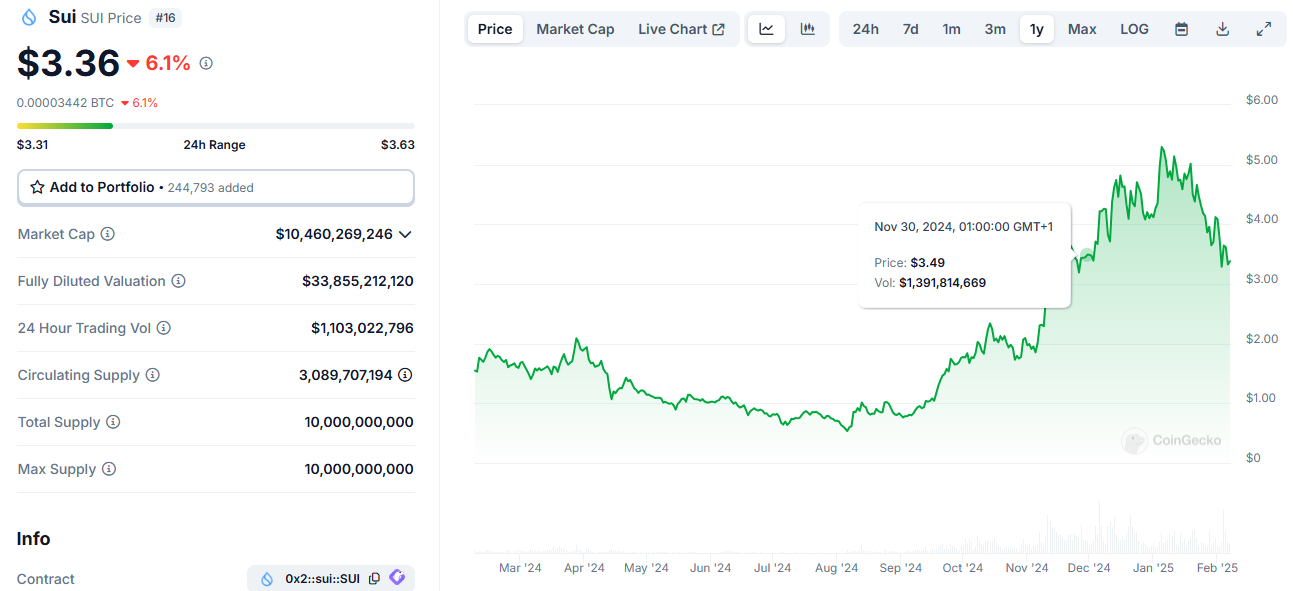
Currently, SUI holds a significant position in the cryptocurrency market. At a price of $3.39, the token maintains a market capitalization of USD 10.58 billion, ranking #13 in the global cryptocurrency landscape. The circulating supply stands at 3.089 billion SUI, with a maximum cap of 10 billion tokens.
The token's trading activity demonstrates strong market engagement, with a 24-hour trading volume reaching USD 1.28 billion. Generally, this volume indicates active participation across various trading platforms and decentralized applications within the Sui ecosystem.
The storage fund mechanism, consequently, ensures fair compensation for validators by distributing stake rewards over time. This approach supports indefinite data storage while maintaining sustainable validator incentives.
Understanding Sui Tokenomics
The foundation of Sui's economic model rests on a carefully structured tokenomics system. With a maximum supply capped at 10 billion SUI tokens, the platform maintains strict control over token availability to ensure long-term stability.
Total Supply and Distribution
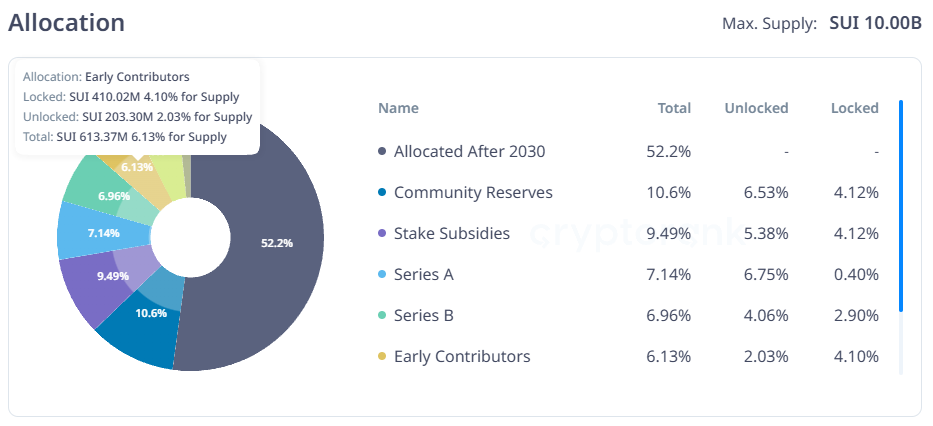
Currently, approximately 3.089 billion SUI tokens are in circulation. The total supply follows a structured distribution pattern, with the main allocations being:
- Community Reserve: 36.53% for delegation and grants
- Early Contributors: 21.14% of total allocation
- Mysten Labs Treasury: 12.42% for development
- Stake Subsidies: 10% supporting network security
- Series A and B investors: Combined 14.1%
Token Unlock Schedule
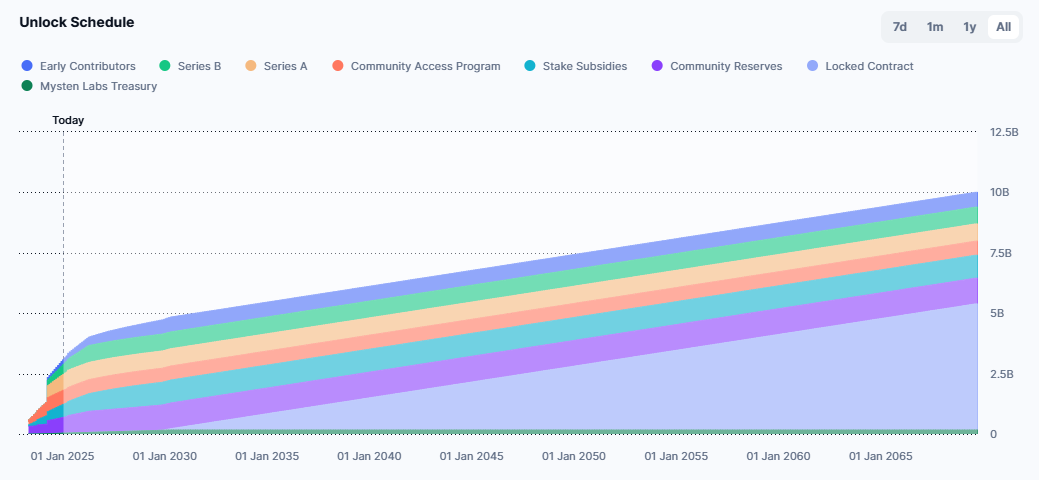
Subsequently, token releases follow a predetermined schedule throughout 2025. Notable upcoming events include a 72.3 million SUI unlock scheduled for March 2025. The platform implements varying vesting periods, primarily ranging from one to seven years, depending on the token allocation category.
Storage Fund Mechanism
The storage fund operates as a unique economic engine within Sui's ecosystem. Throughout each epoch, the fund collects storage fees from transactions, creating a self-sustaining system for data management. Notably, when users delete stored objects, they receive a partial rebate of their initial storage fees.
The fund's size adjusts automatically based on three key factors:
- Storage fee inflows from current epoch transactions
- Returns from fund investments
- Outflows from storage rebates
Accordingly, this mechanism ensures validators receive fair compensation for maintaining network data, while users pay only for the storage space they actually use. The storage fund primarily contributes to network sustainability by creating deflationary pressure, as increased activity leads to more SUI tokens being locked in the fund.
How Does Sui Compare to Bitcoin, Ethereum, and Solana?
For those already familiar with major cryptocurrencies, understanding where Sui fits in the broader ecosystem is crucial. While Bitcoin remains the dominant store of value and Ethereum leads in smart contract adoption, Sui’s design caters to a different niche, high-speed, low-cost transactions with a novel approach to blockchain execution.
Sui vs. Bitcoin
Unlike Bitcoin, which prioritizes decentralization and security through Proof-of-Work, Sui employs a Delegated Proof-of-Stake (DPoS) model, sacrificing some decentralization for efficiency. Bitcoin maximalists may view Sui’s approach as less censorship-resistant, but its speed and low fees make it attractive for applications requiring frequent transactions, such as gaming and DeFi.
Sui vs. Ethereum
While both networks support smart contracts, Ethereum’s account-based model differs from Sui’s object-centric structure. Sui aims to outperform Ethereum in transaction speed and cost by processing transactions in parallel, avoiding the network congestion and high gas fees common in Ethereum’s Layer 1. However, Ethereum’s well-established ecosystem and upcoming scaling solutions (such as Layer 2s) provide strong competition.
Sui vs. Solana
The closest functional competitor to Sui is Solana, another high-performance blockchain known for low fees and fast transaction speeds. Both use parallel execution to process transactions more efficiently than traditional blockchains. However, Solana’s history of network outages raises concerns about reliability, whereas Sui’s architecture is designed to handle scaling with fewer disruptions.
For those evaluating Sui against the top 10 cryptocurrencies, its strongest selling points are its parallel execution model, low transaction fees, and scalability. However, adoption and developer traction will determine whether it can truly rival Ethereum or Solana in the long run.
Last Thoughts
Sui stands out through its innovative approach to blockchain technology, backed by significant network metrics and developer engagement. While its transaction speeds of 297,000 TPS and USD 10.58 billion market cap demonstrate substantial growth, these numbers tell just part of the story.
The platform's object-centric model and Move programming language offer unique advantages, especially for gaming and DeFi applications. Though the network shows promising development with 18.19 million active accounts and growing developer participation, remember that past performance doesn't guarantee future results.
Before engaging with Sui, take time to understand its technical foundations, tokenomics, and specific use cases. Consider how the storage fund mechanism, token distribution schedule, and validator system align with your goals. Most importantly, approach any involvement with Sui as an opportunity to learn about blockchain innovation rather than purely as an investment vehicle.
Brought to You by Flush, the Ultimate Crypto Casino Destination for Gaming Enthusiasts
At Flush, a leading Crypto casino, you can enjoy a smooth, secure gaming experience with real money online slots, live casino games like poker, blackjack, baccarat, roulette, and much more. As a premier crypto casino, Flush features top titles from providers like Nolimit City, Hacksaw Gaming, Pragmatic Play and many more, ensuring an exciting lineup of games for every player.
Sign up at Flush and claim a welcome bonus of up to 150%. Slot spins enter the $10,000 weekly race automatically.
Flush combines a deep slot library with Bitcoin-first deposits and withdrawals. Our 6,000+ games from 70+ providers include the top releases from Pragmatic Play, Nolimit City, Hacksaw Gaming, Play'n GO, and Evolution live dealer. New players claim a welcome bonus of up to 150%.
How We Researched This
Methodology
This explainer draws on Mysten Labs' published documentation of the Sui blockchain, including its object-centric model, the Move language, the Mysticeti consensus engine, delegated proof-of-stake and the storage fund. Market data such as price, market capitalization, ranking, trading volume and circulating supply comes from CoinMarketCap, and gas fee and supply figures from the Suiscan explorer. Tokenomics and unlock details reflect Sui's published allocation and vesting schedule. Market figures reflect the time of writing and change constantly. The comparison with Bitcoin, Ethereum and Solana is qualitative. This is educational content, not investment advice.
FAQ
Frequently Asked Questions
What is Sui?
How fast is the Sui blockchain?
What is the SUI token used for?
What is the maximum supply of SUI?
How much does a Sui transaction cost?
What is the Sui storage fund?
How does Sui compare to Solana?

Share This Post
Share this post for your chance to win!
Related Posts
Level up your knowledge
Bitcoin Futures Explained
Bitcoin futures let traders speculate on price without owning the coin, using leverage that cuts both ways. Here is how regulated futures, perpetuals, margin, and liquidation actually work, and why futures are not a substitute for owning bitcoin outright.
5 min read
BlackRock Bitcoin Price Prediction: Fact-Check
Viral headlines claim BlackRock predicted a specific Bitcoin price, but the reality blends several distinct statements from different executives. Here is what Larry Fink and Rick Rieder have actually, verifiably said, sourced and separated from unverified claims.
5 min read
Bitcoin Hyper: Legit or Hype?
Bitcoin Hyper markets itself as a Bitcoin Layer 2 on a Solana-compatible chain, but it has no live mainnet, an anonymous team, and price speculation running well ahead of any working product. Here is a fact-checked, non-cynical look at where it actually stands.
5 min read