June 2, 2026 • 5 min read
Polymarket Accused of Double-Counting Trading Volume
Quick Answer
Prediction market platform Polymarket is facing criticism after a new independent audit suggested that the company may have inflated its reported trading volume.
Key Facts
| Allegation | Trading volume inflated by double-counting |
| Source | Independent audit and on-chain analysis |
| Mechanism | Maker and taker sides counted as separate volume |
| Fraud Alleged | No |
| User Impact | No effect on balances, positions or outcomes |
| Polymarket's Position | Method is consistent with how DEXs often track activity |
| Regulatory Action | None announced |
| Next Step | Clearer disclosures and updated documentation expected |
Polymarket Accused of Double-Counting Trading Volume
The allegations focus on a methodological issue: counting both the maker and taker side of each trade as separate volume entries, effectively doubling the transaction numbers.
The accusations do not suggest fraud or user losses, but they raise questions about how trading metrics in the prediction-market space should be calculated and communicated.
How the Alleged Double-Counting Happened
The audit highlights a structural detail of Polymarket’s automated market-maker system. Each trade interacts with the liquidity pool, generating two mirrored entries: one for the liquidity provider side and one for the trader side. Some analytics dashboards reportedly counted both as unique volume events.
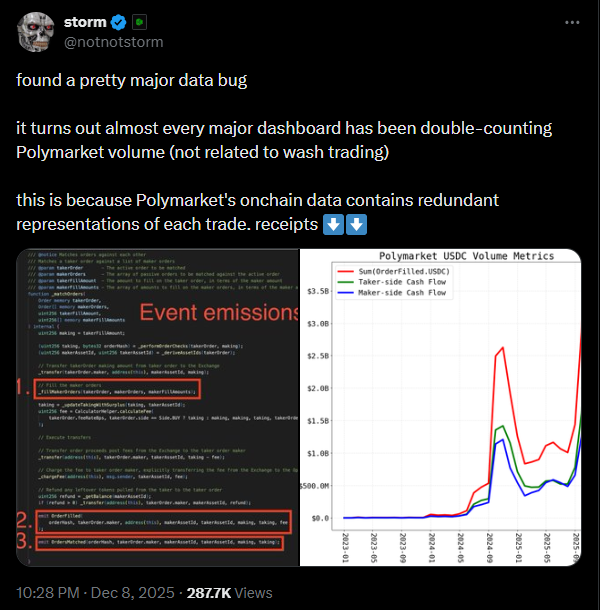
On-chain analyst highlights duplicated trade events that caused major dashboards to double-count Polymarket’s trading volume
Why Accurate Volume Reporting Matters
Volume is a key benchmarking metric across prediction markets and crypto trading platforms. It affects how users perceive platform activity, liquidity strength, pricing efficiency, and overall reliability.
Inflated numbers may:
• distort market-share comparisons
• mislead new traders about real liquidity
• influence media or institutional sentiment
• create false impressions of adoption growth
For a sector positioning itself as a data-driven alternative to traditional betting, accurate reporting is critical.
Polymarket Responds to the Claims
Polymarket has not denied that its reported figures include both sides of a transaction, but the company argues that this approach is consistent with how decentralized exchanges often track activity.
Early comments from platform representatives indicated that volume calculations vary widely across the industry and no universally accepted standard exists for prediction-market AMMs.
Still, the platform acknowledged the need for clearer disclosures and is reportedly reviewing how metrics are displayed on both internal dashboards and third-party trackers.
Impact on Users and the Broader Prediction Market Sector
The allegations do not impact user balances, open positions, or market outcomes. However, the incident has sparked a broader discussion around transparency in crypto analytics.
Industry analysts warn that inconsistent reporting standards can undermine confidence, especially as prediction markets gain traction ahead of major global elections and large-scale events.
Several competing platforms have already issued statements clarifying how they calculate trading volume, suggesting the sector may move toward more uniform reporting in 2025.
What Comes Next for Polymarket
Polymarket is expected to update its documentation and potentially adjust how volume is communicated publicly. The company continues to operate normally, and no regulatory actions have been announced.
The audit has, however, triggered a wave of scrutiny. As prediction markets grow in popularity, accurate and standardized reporting may become a regulatory expectation rather than a best practice.
How We Researched This
Methodology
This article is based on the findings of the independent audit into Polymarket's reported trading volume, on-chain analysis showing duplicated trade events on major analytics dashboards, and public comments from Polymarket representatives responding to the claims. It also reflects statements from competing prediction-market platforms about how they calculate volume. The article reports the allegations and the company's position as they stood at the time of writing. It does not include an independent recalculation of Polymarket's volume, and no regulatory action had been announced.
FAQ
Frequently Asked Questions
Did Polymarket inflate its trading volume?
How did the double-counting happen?
Is Polymarket accused of fraud?
Are Polymarket users' funds affected?
How did Polymarket respond?
Why does accurate trading volume matter?

Share This Post
Share this post for your chance to win!
Related Posts
Level up your knowledge

Bitcoin Futures Explained
Bitcoin futures let traders speculate on price without owning the coin, using leverage that cuts both ways. Here is how regulated futures, perpetuals, margin, and liquidation actually work, and why futures are not a substitute for owning bitcoin outright.
5 min read
BlackRock Bitcoin Price Prediction: Fact-Check
Viral headlines claim BlackRock predicted a specific Bitcoin price, but the reality blends several distinct statements from different executives. Here is what Larry Fink and Rick Rieder have actually, verifiably said, sourced and separated from unverified claims.
5 min read

Bitcoin Hyper: Legit or Hype?
Bitcoin Hyper markets itself as a Bitcoin Layer 2 on a Solana-compatible chain, but it has no live mainnet, an anonymous team, and price speculation running well ahead of any working product. Here is a fact-checked, non-cynical look at where it actually stands.
5 min read